Results by title
125 books match the query 'Human-animal relationships' and 6 start with d
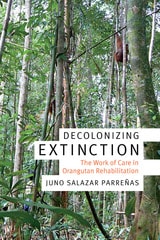
Decolonizing Extinction
The Work of Care in Orangutan RehabilitationJuno Salazar Parreñas
Duke University Press, 2018
In Decolonizing Extinction Juno Salazar Parreñas ethnographically traces the ways in which colonialism, decolonization, and indigeneity shape relations that form more-than-human worlds at orangutan rehabilitation centers on Borneo. Parreñas tells the interweaving stories of wildlife workers and the centers' endangered animals while demonstrating the inseparability of risk and futurity from orangutan care. Drawing on anthropology, primatology, Southeast Asian history, gender studies, queer theory, and science and technology studies, Parreñas suggests that examining workers’ care for these semi-wild apes can serve as a basis for cultivating mutual but unequal vulnerability in an era of annihilation. Only by considering rehabilitation from perspectives thus far ignored, Parreñas contends, could conservation biology turn away from ultimately violent investments in population growth and embrace a feminist sense of welfare, even if it means experiencing loss and pain.
[more]

Developing Animals
Wildlife and Early American PhotographyMatthew Brower
University of Minnesota Press, 2010
Pictures of animals are now ubiquitous, but the ability to capture animals on film was a significant challenge in the early era of photography. In Developing Animals, Matthew Brower takes us back to the time when Americans started taking pictures of the animal kingdom, at the beginning of the twentieth century, the moment when photography became a mass medium and wildlife photography an increasingly popular genre.
Developing Animals compellingly investigates the way photography changed our perception of animals. Brower analyzes how photographers created new ideas about animals as they moved from taking pictures of taxidermic specimens in so-called natural settings to the emergence of practices such as camera hunting, which made it possible to capture images of creatures in the wild.
By combining approaches in visual cultural studies and the history of photography, Developing Animals goes further to argue that photography has been essential not only to the understanding of wildlife but also to the conceptual separation of humans and animals.
[more]
Displaying Death and Animating Life
Human-Animal Relations in Art, Science, and Everyday LifeJane C. Desmond
University of Chicago Press, 2016
The number of ways in which humans interact with animals is almost incalculable. From beloved household pets to the steak on our dinner tables, the fur in our closets to the Babar books on our shelves, taxidermy exhibits to local zoos, humans have complex, deep, and dependent relationships with the animals in our ecosystems. In Displaying Death and Animating Life, Jane C. Desmond puts those human-animal relationships under a multidisciplinary lens, focusing on the less obvious, and revealing the individualities and subjectivities of the real animals in our everyday lives.
Desmond, a pioneer in the field of animal studies, builds the book on a number of case studies. She conducts research on-site at major museums, taxidermy conventions, pet cemeteries, and even at a professional conference for writers of obituaries. She goes behind the scenes at zoos, wildlife clinics, and meetings of pet cemetery professionals. We journey with her as she meets Kanzi, the bonobo artist, and a host of other animal-artists—all of whom are preparing their artwork for auction. Throughout, Desmond moves from a consideration of the visual display of unindividuated animals, to mourning for known animals, and finally to the marketing of artwork by individual animals. The first book in the new Animal Lives series, Displaying Death and Animating Life is a landmark study, bridging disciplines and reaching across divisions from the humanities and social sciences to chart new territories of investigation.
Desmond, a pioneer in the field of animal studies, builds the book on a number of case studies. She conducts research on-site at major museums, taxidermy conventions, pet cemeteries, and even at a professional conference for writers of obituaries. She goes behind the scenes at zoos, wildlife clinics, and meetings of pet cemetery professionals. We journey with her as she meets Kanzi, the bonobo artist, and a host of other animal-artists—all of whom are preparing their artwork for auction. Throughout, Desmond moves from a consideration of the visual display of unindividuated animals, to mourning for known animals, and finally to the marketing of artwork by individual animals. The first book in the new Animal Lives series, Displaying Death and Animating Life is a landmark study, bridging disciplines and reaching across divisions from the humanities and social sciences to chart new territories of investigation.
[more]
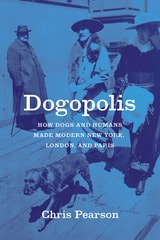
Dogopolis
How Dogs and Humans Made Modern New York, London, and ParisChris Pearson
University of Chicago Press, 2021
Dogopolis presents a surprising source for urban innovation in the history of three major cities: human-canine relationships.
Stroll through any American or European city today and you probably won’t get far before seeing a dog being taken for a walk. It’s expected that these domesticated animals can easily navigate sidewalks, streets, and other foundational elements of our built environment. But what if our cities were actually shaped in response to dogs more than we ever realized?
Chris Pearson’s Dogopolis boldly and convincingly asserts that human-canine relations were a crucial factor in the formation of modern urban living. Focusing on New York, London, and Paris from the early nineteenth century into the 1930s, Pearson shows that human reactions to dogs significantly remolded them and other contemporary western cities. It’s an unalterable fact that dogs—often filthy, bellicose, and sometimes off-putting—run away, spread rabies, defecate, and breed wherever they like, so as dogs became a more and more common in nineteenth-century middle-class life, cities had to respond to people’s fear of them and revulsion at their least desirable traits. The gradual integration of dogs into city life centered on disgust at dirt, fear of crime and vagrancy, and the promotion of humanitarian sentiments. On the other hand, dogs are some people’s most beloved animal companions, and human compassion and affection for pets and strays were equally powerful forces in shaping urban modernity. Dogopolis details the complex interrelations among emotions, sentiment, and the ways we manifest our feelings toward what we love—showing that together they can actually reshape society.
[more]
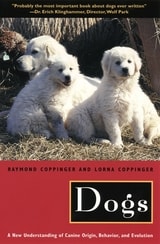
Dogs
A New Understanding of Canine Origin, Behavior and EvolutionRaymond Coppinger and Lorna Coppinger
University of Chicago Press, 2002
Biologists, breeders and trainers, and champion sled dog racers, Raymond and Lorna Coppinger have more than four decades of experience with literally thousands of dogs. Offering a scientifically informed perspective on canines and their relations with humans, the Coppingers take a close look at eight different types of dogs—household, village, livestock guarding, herding, sled-pulling, pointing, retrieving, and hound. They argue that dogs did not evolve directly from wolves, nor were they trained by early humans; instead they domesticated themselves to exploit a new ecological niche: Mesolithic village dumps. Tracing the evolution of today's breeds from these village dogs, the Coppingers show how characteristic shapes and behaviors—from pointing and baying to the sleek shapes of running dogs—arise from both genetic heritage and the environments in which pups are raised.
For both dogs and humans to get the most out of each other, we need to understand and adapt to the biological needs and dispositions of our canine companions, just as they have to ours.
For both dogs and humans to get the most out of each other, we need to understand and adapt to the biological needs and dispositions of our canine companions, just as they have to ours.
[more]
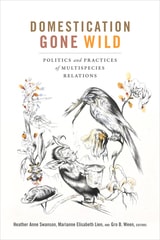
Domestication Gone Wild
Politics and Practices of Multispecies RelationsHeather Anne Swanson, Gro B. Ween, and Marianne E. Lien, editors
Duke University Press, 2018
The domestication of plants and animals is central to the familiar and now outdated story of civilization's emergence. Intertwined with colonialism and imperial expansion, the domestication narrative has informed and justified dominant and often destructive practices. Contending that domestication retains considerable value as an analytical tool, the contributors to Domestication Gone Wild reengage the concept by highlighting sites and forms of domestication occurring in unexpected and marginal sites, from Norwegian fjords and Philippine villages to British falconry cages and South African colonial townships. Challenging idioms of animal husbandry as human mastery and progress, the contributors push beyond the boundaries of farms, fences, and cages to explore how situated relations with animals and plants are linked to the politics of human difference—and, conversely, how politics are intertwined with plant and animal life. Ultimately, this volume promotes a novel, decolonizing concept of domestication that radically revises its Euro- and anthropocentric narrative.
Contributors. Inger Anneberg, Natasha Fijn, Rune Flikke, Frida Hastrup, Marianne Elisabeth Lien, Knut G. Nustad, Sara Asu Schroer, Heather Anne Swanson, Anna Lowenhaupt Tsing, Mette Vaarst, Gro B. Ween, Jon Henrik Ziegler Remme
Contributors. Inger Anneberg, Natasha Fijn, Rune Flikke, Frida Hastrup, Marianne Elisabeth Lien, Knut G. Nustad, Sara Asu Schroer, Heather Anne Swanson, Anna Lowenhaupt Tsing, Mette Vaarst, Gro B. Ween, Jon Henrik Ziegler Remme
[more]