Results by title
78 books match the query 'Humanism' and 5 start with d

Deja Vu
Aberrations Of Cultural MemoryPeter Krapp
University of Minnesota Press, 2004
The pitfalls of cultural memory and forgetting, understood through the genealogy of the phenomenon called déjà vu
Referring to a past that never was, déjà vu shares a structure not only with fiction, but also with the ever more sophisticated effects of media technology. Tracing the term from the end of the nineteenth century, when it was first popularized in the pages of the Revue philosophique, Peter Krapp examines the genealogy and history of the singular and unrepeatable experience of déjà vu. This provocative book offers a refreshing counterpoint to the clichéd celebrations of cultural memory and forces us do a double take on the sanctimonious warnings against forgetting so common in our time.
Disturbances of cultural memory—screen memories, false recognitions, premonitions—disrupt the comfort zone of memorial culture: strictly speaking, déjà vu is neither a failure of memory nor a form of forgetting. Krapp’s analysis of such disturbances in literature, art, and mass media introduces, historicizes, and theorizes what it means to speak of an economy of attention or distraction. Reaching from the early psychoanalytic texts of Sigmund Freud to the plays of Heiner Müller, this exploration of the effects of déjà vu pivots around the work of Walter Benjamin and includes readings of kitsch and aura in Andy Warhol’s work, of cinematic violence and certain exaggerated claims about shooting and cutting, of the memorial character of architecture, and of the high expectations raised by the Internet.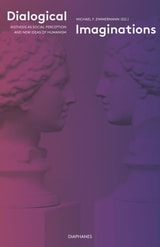
Dialogical Imaginations
Aisthesis as Social Perception and New Ideas of HumanismEdited by Michael F. Zimmermann with Gernot Müller, Christian Sauer, Kerstin Schmidt, Robert Schmidt, and Fosca Mariani Zini
Diaphanes, 0
“Aisthesis” means perception, but, in this volume, as the cover illustration the artist Giulio Paolini made for us demonstrates, it is treated as inscribed into dialogue. Furthermore, the range of its meaning is extended to include societies’ capacities to perceive their own conditions and dispositions—those concerning their inner structures and their external, cultural, and natural contexts. The essays present a wide variety of cultural manifestations of social perception—from the documentary to the fictional. Philosophers and sociologists, literary and art historians, media and film analysts deal with figurations, topoi, and stereotypes as created in various communal spheres and as resulting from media and epistemological practices.
Many of the debates turn around dialogical humanism, but this is certainly not aimed at returning to normative models more regulating than describing the human. Our period has been marked by debates around the post-human, biopolitics, and an increasing awareness of crisis and of global interdependence. Previously, the concept of humanism had been criticized, for good reasons, by Foucault and by philosophers such as Judith Butler. If the editors propose to discuss humanism again, a reevaluation of the dialogical character of humanism—and a reconstruction of its history as marked by dialogical strategies—is the starting point. In dialogical humanism, man, instead of being defined by a system of norms, is and remains an argument—even if, in the final instance, inscrutable, inexhaustible.

Dialogue on the Infinity of Love
Tullia d'Aragona
University of Chicago Press, 1997
Sexually liberated and financially independent, Tullia d'Aragona dared to argue that the only moral form of love between woman and man is one that recognizes both the sensual and the spiritual needs of humankind. Declaring sexual drives to be fundamentally irrepressible and blameless, she challenged the Platonic and religious orthodoxy of her time, which condemned all forms of sensual experience, denied the rationality of women, and relegated femininity to the realm of physicality and sin. Human beings, she argued, consist of body and soul, sense and intellect, and honorable love must be based on this real nature.
By exposing the intrinsic misogyny of prevailing theories of love, Aragona vindicates all women, proposing a morality of love that restores them to intellectual and sexual parity with men. Through Aragona's sharp reasoning, her sense of irony and humor, and her renowned linguistic skill, a rare picture unfolds of an intelligent and thoughtful woman fighting sixteenth-century stereotypes of women and sexuality.

Doctors, Ambassadors, Secretaries
Humanism and Professions in Renaissance ItalyDouglas Biow
University of Chicago Press, 2002
Examining a wide range of treatises, poems, and other works that humanists wrote both as and about doctors, ambassadors, and secretaries, Biow shows how interactions with these professions forced humanists to make their studies relevant to their own times, uniting theory and practice in a way that strengthened humanism. His detailed analyses of writings by familiar and lesser-known figures, from Petrarch, Machiavelli, and Tasso to Maggi, Fracastoro, and Barbaro, will especially interest students of Renaissance Italy, but also anyone concerned with the rise of professionalism during the early modern period.

Duns Scotus on Time and Existence
John Duns Scotus
Catholic University of America Press, 2014