Results by title
115 books match the query 'Hungary' and 4 start with d

Discussing Hitler
Advisers of U.S. Diplomacy in Central Europe, 1934-41Tibor Frank
Central European University Press, 2003

Divide and Pacify
Strategic Social Policies and Political Protests in Post-Communist DemocraciesPieter Vanhuysse
Central European University Press, 2006
Despite dramatic increases in poverty, unemployment, and social inequalities, the Central and Eastern European transitions from communism to market democracy in the 1990s have been remarkably peaceful. This book proposes a new explanation for this unexpected political quiescence. It shows how reforming governments in Poland, Hungary and the Czech Republic have been able to prevent massive waves of strikes and protests by the strategic use of welfare state programs such as pensions and unemployment benefits.
Divide and Pacify explains how social policies were used to prevent massive job losses with softening labor market policies, or to split up highly aggrieved groups of workers in precarious jobs by sending some of them onto unemployment benefits and many others onto early retirement and disability pensions. From a narrow economic viewpoint, these policies often appeared to be immensely costly or irresponsibly populist. Yet a more inclusive social-scientific perspective can shed new light on these seemingly irrational policies by pointing to deeper political motives and wider sociological consequences.

Divide, Provide and Rule
An Integrative History of Poverty Policy, Social Reform, and Social Policy in Hungary under the Habsburg MonarchySusan Zimmermann
Central European University Press, 2011
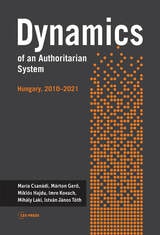
Dynamics of an Authoritarian System
Hungary, 2010–2021Mária Csanádi
Central European University Press, 2022
This conceptually synthetic and empirically rich book demonstrates the vulnerability of democratic settings to authoritarianism and populism. Six scholars from various professional fields explore here the metamorphosis of a political party into a centralized authoritarian system. Viktor Orbán and his Fidesz party needed less than ten years to accomplish this transformation in Hungary. In 2010, after winning a majority that could make changes in the constitution – two-thirds of the parliamentary seats, they evolved and stabilized the system, which produced again the two-thirds majority in 2014 and 2018.
The authors reveal how a democratic setting can be used as a device for political capture. They show how a political entity managed to penetrate almost all sub-fields of the economy to arrive at institutionalized corruption, and how the centralized power structure reproduces itself. With the help of a powerful empirical apparatus—among others analyses of more than 220,000 public tenders, redistributions of state subsidies, and the interconnectedness of those privileged with the political elite — the authors detail the functioning of a crony system and the network aspects of political connections in the rapid enrichment of politically-linked businesses. Their studies demonstrate the role of political capture in this redistribution and how this capture leads to a new social stratification.