Results by title
178 books match the query 'Identification' and 4 start with d
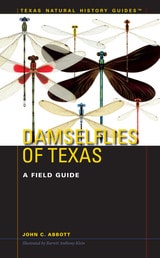
Damselflies of Texas
A Field GuideBy John C. Abbott
University of Texas Press, 2011
On any warm summer day, you can easily observe damselflies around a vegetated pond or the rocks along the banks of a stream. Like the more familiar dragonfly, damselflies are among the most remarkably distinctive insects in their appearance and biology, and they have become one of the most popular creatures sought by avocational naturalists.
Damselflies of Texas is the first field guide dedicated specifically to the species found in Texas. It covers 77 of the 138 species of damselflies known in North America, making it a very useful guide for the entire United States. Each species account includes:
- illustrations of as many forms (male, female, juvenile, mature, and color morphs) as possible
- common and scientific names, with pronunciation
- distribution map
- key features
- identifying characteristics
- discussion of similar species
- status in Texas
- habitat, seasonality, and general comments
In addition to photographing damselflies in the wild, the author and illustrator have developed a new process for illustrating each species by scanning preserved specimens and digitally painting them. The resulting illustrations show detail that is not visible in photographs. The book also contains chapters on damselfly anatomy, life history, conservation, names, and photography, as well as a list of species that may eventually be discovered in Texas, state and global conservation rankings, seasonality of all species in chronological order, and additional resources and publications on the identification of damselflies.
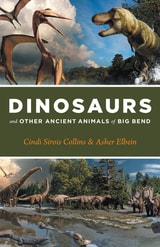
Dinosaurs and Other Ancient Animals of Big Bend
Cindi Sirois Collins and Asher Elbein
University of Texas Press, 2023
A time-traveling field guide to the ancient version of Big Bend National Park.
The sheer beauty of Big Bend National Park, along the shores of the Rio Grande in west Texas, never fails to astonish. Yet what lies beneath this natural treasure may be even more extraordinary than what meets the eye. Hidden in the rocks of Big Bend are the remains of giants: toothy sea lizards, enormous flying reptiles, and dinosaurs.
Dinosaurs and Other Ancient Animals of Big Bend is a field guide to what once was. Inspired by the latest research, Cindi Sirois Collins and Asher Elbein imagine what it was like to walk among the plants and animals whose fossil remains tell the story of evolution and geological transformation in this singular landscape. We glimpse the drama of Big Bend’s rugged landscape in creation—the desert’s emergence from retreating oceans and volcanic eruptions. Immersive vignettes introduce dinosaurs, giant fish, and saber-toothed cats. And the history of discovery in the park proves a gripping tale, as paleontologists sifted major scientific insights from the soils, rocks, and riverbeds. Complete with vivid illustrations, this is a wholly original sensory and narrative experience that will deepen any reader’s knowledge and sense of wonder.

Disaster Archaeology
Richard A Gould
University of Utah Press, 2007
This methodology involves a humanitarian element that often motivates archaeologists to perform this emotionally difficult work, and it requires a commitment to scientifically controlled field recovery and documentation of human remains, personal effects, and other physical evidence. First-hand experiences are described from the World Trade Center, 'The Station' nightclub fire in Rhode Island, and from Hurricane Katrina.
Disaster archaeology involves the meticulous, empirical use of archaeological science as well as emotional sensitivity toward victims and victims’ family and friends. By combining standards of forensic science with state-of-the-art field techniques, archaeologists can decisively affect the outcome of post-disaster investigations and recoveries.
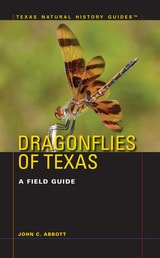
Dragonflies of Texas
A Field GuideBy John C. Abbott
University of Texas Press, 2015
Dragonflies and damselflies (together known as Odonata) are among the most remarkably distinctive insects in their appearance and biology, and they have become some of the most popular creatures sought by avocational naturalists. Texas hosts 160 species of dragonflies, nearly half of the 327 species known in North America, making the state a particularly good place to observe dragonflies in their natural habitats.
Dragonflies of Texas is the definitive field guide to these insects. It covers all 160 species with in situ photographs and detailed anatomical images as needed. Each species is given a two-page spread that includes photographs of both sexes and known variations when possible, key features, a distribution map, identification, discussion of similar species, status in Texas, habitat, seasonality, and general comments. Many of the groups also have comparative plates that show anatomically distinctive characteristics. In addition to the species accounts, John Abbott discusses dragonfly anatomy, life history, conservation, names, and photography. He also provides information on species that may eventually be discovered in Texas, state and global conservation rankings, seasonality of all species in chronological order, and additional resources and publications on the identification of dragonflies.