Results by title
112 books match the query 'Immigration' and 7 start with d
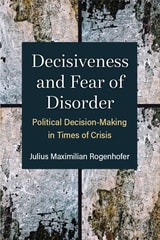
Decisiveness and Fear of Disorder
Political Decision-Making in Times of CrisisJulius Maximilian Rogenhofer
University of Michigan Press, 2024
Rogenhofer shows how his theoretical approach allows us to reinterpret a range of crisis situations beyond the irregular migration context, including democracies’ initial responses to Covid-19, the European Sovereign Debt Crisis, and United States climate politics. These additional case studies help position concerns with decisiveness amid the challenges that populism and technocracy increasingly pose to representative democracies.
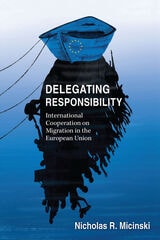
Delegating Responsibility
International Cooperation on Migration in the European UnionNicholas R. Micinski
University of Michigan Press, 2022
Delegating Responsibility explores the politics of migration in the European Union and explains how the EU responded to the 2015–17 refugee crisis. Based on 86 interviews and fieldwork in Greece and Italy, Nicholas R. Micinski proposes a new theory of international cooperation on international migration. States approach migration policies in many ways—such as coordination, collaboration, subcontracting, and unilateralism—but which policy they choose is based on capacity and on credible partners on the ground. Micinski traces the fifty-year evolution of EU migration management, like border security and asylum policies, and shows how EU officials used “crises” as political leverage to further Europeanize migration governance. In two in-depth case studies, he explains how Italy and Greece responded to the most recent refugee crisis. He concludes with a discussion of policy recommendations regarding contemporary as well as long-term aspirations for migration management in the EU.

Diaspora and Immigration, Volume 98
V. Y. Mudimbe and Sabine Engel
Duke University Press, 0
Experts from a variety of fields—anthropology, sociology, history, literature, and African, Hispanic, and Jewish studies—examine specific diasporas, immigrant communities, and “border identities” ranging from Muslims in Europe to Chicanos in Texas, from Chinese immigrants in California to the "peach blossom diaspora" in Taiwan. They discuss the Jewish Diaspora and the creation of the State of Israel, as well as two centuries of Irish diasporic experiences in Australia and America. Following testimonies by German, Filipino, Italian American, and South African Israeli academics, who scrutinize their respective "personal diasporas," this special issue concludes with some afterthoughts on diaspora and the potential for global unity in the face of today's global diversity.
Contributors. Jean Bazin, Louis Shabat Bethlehem, Gordon H. Chang, Ngwarsungu Chiwengo, Eileen Cheng-yin Chow, Christopher Davis, Marcel Detienne, Sabine Engel, Daphna Golan, Hans Ulrich Gumbrecht, Ramón A. Gutiérrez, Daniel Itzkovitz, Riva Kastoryano, Vassilis Lambropoulos, V. Y. Mudimbe, Peter Murphy, Richard Roberts, Aron Rodrigue, Ramón Saldívar, Kenneth J. Surin, Neferti Xina M. Tadiar, Marianna De Marco Torgovnick, Danielle Trudeau, Candice Ward, Steven Zipperstein
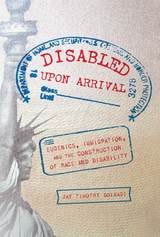
Disabled Upon Arrival
Eugenics, Immigration, and the Construction of Race and DisabilityJay Timothy Dolmage
The Ohio State University Press, 2018
Through careful archival research and consideration of the larger ideologies of racialization and xenophobia, Disabled Upon Arrival links anti-immigration rhetoric to eugenics—the flawed “science” of controlling human population based on racist and ableist ideas about bodily values. Dolmage casts an enlightening perspective on immigration restriction, showing how eugenic ideas about the value of bodies have never really gone away and revealing how such ideas and attitudes continue to cast groups and individuals as disabled upon arrival.

Domestic Disturbances
Re-Imagining Narratives of Gender, Labor, and ImmigrationBy Irene Mata
University of Texas Press, 2014
The issue of immigration is one of the most hotly debated topics in the national arena, with everyone from right-wing pundits like Sarah Palin to alternative rockers like Zack de la Rocha offering their opinion. The traditional immigrant narrative that gained popularity in the nineteenth and twentieth centuries continues to be used today in describing the process of the “Americanization” of immigrants. Yet rather than acting as an accurate representation of immigrant experiences, this common narrative of the “American Dream” attempts to ideologically contain those experiences within a story line that promotes the idea of achieving success through hard work and perseverance.
In Domestic Disturbances, Irene Mata dispels the myth of the “shining city on the hill” and reveals the central truth of hidden exploitation that underlies the great majority of Chicana/Latina immigrant stories. Influenced by the works of Latina cultural producers and the growing interdisciplinary field of scholarship on gender, immigration, and labor, Domestic Disturbances suggests a new framework for looking at these immigrant and migrant stories, not as a continuation of a literary tradition, but instead as a specific Latina genealogy of immigrant narratives that more closely engage with the contemporary conditions of immigration. Through examination of multiple genres including film, theatre, and art, as well as current civil rights movements such as the mobilization around the DREAM Act, Mata illustrates the prevalence of the immigrant narrative in popular culture and the oppositional possibilities of alternative stories.
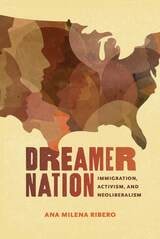
Dreamer Nation
Immigration, Activism, and NeoliberalismAna Milena Ribero
University of Alabama Press, 2023
Dreamer Nation tells the story of how Dreamers in the Obama era creatively confronted a complex sociopolitical landscape to advocate for immigrant rights and empower undocumented youth to proudly represent their lives and identities, all while under the ever-present threat of detention and deportation. Contributing to rhetorical studies of social movements, immigration, and minoritized rhetorics, Ribero argues that even though Dreamer rhetorics were reflective of the discursive limits of the neoliberal milieu, they also worked to disrupt neoliberal constraints through activism that troubled the primacy of the nation-state and citizenship, refused to adhere to respectability politics, forwarded embodied identity and transnational belonging, and looked for liberation in community—not solely in legislative action.
Each chapter presents a different rhetorical situation within the US “crisis” of immigration and the rhetoric that Dreamers used to respond to it. Organized chronologically, the chapters document Dreamer activism during the Obama presidency, from the 2010 hunger strikes advocating for the DREAM Act to undocuqueer “artivism” responding to Trump’s presidential campaign. The author draws not only on the methods and theories of rhetorical studies but also on women of color feminisms, ethnic studies, critical theory, and queer theory. In this way, the book looks across disciplines to illustrate the rhetorical savvy of one of the most important US social movements of our time.
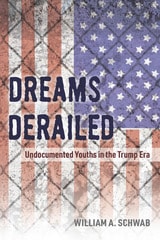
Dreams Derailed
Undocumented Youths in the Trump EraWilliam A. Schwab
University of Arkansas Press, 2018
During the 2016 presidential campaign millions of voters, concerned about the economic impact of illegal immigration, rallied behind the notion of a border wall between the United States and Mexico. Well into the Trump presidency, immigration endures as a hotly contested issue in United States politics.
In Dreams Derailed sociologist William A. Schwab shares the stories of immigration reform advocates and follows up on stories told in his 2013 book Right to DREAM, which argued in favor of the DREAM Act that would have provided conditional residency for undocumented youth brought to the United States as children, a version of which was later enacted by executive order and referred to as DACA (Deferred Action for Childhood Arrivals).
Taking as its focal point the Trump administration’s decision to rescind Obama-era DACA protection, Dreams Derailed delves into the economic, political, and social factors that inform the public conversation about immigration, making a clear case for the many benefits of inclusive policies and the protection of undocumented youths. Schwab also takes a close look at the factors that carried Donald Trump to the White House, demonstrates how economic upheaval and the issue of immigration influenced the 2016 presidential election, analyzes current immigration laws, and suggests next steps for reform.