Results by title
83 books match the query 'Inclusive Education' and 8 start with d
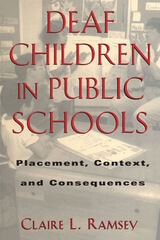
Deaf Children in Public Schools
Placement, Context, and ConsequencesClaire L. Ramsey
Gallaudet University Press, 1997
Ramsey points out that these deaf children were placed in two different environments, with the general population of hearing students, and separately with other deaf and hard of hearing children. Her incisive study reveals that although both settings were ostensibly educational, inclusion in the general population was done to comply with the law, not to establish specific goals for the deaf children. In contrast, self-contained classes for deaf and hard of hearing children were designed especially to concentrate upon their particular learning needs. Deaf Children in Public Schools also demonstrates that the key educational element of language development cannot be achieved in a social vacuum, which deaf children face in the real isolation of the mainstream classroom.
Based upon these insights, Deaf Children in Public Schools follows the deaf students in school to consider three questions regarding the merit of language study without social interaction or cultural access, the meaning of context in relation to their educational success, and the benefits of the perception of the setting as the context rather than as a place. The intricate answers found in this cohesive book offer educators, scholars, and parents a remarkable stage for assessing and enhancing the educational context for the deaf children within their purview.

Deaf Education in America
Voices of Children from Inclusion SettingsJanet Cerney
Gallaudet University Press, 2007
Deaf Education in America: Voices of Children from Inclusion Settings provides a detailed examination of the complex issues surrounding the integration of deaf students into the general classroom. Author Janet Cerney begins her comprehensive work by stressing to parents, educators, and policymakers the importance of learning the circumstances in which mainstreaming and inclusion can be successful for deaf students. This process requires stakeholders to identify and evaluate the perceived benefits and risks before making placement and implementation decisions. The influences of the quality of communication and the relationships built by and with the students are of paramount importance in leading to success.
In conjunction with these principles, this thorough study examines the theory and history behind inclusion, including the effects of the No Child Left Behind education act. Cerney incorporates this knowledge with interviews of the deaf students themselves as well as with their interpreters and teachers. To ensure complete candidness, the students were surveyed in their homes, and the interpreters and educators were questioned separately. Through these exchanges, Cerney could determine what worked well for the deaf students, what barriers interfered with their access to communication, and what support structures were needed to eliminate those barriers. As a result, Deaf Education in America offers concrete information on steps that can be taken to ensure success in an inclusion setting, results that reverberate through the voices of the deaf students.
Decentering Advocacy in English Language Teaching
Global Perspectives and Local PracticesKate Mastruserio Reynolds, Grazzia Maria Mendoza Chirinos, Debra Suarez, Okon Effiong, and Georgios Kormpas
University of Michigan Press, 2024
In each chapter, an ELT advocate describes the need for their project, the steps they took, the challenges they faced in their particular context, the parameters they needed to work within, and how they worked within these constraints to achieve their goals. These stories offer insight into classroom and school focused efforts as well as social projects, and touch upon contexts in which educators may feel that they cannot engage in overt advocacy movements. With chapters focused on Africa, East Asia, the Middle East, and Latin America, the volume contributors identify patterns based on what has worked well transculturally and in sociopolitically constrained contexts to develop effective principles and practices. By bringing many different advocacy efforts and the latest advocacy research together, Decentering Advocacy in English Language Teaching identifies recognizable standards that can take the onus off of individual advocates to reinvent the wheel.

Decolonizing the University
Edited by Gurminder K. Bhambra, Kerem Nisancioglu and Dalia Gebrial
Pluto Press, 2018
In 2015, students at the University of Cape Town demanded the removal of a statue of Cecil Rhodes, the imperialist, racist business magnate, from their campus. Their battle cry, #RhodesMustFall, sparked an international movement calling for the decolonization of universities all over the world.
Today, as the movement develops beyond the picket line, how might it go on to radically transform the terms upon which universities exist? In this book, students, activists, and scholars discuss the possibilities and the pitfalls of doing decolonial work in the heart of the establishment. Subverting curricula, demanding diversity, and destroying old boundaries, this is a radical call for a new era of education. Chapters include:
*Rhodes Must Fall: Oxford and Movements for Change (Dalia Febrial)
*Race and the Neoliberal University ((John Holmwood)
*Black/Academia (Robbie Shilliam)
*The Challenge for Black Studies in the Neoliberal University (Kehinde Andrews)
*Open Initiatives for Decolonising the Curriculum (Pat Lockley)
*Decolonising Education: A Pedagogic Intervention (Carol Azumah Dennis)
*Understanding Eurocentrism as a Structural Problem of Undone Science (William Jamal Richardson)
As the book’s insightful Introduction states, "Taking colonialism as a global project as a starting point, it becomes difficult to turn away from the Western university as a key site through which colonialism—and colonial knowledge in particular—is produced, consecrated, institutionalized and naturalized." Offering resources for students and academics to challenge and resist colonialism inside and outside the classroom, Decolonizing the University provides the tools for radical change in educational disciplines, pedagogies, and institutions.
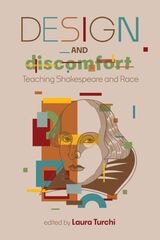
Design and Discomfort
Teaching Shakespeare and RaceEdited by Laura B. Turchi
Arizona Center for Medieval and Renaissance Studies, 2025
Design and Discomfort confronts the complexities of teaching Shakespeare in today’s classrooms, where discussions of race, bias, and historical legacies can provoke discomfort—but also transformation. Edited by Laura B. Turchi, this collection brings together educators and teaching artists who share innovative strategies for rethinking Shakespeare’s role in education.
Rather than treating Shakespeare as an untouchable authority, the contributors explore how his works can be a springboard for broader conversations about identity and justice. They advocate for performance-based and student-driven approaches that help students see themselves—their communities, their families, and their lived experiences—in the complex and seemingly distant world of Shakespeare.
This open-access volume provides both conceptual essays and practical lesson designs for educators navigating the intersections of Shakespeare and race. By embracing discomfort as part of the learning process, Design and Discomfort reframes how Shakespeare should be taught in classrooms today.

Divergent Paths to College
Race, Class, and Inequality in High SchoolsHolland, Megan M
Rutgers University Press, 2019
Diversifying STEM
Multidisciplinary Perspectives on Race and GenderEbony O. McGee
Rutgers University Press, 2020
Research frequently neglects the important ways that race and gender intersect within the complex structural dynamics of STEM. Diversifying STEM fills this void, bringing together a wide array of perspectives and the voices of a number of multidisciplinary scholars. The essays cover three main areas: the widely-held ideology that science and mathematics are “value-free,” which promotes pedagogies of colorblindness in the classroom as well as an avoidance of discussions around using mathematics and science to promote social justice; how male and female students of color experience the intersection of racist and sexist structures that lead to general underrepresentation and marginalization; and recognizing that although there are no quick fixes, there exists evidence-based research suggesting concrete ways of doing a better job of including individuals of color in STEM. As a whole this volume will allow practitioners, teachers, students, faculty, and professionals to reimagine STEM across a variety of educational paradigms, perspectives, and disciplines, which is critical in finding solutions that broaden the participation of historically underrepresented groups within the STEM disciplines.
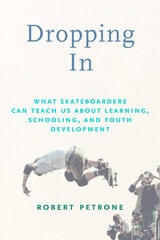
Dropping In
What Skateboarders Can Teach Us about Learning, Schooling, and Youth DevelopmentRobert Petrone
University of Massachusetts Press, 2023
The die-hard local skateboarders of Franklin Skatepark—a group of working-class, Latino and white young men in the rural Midwest—are typically classified by schools and society as “struggling,” “at-risk,” “failing,” and “in crisis.” But at the skatepark, they thrive and succeed, not only by landing tricks but also by finding meaning and purpose in their lives.
In Dropping In, Robert Petrone draws from multiple years of ethnographic research to bring readers into this rich environment, exploring how and why these young men engage more with skateboarding and its related cultural communities than with school. For them, it is in these alternative communities and spaces that they meet their intellectual, literate, and learning needs; cultivate meaningful and supportive relationships; and develop a larger understanding of their place in the world. By looking at what these skateboarders can teach us about what is right and working in their lives, Petrone asks educators and others committed to youth development to rethink schooling structures and practices to provide equitable education for all students.