Results by title
456 books match the query 'India' and 21 start with d
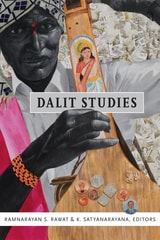
Dalit Studies
Ramnarayan S. Rawat and K. Satyanarayana, editors
Duke University Press, 2016
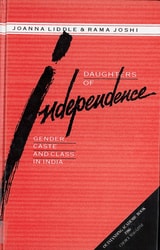
Daughters of Independence
Joanna Liddle
Rutgers University Press, 1989
For thousands of years Indian women have had a cultural tradition of resisting male domination. At the same time, the control of female sexuality has always been central to social hierarchies in India. Women are constrained in both class and caste hierarchies, to help distinguish the men at the top of the hierarchy from men at the bottom, where women are less constrained. In class society the seclusion of women allowed men to have sexual control over women and to retain the property that was transferred in marriage.
In contemporary India, professional women have had success entering the professions as the social groups to which they belong move increasingly to class rather than caste structures. But men continue to control the type of education they receive and the type of employment open to them, and to participate in the sexual harassment of women in the workplace. The concept that women are inferior to men--a concept that is not part of the Indian cultural heritage--is growing. In a sense, working professional women strengthen male control. The class structure is no more egalitarian than the caste structure, as oppression simply takes other forms.
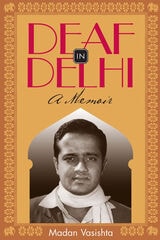
Deaf in Delhi
A MemoirMadan Vasishta
Gallaudet University Press, 2006
Vasishta’s story reflects the India of his youth, an emerging nation where most people struggled with numbing poverty and depended upon close family ties, tradition, and faith to see them through. His family’s search for a cure took him to a host of medical specialists and just as many sadhus and mahatmas, holy men and priests. The school in his small village was ill-prepared to educate deaf students then, so he herded the family cattle, usually the work of hired servants. Vasishta refused to accept this as his final lot in life and fantasized constantly about better jobs. Eventually, he moved to Delhi where his dream of becoming a photographer came true. He also discovered the Delhi Deaf community that, with his family, helped him to achieve an even higher goal, traveling to America to earn a degree at Gallaudet College.
Vasishta, a natural raconteur, imbues Deaf in Delhi with the ever-present ebullience that served him so well in his journey. Readers will savor his good humor and honest observations and look forward to his next book with great relish.
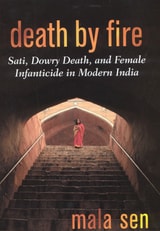
Death by Fire
Sati, Dowry Death, and Female Infanticide in Modern IndiaSen, Mala
Rutgers University Press, 2002
The Indian village of Deorala in Rajasthan, the northwestern Indian state that borders Pakistan, is neither remote nor feudal in the strictest sense. A tarmac road links the population of 10,000 to neighboring villages and towns, there is running water and electricity, and the villagers have had television for more than twenty years. On September 4, 1987, Deorala found itself in the center of a furor that awoke age-old conflicts in Indian society. Before a crowd of several thousand people, mostly men, a young woman dressed in her bridal finery was burned alive on her husband’s funeral pyre. The apparent revival of an ancient tradition opened old wounds in Indian society and focused world attention on the status and treatment of women in modern India.
The ancient practice of sati — the self-immolation of a woman on her husband’s funeral pyre — was outlawed by the British administration in India in 1829, and sati was widely believed to have died out. The fate of 18-year-old Roop Kanwar changed that perception. Mala Sen explores the reality of life and death for women in modern India in a study that is both illuminating and terrifying. The book is part journey through the India that the author knows and loves, and part exploration of the enigma that India still remains in the minds of many. Starting with Kanwar, Sen enters the worlds of three women: a goddess, a burned bride, and a woman accused of killing her daughter, and shows how, in this society in which ancient and modern apparently co-exist comfortably, there is increasingly cause for real alarm. She creates an image of a state in which political turmoil is constantly at the surface, and in which the role of women is constantly being redefined.
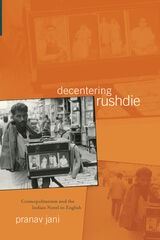
Decentering Rushdie
Cosmopolitanism and the Indian Novel in EnglishPranav Jani
The Ohio State University Press, 2010
Interrogating current theories of cosmopolitanism, nationalism, and aesthetics in Postcolonial Studies, Decentering Rushdie offers a new perspective on the Indian novel in English. Since Salman Rushdie’s Midnight’s Children won the Booker Prize in 1981, its postmodern style and postnational politics have dominated discussions of postcolonial literature. As a result, the rich variety of narrative forms and perspectives on the nation that constitute the field have been obscured, if not erased altogether.
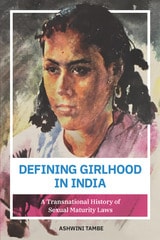
Defining Girlhood in India
A Transnational History of Sexual Maturity LawsAshwini Tambe
University of Illinois Press, 2019
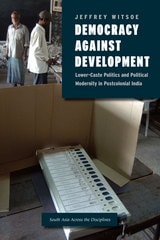
Democracy against Development
Lower-Caste Politics and Political Modernity in Postcolonial IndiaJeffrey Witsoe
University of Chicago Press, 2013
Witsoe looks at the history of colonialism in India and its role in both shaping modern caste identities and linking locally powerful caste groups to state institutions, which has effectively created a postcolonial patronage state. He then looks at the rise of lower-caste politics in one of India’s poorest and most populous states, Bihar, showing how this increase in democratic participation has radically threatened the patronage state by systematically weakening its institutions and disrupting its development projects. By depicting democracy and development as they truly are in India—in tension—Witsoe reveals crucial new empirical and theoretical insights about the long-term trajectory of democratization in the larger postcolonial world.
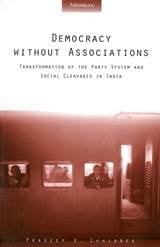
Democracy without Associations
Transformation of the Party System and Social Cleavages in IndiaPradeep K. Chhibber
University of Michigan Press, 2001

Development as Communication
A Perspective on IndiaUma Narula
Southern Illinois University Press, 1986
This book applies a systematic communication theory to the 30-plus years of development experience in India.
Never before has development been treated from a communication perspective. This perspective demonstrates that the role of communication in development is not limited to the technology of satellites or to the economics of mass media; it is a way of thinking about the interaction among all agents involved.
The empirical data describe patterns of social realities, actions, and communication networks among planners, contact agents, and the masses in two Indian communities. The result is an analytical review of development theories and practice in India.
This study is practical as well as theoretical. The authors show how the theory of the “coordinated management of meaning” applies to large-scale social interactions. They also offer specific recommendations for Indian development planners.
Development in Multiple Dimensions
Social Power and Regional Policy in IndiaAlexander Lee
University of Michigan Press, 2019
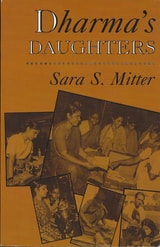
Dharma's Daughters
Contemporary Indian Women and Hindu CultureMitter, Sara S
Rutgers University Press, 1991
Women in India today are faced with a major conflict: how to adjust to rapid modernization and industrialization without abandoning traditional roles and customs. One of the assets of Hinduism has been its ability to incorporate seemingly unorthodox ideas, not fight against them. Contemporary Indian women today are trying to reconcile innovation with tradition as they assert that women are significant participants in the economy, that crimes against women should be investigated and prosecuted, and that a woman can divorce her husband. This is no easy task in light of the highly structured nature of Indian society. It is both hierarchical and patriarchal. Regardless of a family's economic position, women in the family are considered inferior. It is the woman's job, first and foremost, to be loyal to her husband and to be a good mother to her children.
Dharma's Daughters is divided into three sections. The first introduces us to women who live and work in Bombay, where the population is dense and the housing is inadequate. We meet manual laborers, members of construction crews, and illiterate domestic workers who live in shanties. Mitter paints a vivid picture of the harried lives of these women. In the second section Mitter describes Hindu mythology and the traditions that form the basis for women's lives. In the final section, Mitter tells of the increasing mobilization and resistance of Indian women since the 1970s.
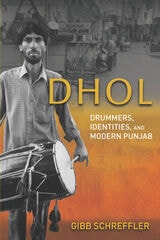
Dhol
Drummers, Identities, and Modern PunjabGibb Schreffler
University of Illinois Press, 2021
Gibb Schreffler draws on two decades of research to investigate dhol's place among the cultural formations within Punjabi communities. Analyzing the identities of musicians, Schreffler illuminates concepts of musical performance, looks at how these concepts help create or articulate Punjabi social structure, and explores identity construction at the intersections of ethnicity, class, and nationality in Punjab and the diaspora. As he shows, understanding the identities of dhol players is an ethical necessity that acknowledges their place in Punjabi cultural history and helps to repair their representation.
An engaging and rich ethnography, Dhol reveals a beloved instrumental form and the musical and social practices of its overlooked performers.

Directory of World Cinema
IndiaEdited by Adam Bingham
Intellect Books, 2015

Disabled Empire
The Colonial Body in First World War BritainHilary R. Buxton
University of Chicago Press, 2026
Disabled Empire examines how imperial precedents and racial ideologies shaped the medical treatments that the British state offered to several million Black and brown servicemen during World War I. In recovering the voices and experiences of these soldiers, Hilary R. Buxton illustrates how they navigated the institutional culture of the imperial military and how they helped to shape health and welfare systems well beyond the interwar period.
The Great War was the first time that troops and volunteers from nearly all reaches of the Empire participated in the war effort side-by-side. Despite official attempts at segregation, colonial troops met in trenches, mobile camps, casualty clearing stations, hospital ships, and convalescent homes. Just as importantly, those organizing treatment encountered men of different ethnicities, religions, and cultures from across and beyond the British Empire. For British officials, this moment offered an opportunity to remake colonial efficiency and medical knowledge. Yet, as Buxton shows, colonial servicemen were not passive subjects in a wartime laboratory: they were vocal participants who demanded a say in the therapies prescribed to them, the rations they required, the psychiatric care they received, and the prosthetics with which they were fitted. Together, these encounters profoundly remade colonial relations, reshaping imperial science, administration, and colonial understandings of subjecthood.
Disabled Empire pushes literature on the war and medicine outside its national, Eurocentric focus to confront the colonial logic of global health inequity.
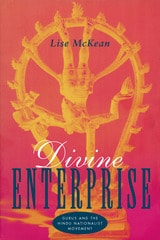
Divine Enterprise
Gurus and the Hindu Nationalist MovementLise McKean
University of Chicago Press, 1996
In this close look at the business of religion, McKean traces the ideological and organizational antecedents to the Hindu nationalist movement. The Indian state's increasing patronage of Hindu institutions makes competition for its support greater than ever. Using materials from guru's publications, the press, and extensive field research, McKean examines how participation by upper-caste ruling class groups in the Divine Life Society and other Hindu organizations further legitimates their own authority.
With a remarkable selection of photographs and advertisements showing icons of spirituality used to sell commodities from textiles to cement to comic books, McKean illustrates the pervasive presence of Hindu imagery in India's burgeoning market economy. She shows how gurus popularize Hindu nationalism through imagery such as the goddess, Mother India, and her martyred sons and daughters.

Doctor Mary in Arabia
MemoirsBy Mary Bruins Allison
University of Texas Press, 1994
Until fairly recently, Arab women rarely received professional health care, since few women doctors had ever practiced in Arabia and their culture forbade them from consulting male doctors. Not surprisingly, Dr. Mary Bruins Allison faced an overwhelming demand when she arrived in Kuwait in 1934 as a medical missionary of the Reformed Church of America. Over the next forty years, "Dr. Mary" treated thousands of women and children, faithfully performing the duties that seemed required of her as a Christian—to heal the sick and seek converts.
These memoirs record a fascinating life. Dr. Allison briefly describes her upbringing and her professional training at Women's Medical College of Pennsylvania. She then focuses on her experiences in Kuwait, where women of all classes, including royalty, flocked to her care. In addition to describing many of her cases, Dr. Allison paints a richly detailed picture of life in Kuwait both before and after the discovery of oil transformed the country. Her recollections include invaluable details of women's lives in the Middle East during the early and mid-twentieth century. They add a valuable chapter to the story of modern medicine, to the largely unsuccessful efforts of the Christian church to win converts in the Middle East, and to the opportunities and limitations that faced American women of the period.
Dr. Allison also worked briefly in Bahrain, Qatar, Oman, and India, and she includes material on each country. The introduction situates her experiences in the context of Middle Eastern and medical developments of the period.
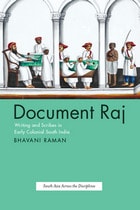
Document Raj
Writing and Scribes in Early Colonial South IndiaBhavani Raman
University of Chicago Press, 2012
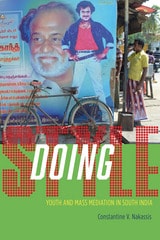
Doing Style
Youth and Mass Mediation in South IndiaConstantine V. Nakassis
University of Chicago Press, 2016
As Nakassis shows, while signs of the global, modern world are everywhere in post-liberalization India, for most of these young people this world is still very distant—a paradox that results in youth’s profound sense of being in between. This in-betweenness manifests itself in the ambivalent quality of style, the ways in which stylish objects are necessarily marked as counterfeit, mixed, or ironical. In order to show how this in-betweenness materializes in particular media, Nakassis explores the entanglements between youth peer groups and the sites where such stylish media objects are produced, arguing that these entanglements deeply condition the production and circulation of the media objects themselves. The result is an important and timely look at the tremendous forces of youth culture, globalization, and mass media as they interact in the vibrancy of a rapidly changing India.
Drama of Democracy
Political Representation in MumbaiLisa Björkman
University of Minnesota Press, 2025
The performative arts of political communication and representation in Mumbai
In an era of global political passions, many have wondered whether some sort of natural affinity exists between political style and substance. Does liberal democracy speak the language of rationality and sincerity while political emotion, imagery, and embodiment properly belong to authoritarianism? Taking an ethnographic approach to the relationship between political form and political content, Drama of Democracy explores the material substance of representations (things like heady crowds and rousing images) together with language-based forms of political communication, such as public oration and community meetings.
Drawing on a decade of research in the city of Mumbai, Lisa Björkman shows that embodied performance is the very site and substance of representation and demonstrates how Mumbaikars evaluate performative bids to represent. The ethnographic accounts demonstrate the extraordinary fluency in this evaluative work in Mumbai, where people from all walks of life are remarkably astute at navigating and assessing political signs and representations, endlessly discussing and debating possible meanings of the city’s dense material-semiotic ecologies—whether words or images, cash or crowds, flyers or flowers.
In Mumbai, Björkman argues, the evaluative criterion of representation is not whether something is sign or substance, or even whether people are deemed to utter truths or falsehoods. Rather, what matters is whether and how a performance activates and actuates the social relations and political subjectivities that it professes to display. Drama of Democracy highlights Mumbaikars’ communicative fluency and theatrical acumen to offer a conceptual toolbox through which contemporary political churnings around the globe might be understood.
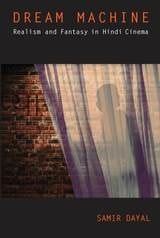
Dream Machine
Realism and Fantasy in Hindi CinemaSamir Dayal
Temple University Press, 2015
Popular Hindi films offer varied cinematic representations ranging from realistic portraits of patriotic heroes to complex fantasies that go beyond escapism. In Dream Machine, Samir Dayal provides a history of Hindi cinema starting with films made after India’s independence in 1947. He constructs a decade-by-decade consideration of Hindi cinema’s role as a site for the construction of “Indianness.”
Dayal suggests that Hindi cinema functions as both mirror and lamp, reflecting and illuminating new and possible representations of national and personal identity, beginning with early postcolonial films including Awaara and Mother India, a classic of the Golden Age. More recent films address critical social issues, such as My Name is Khan and Fire, which concern terrorism and sexuality, respectively. Dayalalso chronicles changes in the industry and in audience reception, and the influence of globalization, considering such films as Slumdog Millionaire.
Dream Machine analyzes the social and aesthetic realism of these films concerning poverty and work, the emergence of the middle class, crime, violence, and the law while arguing for their sustained and critical attention to forms of fantasy.

Dream Zones
Anticipating Capitalism and Development in IndiaJamie Cross
Pluto Press, 2014
Dream Zones explores the dreamed of and desired futures that constitute, sustain and disrupt capitalism in contemporary India.
Drawing on five years of research in and around India's Special Economic Zones (SEZs), the book follows the stories of regional politicians, corporate executives, rural farmers, industrial workers and social activists to show how the pursuit of growth, profit and development shapes the politics of industrialisation and liberalisation.
This book offers a timely reminder that the global economy is shaped by sentiment as much as reason and that un-realised expectations are the grounds on which new hopes for the future are sown.