Results by title
200 books match the query 'Indians of Mexico' and 7 start with d
Debating Oaxaca Archaeology
Edited by Joyce Marcus
University of Michigan Press, 1990
Decoding Gender
Law and Practice in Contemporary MexicoBaitenmann, Helga
Rutgers University Press, 2007
By bringing new interdisciplinary perspectives to issues such as the quality of citizenship and the rule of law in present-day Mexico, this book raises important issues for research on the relationship between law and gender more widely.
Defiance and Deference in Mexico's Colonial North
Indians under Spanish Rule in Nueva VizcayaBy Susan Deeds
University of Texas Press, 2003
Thomas F. McGann Memorial Prize, Rocky Mountain Council on Latin American Studies, 2004
Southwest Book Award, Border Regional Library Association, 2003
In their efforts to impose colonial rule on Nueva Vizcaya from the sixteenth century to the middle of the seventeenth, Spaniards established missions among the principal Indian groups of present-day eastern Sinaloa, northern Durango, and southern Chihuahua, Mexico—the Xiximes, Acaxees, Conchos, Tepehuanes, and Tarahumaras. Yet, when the colonial era ended two centuries later, only the Tepehuanes and Tarahumaras remained as distinct peoples, the other groups having disappeared or blended into the emerging mestizo culture of the northern frontier. Why were these two indigenous peoples able to maintain their group identity under conditions of conquest, while the others could not?
In this book, Susan Deeds constructs authoritative ethnohistories of the Xiximes, Acaxees, Conchos, Tepehuanes, and Tarahumaras to explain why only two of the five groups successfully resisted Spanish conquest and colonization. Drawing on extensive research in colonial-era archives, Deeds provides a multifaceted analysis of each group's past from the time the Spaniards first attempted to settle them in missions up to the middle of the eighteenth century, when secular pressures had wrought momentous changes. Her masterful explanations of how ethnic identities, subsistence patterns, cultural beliefs, and gender relations were forged and changed over time on Mexico's northern frontier offer important new ways of understanding the struggle between resistance and adaptation in which Mexico's indigenous peoples are still engaged, five centuries after the "Spanish Conquest."

Delirio—The Fantastic, the Demonic, and the Réel
The Buried History of Nuevo LeónBy Marie Theresa Hernández
University of Texas Press, 2002
Striking, inexplicable stories circulate among the people of Nuevo León in northern Mexico. Stories of conversos (converted Jews) who fled the Inquisition in Spain and became fabulously wealthy in Mexico. Stories of women and children buried in walls and under houses. Stories of an entire, secret city hidden under modern-day Monterrey. All these stories have no place or corroboration in the official histories of Nuevo León.
In this pioneering ethnography, Marie Theresa Hernández explores how the folktales of Nuevo León encode aspects of Nuevolenese identity that have been lost, repressed, or fetishized in "legitimate" histories of the region. She focuses particularly on stories regarding three groups: the Sephardic Jews said to be the "original" settlers of the region, the "disappeared" indigenous population, and the supposed "barbaric" society that persists in modern Nuevo León. Hernández's explorations into these stories uncover the region's complicated history, as well as the problematic and often fascinating relationship between history and folklore, between officially accepted "facts" and "fictions" that many Nuevoleneses believe as truth.
Dietary Reconstruction at Chalcatzingo
A Formative Period Site in Morelos, MexicoMargaret J. Schoeninger
University of Michigan Press, 2019
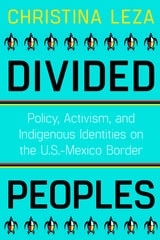
Divided Peoples
Policy, Activism, and Indigenous Identities on the U.S.-Mexico BorderChristina Leza
University of Arizona Press, 2019
Divided Peoples addresses the impact border policies have on traditional lands and the peoples who live there—whether environmental degradation, border patrol harassment, or the disruption of traditional ceremonies. Anthropologist Christina Leza shows how such policies affect the traditional cultural survival of Indigenous peoples along the border. The author examines local interpretations and uses of international rights tools by Native activists, counterdiscourse on the U.S.-Mexico border, and challenges faced by Indigenous border activists when communicating their issues to a broader public.
Through ethnographic research with grassroots Indigenous activists in the region, the author reveals several layers of division—the division of Indigenous peoples by the physical U.S.-Mexico border, the divisions that exist between Indigenous perspectives and mainstream U.S. perspectives regarding the border, and the traditionalist/nontraditionalist split among Indigenous nations within the United States. Divided Peoples asks us to consider the possibilities for challenging settler colonialism both in sociopolitical movements and in scholarship about Indigenous peoples and lands.
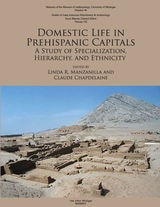
Domestic Life in Prehispanic Capitals
A Study of Specialization, Hierarchy, and EthnicityEdited by Linda R. Manzanilla and Claude Chapdelaine
University of Michigan Press, 2009