Results by title
63 books match the query 'Indigenous Languages in the Americas' and 2 start with d
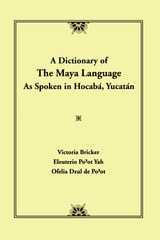
Dictionary Of The Maya Language
As Spoken in Hocaba YucatanVictoria Bricker
University of Utah Press, 1998
The Maya language of Yucatan is known as Yucate by linguists, but its speakers refer to it as May. Dialiectical differences are minimal across the peninsula, and the more than 750,000 speakers of Maya can be understood wherever they go. Moreover, it is not only a living language but is of great use to epigraphers working on ancient Maya glyphs.
This dictionary is the culmination of fourteen years’ labor centering on the town and dialect of Hocaba. Whereas other dictionaries of may use Latin paradigms, this is the first to provide a comprehensive, systematic listing of the stems that can be derived from each root and that give Maya its distinctive character. The entries cover the full range of Maya speech, from simple expressions and idioms to compound stems. Maya sample sentences provide a window into the richness of everyday communication, with its mixture of wit, epithets, insults, riddles, aphorisms, and exchanges of information, including a wonderful assortment of metaphorical expressions like "peccary’s eyelashes" for a type of bean, "the end of the road" for marriage, and a verb meaning "to draw breath with puckered mouth after eating chili." Among the cultural domains encompassed by the dictionary are agriculture, architecture, astronomy, culinary practices and recipes, education, folklore, games, humor, medical prescriptions, ritual, toys, and weaving, many of which have roots in the Precolumbian past. In addition to the dictionary entries, this work also contains a short grammar, a botanical index, and bibliography.
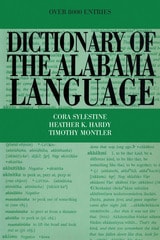
Dictionary of the Alabama Language
By Cora Sylestine, Heather K. Hardy and Timothy Montler
University of Texas Press, 1993
The Alabama language, a member of the Muskogean language family, is spoken today by the several hundred inhabitants of the Alabama-Coushatta Indian Reservation in Polk County, Texas. This dictionary of Alabama was begun over fifty years ago by tribe member Cora Sylestine. She was aided after 1980 by linguists Heather K. Hardy and Timothy Montler, who completed work on the dictionary after her death.
This state-of-the-art analytical dictionary contains over 8,000 entries of roots, stems, and compounds in the Alabama-English section. Each entry contains precise definitions, full grammatical analyses, agreement and other part-of-speech classifications, variant pronunciations, example sentences, and extensive cross-references to stem entries. The Alabama-English section is followed by a thorough English-Alabama finder list that functions as a full index to the definitions in the Alabama-English section.