55 books match the query 'Individual Architects & Firms' and 4 start with d
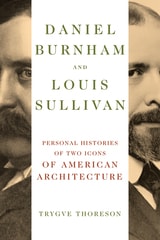
cover of Daniel Burnham and Louis Sullivan: Personal Histories of Two Icons of American Architecture

Daniel Burnham and Louis Sullivan

Personal Histories of Two Icons of American Architecture

Trygve Thoreson

University of Illinois Press, 2026

Peers, foils, colleagues, and rivals—Daniel Burnham and Louis Sullivan’s impact on each other still expresses itself in architectural masterworks that anchor Chicago’s cityscape. Trygve Thoreson’s parallel biography places their lives and careers within a panoramic history of the late 1800s and early 1900s. Thoreson delves into their influences while bringing to life the social, intellectual, and cultural milieus of their time. Unearthing a wealth of personal details, Thoreson pays particular attention to the influences that formed Burnham and Sullivan and shaped not only their designs but their conception of themselves as artists. He also examines the confluence of historical forces that pulled the two men together and pushed them apart—a fruitful back-and-forth that built surprising links into their work and steered world architecture in bold new directions.

An engaging piece of nonfiction storytelling, Daniel Burnham and Louis Sullivan reveals new facets of the architects’ personal, intellectual, and artistic lives.
[more]
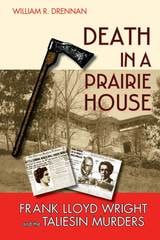
cover of Death in a Prairie House: Frank Lloyd Wright and the Taliesin Murders

Death in a Prairie House

Frank Lloyd Wright and the Taliesin Murders

Drennan

University of Wisconsin Press, 2008

     The most pivotal and yet least understood event of Frank Lloyd Wright’s celebrated life involves the brutal murders in 1914 of seven adults and children dear to the architect and the destruction by fire of Taliesin, his landmark residence, near Spring Green, Wisconsin. Unaccountably, the details of that shocking crime have been largely ignored by Wright’s legion of biographers—a historical and cultural gap that is finally addressed in William Drennan’s exhaustively researched Death in a Prairie House: Frank Lloyd Wright and the Taliesin Murders.
     In response to the scandal generated by his open affair with the proto-feminist and free love advocate Mamah Borthwick Cheney, Wright had begun to build Taliesin as a refuge and "love cottage" for himself and his mistress (both married at the time to others).
      Conceived as the apotheosis of Wright’s prairie house style, the original Taliesin would stand in all its isolated glory for only a few months before the bloody slayings that rocked the nation and reduced the structure itself to a smoking hull.
     Supplying both a gripping mystery story and an authoritative portrait of the artist as a young man, Drennan wades through the myths surrounding Wright and the massacre, casting fresh light on the formulation of Wright’s architectural ideology and the cataclysmic effects that the Taliesin murders exerted on the fabled architect and on his subsequent designs.
 
Best Books for General Audiences, selected by the American Association of School Librarians, and Outstanding Book, selected by the Public Library Association
[more]
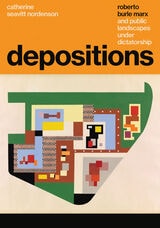
cover of Depositions: Roberto Burle Marx and Public Landscapes under Dictatorship

Depositions

Roberto Burle Marx and Public Landscapes under Dictatorship

By Catherine Seavitt Nordenson

University of Texas Press, 2018

Recipient of 2019 John Brinckerhoff Jackson Book Prize, Foundation for Landscape Studies
2021 On the Brinck Book Award Winner

“Burle Marx created a new and modern grammar for international landscape design.”
—Lauro Cavalcanti, quoted in the New York Times

“The real creator of the modern garden.”
—American Institute of Architects

Presenting the first English translation of Burle Marx’s “depositions,” this volume highlights the environmental advocacy of a preeminent Brazilian landscape architect who advised and challenged the country’s military dictatorship.

Roberto Burle Marx (1909–1994) is internationally known as one of the preeminent modernist landscape architects. He designed renowned public landscapes in Brazil, beginning with small plazas in Recife in the 1930s and culminating with large public parks in the early 1960s, most significantly the Parque do Flamengo in Rio de Janeiro. Depositions explores a pivotal moment in Burle Marx’s career—the years in which he served as a member of the Federal Cultural Council created by the military dictatorship in the mid-1960s. Despite the inherent conflict and risk in working with the military regime, Burle Marx boldly used his position to advocate for the protection of the unique Brazilian landscape, becoming a prophetic voice of caution against the regime’s policies of rapid development and resource exploitation.

Depositions presents the first English translation of eighteen environmental position pieces that Burle Marx wrote for the journal Cultura , a publication of the Brazilian Ministry of Education and Culture, from 1967 through 1973. Catherine Seavitt Nordenson introduces and contextualizes the depositions by analyzing their historical and political contexts, as well as by presenting pertinent examples of Burle Marx’s earlier public projects, which enables a comprehensive reading of the texts. Addressing deforestation, the establishment of national parks, the place of commemorative sculpture, and the unique history of the Brazilian cultural landscape, Depositions offers new insight into Burle Marx’s outstanding landscape oeuvre and elucidates his transition from prolific designer to prescient counselor.
[more]
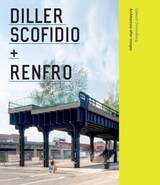
cover of Diller Scofidio + Renfro: Architecture after Images

Diller Scofidio + Renfro

Architecture after Images

Edward Dimendberg

University of Chicago Press, 2013

In Diller Scofidio + Renfro: Architecture after Images, Edward Dimendberg offers the first comprehensive treatment of one of the most imaginative contemporary design studios.  Since founding their practice in 1979, Elizabeth Diller and Ricardo Scofidio have integrated architecture, urban design, media art, and the performing arts in a dazzling array of projects, which include performances, art installations, and books, in addition to buildings and public spaces.  At the center of this work is a fascination with vision and a commitment to questioning the certainty and security long associated with architecture.

Dimendberg provides an extensive overview of these concerns and the history of the studio, revealing how principals Elizabeth Diller, Ricardo Scofidio, and Charles Renfro continue to expand the definition of architecture, question the nature of space and vision in contemporary culture, and produce work that is endlessly surprising and rewarding, from New York’s High Line to Blur, an artificial cloud, and Facsimile, a video screen that moves around a building facade.  Dimendberg also explores the relation of work by DS+R to that by earlier modernists such as Marcel Duchamp and John Hejduk.  He reveals how the fascination of the architects with evolving forms of media, technology, and building materials has produced works that unsettle distinctions among architecture and other media.
 
Based on interviews with the architects, their clients, and collaborators as well as unprecedented access to unpublished documents, sketchbook entries, and archival records, Diller Scofidio + Renfro is the most thorough consideration of DS+R in any language. Illustrated with many previously unpublished renderings in addition to photos from significant contemporary photographers, this book is an essential study of one of the most significant and creative architecture and design studios working today.

[more]