Results by title
71 books match the query 'Inequality' and 5 start with d
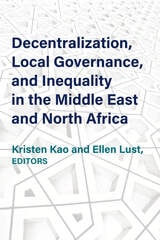
Decentralization, Local Governance, and Inequality in the Middle East and North Africa
Kristen Kao and Ellen M. Lust, Editors
University of Michigan Press, 2025
While many scholars, policymakers, and development practitioners view decentralization as a way to increase participation, strengthen political representation, and improve social welfare, little is known about the experiences of communities in the context of decentralization – particularly in the Middle East and North Africa. This volume directs our attention toward the ways in which decentralization is “lived locally” by citizens of the MENA region, underscoring the simultaneous influences of individual-level factors (e.g., gender, education) and local context (e.g., development levels, electoral institutions) on governance processes and outcomes.
A group of international scholars brings together methodologically diverse, original research in Lebanon, Morocco, Syria, and Tunisia to expand the literature on decentralization. Following a preface by Hicham Alaoui, the empirical chapters are arranged into three thematic sections. These focus on subnational variations in the relationships between central and local actors, citizen engagement with state and non-state institutions, and the extent to which representatives reflect their local communities. Together, these chapters provide important insights into governance, participation, and representation in the MENA and open new questions for furthering the study of governance and local development. Only by unpacking perspectives and governance experiences at the micro-level can we understand how decentralization policies affect citizens’ everyday lives.
A group of international scholars brings together methodologically diverse, original research in Lebanon, Morocco, Syria, and Tunisia to expand the literature on decentralization. Following a preface by Hicham Alaoui, the empirical chapters are arranged into three thematic sections. These focus on subnational variations in the relationships between central and local actors, citizen engagement with state and non-state institutions, and the extent to which representatives reflect their local communities. Together, these chapters provide important insights into governance, participation, and representation in the MENA and open new questions for furthering the study of governance and local development. Only by unpacking perspectives and governance experiences at the micro-level can we understand how decentralization policies affect citizens’ everyday lives.
[more]

Degrees of Risk
Navigating Insecurity and Inequality in Public Higher EducationBlake R. Silver
University of Chicago Press, 2024
An ethnographic analysis of how insecurity is at the heart of contemporary higher education.
Institutions of higher education are often described as “ivory towers,” places of privilege where students exist in a “campus bubble,” insulated from the trials of the outside world. These metaphors reveal a widespread belief that college provides young people with stability and keeps insecurity at bay. But for many students, that’s simply not the case.
Degrees of Risk reveals how insecurity permeates every facet of college life for students at public universities. Sociologist Blake Silver dissects how these institutions play a direct role in perpetuating uncertainty, instability, individualism, and anxiety about the future. Silver examined interviews with more than one hundred students who described the risks that surrounded every decision: which major to choose, whether to take online classes, and how to find funding. He expertly identified the ways the college experience played out differently for students from different backgrounds. For students from financially secure families with knowledge of how college works, all the choices and flexibility of college felt like an adventure or a wealth of opportunities. But for many others, especially low-income, first-generation students, their personal and family circumstances meant that that flexibility felt like murkiness and precarity. In addition, he discovered that students managed insecurity in very different ways, intensifying inequality at the intersections of socioeconomic status, race, gender, and other sociodemographic dimensions. Drawing from these firsthand accounts, Degrees of Risk presents a model for a better university, one that fosters success and confidence for a diverse range of students.
[more]
Degrees of Risk
Navigating Insecurity and Inequality in Public Higher EducationBlake R. Silver
University of Chicago Press, 2024
This is an auto-narrated audiobook version of this book.
An ethnographic analysis of how insecurity is at the heart of contemporary higher education.
Institutions of higher education are often described as “ivory towers,” places of privilege where students exist in a “campus bubble,” insulated from the trials of the outside world. These metaphors reveal a widespread belief that college provides young people with stability and keeps insecurity at bay. But for many students, that’s simply not the case.
Degrees of Risk reveals how insecurity permeates every facet of college life for students at public universities. Sociologist Blake Silver dissects how these institutions play a direct role in perpetuating uncertainty, instability, individualism, and anxiety about the future. Silver examined interviews with more than one hundred students who described the risks that surrounded every decision: which major to choose, whether to take online classes, and how to find funding. He expertly identified the ways the college experience played out differently for students from different backgrounds. For students from financially secure families with knowledge of how college works, all the choices and flexibility of college felt like an adventure or a wealth of opportunities. But for many others, especially low-income, first-generation students, their personal and family circumstances meant that that flexibility felt like murkiness and precarity. In addition, he discovered that students managed insecurity in very different ways, intensifying inequality at the intersections of socioeconomic status, race, gender, and other sociodemographic dimensions. Drawing from these firsthand accounts, Degrees of Risk presents a model for a better university, one that fosters success and confidence for a diverse range of students.
[more]
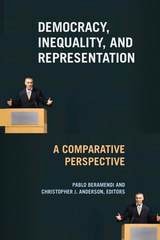
Democracy, Inequality, and Representation in Comparative Perspective
Pablo Beramendi
Russell Sage Foundation, 2008
The gap between the richest and poorest Americans has grown steadily over the last thirty years, and economic inequality is on the rise in many other industrialized democracies as well. But the magnitude and pace of the increase differs dramatically across nations. A country's political system and its institutions play a critical role in determining levels of inequality in a society. Democracy, Inequality, and Representation argues that the reverse is also true—inequality itself shapes political systems and institutions in powerful and often overlooked ways. In Democracy, Inequality, and Representation, distinguished political scientists and economists use a set of international databases to examine the political causes and consequences of income inequality. The volume opens with an examination of how differing systems of political representation contribute to cross-national variations in levels of inequality. Torben Iverson and David Soskice calculate that taxes and income transfers help reduce the poverty rate in Sweden by over 80 percent, while the comparable figure for the United States is only 13 percent. Noting that traditional economic models fail to account for this striking discrepancy, the authors show how variations in electoral systems lead to very different outcomes. But political causes of disparity are only one part of the equation. The contributors also examine how inequality shapes the democratic process. Pablo Beramendi and Christopher Anderson show how disparity mutes political voices: at the individual level, citizens with the lowest incomes are the least likely to vote, while high levels of inequality in a society result in diminished electoral participation overall. Thomas Cusack, Iverson, and Philipp Rehm demonstrate that uncertainty in the economy changes voters' attitudes; the mere risk of losing one's job generates increased popular demand for income support policies almost as much as actual unemployment does. Ronald Rogowski and Duncan McRae illustrate how changes in levels of inequality can drive reforms in political institutions themselves. Increased demand for female labor participation during World War II led to greater equality between men and women, which in turn encouraged many European countries to extend voting rights to women for the first time. The contributors to this important new volume skillfully disentangle a series of complex relationships between economics and politics to show how inequality both shapes and is shaped by policy. Democracy, Inequality, and Representation provides deeply nuanced insight into why some democracies are able to curtail inequality—while others continue to witness a division that grows ever deeper.
[more]
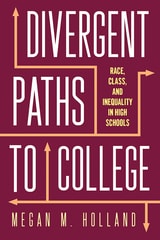
Divergent Paths to College
Race, Class, and Inequality in High SchoolsHolland, Megan M
Rutgers University Press, 2019
In Divergent Paths to College, Megan M. Holland examines how high schools structure different pathways that lead students to very different college destinations based on race and class. She finds that racial and class inequalities are reproduced through unequal access to key sources of information, even among students in the same school and even in schools with well-established college-going cultures. As the college application process becomes increasingly complex and high-stakes, social capital, or relationships with people who can provide information as well as support and guidance, becomes much more critical. Although much has been written about the college-bound experience, we know less about the role that social capital plays, and specifically how high schools can serve as organizational brokers of social ties. The relationships that high schools cultivate between students and higher education institutions by inviting college admissions officers into their schools to market to students, is a particularly critical, yet unexplored source of college information.
[more]