Results by title
124 books match the query 'Information technology' and 9 start with d
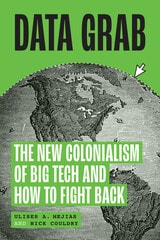
Data Grab
The New Colonialism of Big Tech and How to Fight BackUlises A. Mejias and Nick Couldry
University of Chicago Press, 2024
Large technology companies like Meta, Amazon, and Alphabet have unprecedented access to our daily lives, collecting information when we check our email, count our steps, shop online, and commute to and from work. Current events are concerning—both the changing owners (and names) of billion-dollar tech companies and regulatory concerns about artificial intelligence underscore the sweeping nature of Big Tech’s surveillance and the influence such companies hold over the people who use their apps and platforms.
As trusted tech experts Ulises A. Mejias and Nick Couldry show in this eye-opening and convincing book, this vast accumulation of data is not the accidental stockpile of a fast-growing industry. Just as nations stole territories for ill-gotten minerals and crops, wealth, and dominance, tech companies steal personal data important to our lives. It’s only within the framework of colonialism, Mejias and Couldry argue, that we can comprehend the full scope of this heist.
Like the land grabs of the past, today’s data grab converts our data into raw material for the generation of corporate profit against our own interests. Like historical colonialism, today’s tech corporations have engineered an extractive form of doing business that builds a new social and economic order, leads to job precarity, and degrades the environment. These methods deepen global inequality, consolidating corporate wealth in the Global North and engineering discriminatory algorithms. Promising convenience, connection, and scientific progress, tech companies enrich themselves by encouraging us to relinquish details about our personal interactions, our taste in movies or music, and even our health and medical records. Do we have any other choice?
Data Grab affirms that we do. To defy this new form of colonialism we will need to learn from previous forms of resistance and work together to imagine entirely new ones. Mejias and Couldry share the stories of voters, workers, activists, and marginalized communities who have successfully opposed unscrupulous tech practices. An incisive discussion of the digital media that’s transformed our world, Data Grab is a must-read for anyone concerned about privacy, self-determination, and justice in the internet age.
Data Power
Radical Geographies of Control and ResistanceJim E. Thatcher
Pluto Press, 2021
In recent years, popular media has inundated audiences with sensationalized headlines recounting data breaches, new forms of surveillance and other dangers of our digital age. Despite their regularity, such accounts treat each case as unprecedented and unique. This book proposes a radical rethinking of the history, present and future of our relations with the digital, spatial technologies that increasingly mediate our everyday lives.
From smartphones to surveillance cameras, to navigational satellites, these new technologies offer visions of integrated, smooth and efficient societies, even as they directly conflict with the ways users experience them. Recognizing the potential for both control and liberation, the authors argue against both acquiescence to and rejection of these technologies.
Through intentional use of the very systems that monitor them, activists from Charlottesville to Hong Kong are subverting, resisting and repurposing geographic technologies. Using examples as varied as writings on the first telephones to the experiences of a feminist collective for migrant women in Spain, the authors present a revolution of everyday technologies. In the face of the seemingly inevitable circumstances, these technologies allow us to create new spaces of affinity, and a new politics of change.
Diasporas in the New Media Age
Identity, Politics, and CommunityAndoni Alonso
University of Nevada Press, 2010
The explosion of digital information and communication technologies has influenced almost every aspect of contemporary life. Diasporas in the New Media Age is the first book-length examination of the social use of these technologies by emigrants and diasporas around the world. The eighteen original essays in the book explore the personal, familial, and social impact of modern communication technology on populations of European, Asian, African, Caribbean, Middle Eastern, and Latin American emigrants. It also looks at the role and transformation of such concepts as identity, nation, culture, and community in the era of information technology and economic globalization. The contributors, who represent a number of disciplines and national origins, also take a range of approaches—empirical, theoretical, and rhetorical—and combine case studies with thoughtful analysis. Diasporas in the New Media Age is both a discussion of the use of communication technologies by various emigrant groups and an engaging account of the immigrant experience in the contemporary world. It offers important insights into the ways that dispersed populations are using digital media to maintain ties with their families and homeland, and to create new communities that preserve their culture and reinforce their sense of identity. In addition, the book is a significant contribution to our understanding of the impact of technology on society in general.
Digital Community Engagement
Partnering Communities with the AcademyEdited by Rebecca Wingo, Jason Heppler, and Paul Schadewald
University of Minnesota Press, 2020
Digital projects can empower communities through collaboration and create new primary sources, collapse barriers, and spark new dialogue. Digital Community Engagement “lifts the hood” and presents nine examples of digital collaborations from constructing a public response to police violence, to creating digital stories of homelessness, to young activists united around local people in the Deep South to build a grassroots movement for social change.
Wingo, Heppler and Schadewald bring together cutting-edge campus-community partnerships with a focus on digital projects. The case studies, authored by academics and their community partners, explore models for digital community engagement that leverage new media through reciprocal partnerships. The contributions to this volume stand at the crossroads of digital humanities, public history, and community
Digital Depression
Information Technology and Economic CrisisDan Schiller
University of Illinois Press, 2014
Digital Mythologies
The Hidden Complexities of the InternetValovic, Thomas
Rutgers University Press, 1999
Surf the web. Ride the information highway. Log on to the future. Corporate ad campaigns like these have become pervasive in the 1990s. You're either online, or you're falling behind the times-at least, that's what the media tells us.
Ever since the 1990s, when the Internet gained widespread popularity, it has been heralded as one of the best things ever to happen to technology and communications. Commentators expected it to revolutionize how we communicate, do business, and educate our children. Conversely, other pundits have vehemently attacked this technology. Naysayers of "cyberlife" emerged with their warnings of how the Net provides an uncensored, round-the-clock venue for pornography, for inaccurate, simplified information, and is rife with opportunities to violate our right to privacy. In Digital Mythologies, Thomas Valovic hopes to raise the level of discussion by giving a full and balanced picture of how the Net affects our lives.
Digital Mythologies, a collection of Valovic's essays, asks hard questions about where computer and communications technology is taking us. Through anecdotes drawn from his experiences as former editor-in-chief of Telecommunications magazine, the author gives readers an insider's peek behind the scenes of the Internet industry. He explores the underlying social and political implications of the Internet and its associated technologies, based on his contention that the cyberspace experience is far more complex than is commonly assumed. Valovic explores these hidden complexities, and points to fascinating connections between the Internet and our contemporary culture.
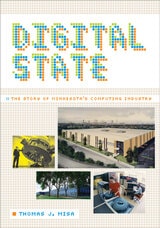
Digital State
The Story of Minnesota's Computing IndustryThomas J. Misa
University of Minnesota Press, 2013
Accounts of the early events of the computing industry—the Turing machine, the massive Colossus, the ENIAC computer—are well-told tales, and equally well known is the later emergence of Silicon Valley and the rise of the personal computer. Yet there is an extraordinary untold middle history—with deep roots in Minnesota. From the end of World War II through the 1970s, Minnesota was home to the first computing-centered industrial district in the world.
Drawing on rare archival documents, photographs, and a wealth of oral histories, Digital State unveils the remarkable story of computer development in the heartland after World War II. These decades found corporations—concentrated in large part in Minnesota—designing state-of-the-art mainframe technologies, revolutionizing new methods of magnetic data storage, and, for the first time, truly integrating software and hardware into valuable products for the American government and public. Minnesota-based companies such as Engineering Research Associates, Univac, Control Data, Cray Research, Honeywell, and IBM Rochester were major international players and together formed an unrivaled epicenter advancing digital technologies. These companies not only brought vibrant economic growth to Minnesota, they nurtured the state’s present-day medical device and software industries and possibly even tomorrow’s nanotechnology.
Thomas J. Misa’s groundbreaking history shows how Minnesota recognized and embraced the coming information age through its leading-edge companies, its workforce, and its prominent institutions. Digital State reveals the inner workings of the birth of the digital age in Minnesota and what we can learn from this era of sustained innovation.
Digital Technology and Democratic Theory
Edited by Lucy Bernholz, Hélène Landemore, and Rob Reich
University of Chicago Press, 2021
To understand these transformations, this book brings together contributions by scholars from multiple disciplines to wrestle with the question of how digital technologies shape, reshape, and affect fundamental questions about democracy and democratic theory. As expectations have whiplashed—from Twitter optimism in the wake of the Arab Spring to Facebook pessimism in the wake of the 2016 US election—the time is ripe for a more sober and long-term assessment. How should we take stock of digital technologies and their promise and peril for reshaping democratic societies and institutions? To answer, this volume broaches the most pressing technological changes and issues facing democracy as a philosophy and an institution.
Disconnected
Haves and Have-Nots in the Information AgeWresch, William
Rutgers University Press, 1996
In the Information Age, information is power. Who produces all that information, how does it move around, who uses it, to what ends, and under what constraints? Who gets that power? And what happens to the people who have no access to it?
Disconnected begins with a striking vignette of two men: One is the thriving manager of a company selling personal computers and computer services. The other is just one among thousands of starving laborers. He has no way to find the information that might help him find a job, he cannot afford newspapers, rarely sees television, cannot understand the dialect of local radio broadcasts, will probably never touch a computer. These two men happen to live in Windhoek, Namibia, but this is not a story about Africa––it is a story that could be repeated almost anywhere in the world, even next door.
With vivid anecdotes and data, William Wresch contrasts the opportunities of the information-rich with the limited prospects of the information-poor. Surveying the range of information––personal, public, organizational, commercial––that has become the currency of exchange in today’s world, he shows how each represents a form of power. He analyzes the barriers that keep people information-poor: geography, tyranny, illiteracy, psychological blinders, “noise,” crime. Technology alone, he demonstrates, is not the answer. Even the technology-rich do not always get access to important information––or recognize its value.
Wresch spells out the grim consequences of information inequity for individuals and society. Yet he ends with reasons for optimism and stories of people who are working to pull down the impediments to the flow of information.