Results by title
123 books match the query 'Internet' and 11 start with d
Data Privacy Protection and the Conduct of Applied Research
Methods, Approaches, and New FindingsEdited by V. Joseph Hotz, Ruobin Gong, and Ian M. Schmutte
University of Chicago Press, 2026
A necessary exploration into the mechanics of data privacy protections within empirical social science research.
The explosion of computational power and data availability has revolutionized empirical social science research, but it has also created unprecedented challenges for protecting the privacy of individuals and businesses. As computational tools make it increasingly possible to breach data anonymity in government surveys by combining the survey data with additional information from external sources, statistical agencies face mounting pressure to develop new privacy protection methods while maintaining data quality essential for research and policymaking. This volume explores how innovations in data privacy protection, including differential privacy and synthetic data methods, affect the conduct of empirical analysis in economics, computer science, and statistics. Contributors explore critical questions about the trade-offs between privacy and data usability: How do new protection methods impact statistical inference and parameter estimation? What standards should data providers adopt? The chapters examine frameworks for characterizing privacy protection, disclosure limitation challenges for survey data, methodological innovations for privacy-preserving statistical analysis, regulatory considerations in modern data governance, and strategies for balancing confidentiality with research access.
This volume provides researchers, statistical agencies, and policymakers with essential guidance for navigating the complex landscape where data protection meets scientific inquiry.
Digital Activism in the Mexican Nations
Resistance, Catharsis, TransformationDavid S. Dalton
Rutgers University Press, 2026
Digital Activism in the Mexican Nations analyzes Mexico’s rich history of digital activism, which is among the most vibrant of any country in the Hispanic world. The book begins with a discussion of the Zapatista uprising of 1994—which is widely understood as the first digital social movement in the history of the world—and ends with a discussion of the digital strategies of migrant communities trekking through Mexico into the present.
Conceptualizing (digital) activism as a type of performance, the book opens a dialogue with Brecht’s binary of cathartic and transformative performance. As such, it suggests that activist movements centered on expressive manifestations of emotion tend to stifle a social movement’s revolutionary potential by stifling their ability to resonate with potential allies outside their community. At the same time, it argues that the most successful digital social movements seek strategies to build connections with allies who can help them to shift state policy.

Digital Dilemmas
The State, the Individual, and Digital Media in CubaVenegas, Cristina
Rutgers University Press, 2010
Digital Dilemmas views Cuba from the Soviet Union's demise to the present, to assess how conflicts over media access play out in their both liberating and repressive potential. Drawing on extensive scholarship and interviews, Cristina Venegas questions myths of how Internet use necessarily fosters global democracy and reveals the impact of new technologies on the country's governance and culture. She includes film in the context of broader media history, as well as artistic practices such as digital art and networks of diasporic communities connected by the Web. This book is a model for understanding the geopolitic location of power relations in the age of digital information sharing.

Digital Legend and Belief
The Slender Man, Folklore, and the MediaAndrew Peck
University of Wisconsin Press, 2023
Peck argues that the story of the Slender Man is really a story about the changing nature of belief in the age of the internet. Widely adopted digital technologies, from smartphones to social media, offer vast potential for extending traditional and expressive social behaviors in new ways. As such, understanding the online landscape of contemporary folklore is crucial for grasping the formation and circulation of belief in the digital age. Ultimately, Peck argues that advancing our comprehension of legends online can help us better understand how similar belief genres—like fake news, conspiracy theories, hoaxes, rumors, meme culture, and anti-expert movements—are enabled by digital media.

Digital Mythologies
The Hidden Complexities of the InternetValovic, Thomas
Rutgers University Press, 1999
Surf the web. Ride the information highway. Log on to the future. Corporate ad campaigns like these have become pervasive in the 1990s. You're either online, or you're falling behind the times-at least, that's what the media tells us.
Ever since the 1990s, when the Internet gained widespread popularity, it has been heralded as one of the best things ever to happen to technology and communications. Commentators expected it to revolutionize how we communicate, do business, and educate our children. Conversely, other pundits have vehemently attacked this technology. Naysayers of "cyberlife" emerged with their warnings of how the Net provides an uncensored, round-the-clock venue for pornography, for inaccurate, simplified information, and is rife with opportunities to violate our right to privacy. In Digital Mythologies, Thomas Valovic hopes to raise the level of discussion by giving a full and balanced picture of how the Net affects our lives.
Digital Mythologies, a collection of Valovic's essays, asks hard questions about where computer and communications technology is taking us. Through anecdotes drawn from his experiences as former editor-in-chief of Telecommunications magazine, the author gives readers an insider's peek behind the scenes of the Internet industry. He explores the underlying social and political implications of the Internet and its associated technologies, based on his contention that the cyberspace experience is far more complex than is commonly assumed. Valovic explores these hidden complexities, and points to fascinating connections between the Internet and our contemporary culture.
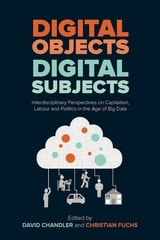
Digital Objects, Digital Subjects
Interdisciplinary Perspectives on Capitalism, Labour and Politics in the Age of Big DataDavid Chandler and Christian Fuchs
University of Westminster Press, 2019
This volume explores activism, research and critique in the age of digital subjects and objects and Big Data capitalism after a digital turn said to have radically transformed our political futures. Optimists assert that the ‘digital’ promises: new forms of community and ways of knowing and sensing, innovation, participatory culture, networked activism, and distributed democracy. Pessimists argue that digital technologies have extended domination via new forms of control, networked authoritarianism and exploitation, dehumanization and the surveillance society. Leading international scholars present varied interdisciplinary assessments of such claims – in theory and via dialogue – and of the digital’s impact on society and the potentials, pitfalls, limits and ideologies, of digital activism. They reflect on whether computational social science, digital humanities and ubiquitous datafication lead to digital positivism that threatens critical research or lead to new horizons in theory and society.
An electronic version of this book is freely available, thanks to the support of libraries working with Knowledge Unlatched. KU is a collaborative initiative designed to make high quality books Open Access for the public good. More information about the initiative and details about KU’s Open Access programme can be found at www.knowledgeunlatched.org.

Digital Platforms and the Press
James Meese
Intellect Books, 2023
Platform dependence is a concept that is used to describe what happens when businesses or an entire sector become reliant on one or more digital platforms for their survival. Digital Platforms and the Press argues that we face a major risk of a platform-dependent press—a development that threatens liberal democracies across the world. As James Meese shows, the situation is occurring across the news industry, to the extent that it is difficult to imagine the production, distribution, and long-term survival of news in liberal democracies without the involvement of platforms. As governments, regulators, and citizens become increasingly concerned about platform power, Digital Platforms and the Press is the first book to highlight the long-term economic and social consequences of platform dependence for the news sector.
Digital Rebellion
The Birth of the Cyber LeftTodd Wolfson
University of Illinois Press, 2014
Todd Wolfson reveals how aspects of the mid-1990s Zapatistas movement--network organizational structure, participatory democratic governance, and the use of communication tools as a binding agent--became essential parts of Indymedia and other Cyber Left organizations. From there he uses oral interviews and other rich ethnographic data to chart the media-based think tanks and experiments that continued the Cyber Left's evolution through the Independent Media Center's birth around the 1999 WTO protests in Seattle.
Melding virtual and traditional ethnographic practice to explore the Cyber Left's cultural logic, Wolfson maps the social, spatial and communicative structure of the Indymedia network and details its operations on the local, national and global level. He looks at the participatory democracy that governs global social movements and the ways democracy and decentralization have come into tension, and how "the switchboard of struggle" conducts stories from the hyper-local and disperses them worldwide. As he shows, understanding the intersection of Indymedia and the Global Social Justice Movement illuminates their foundational role in the Occupy struggle and other emergent movements that have re-energized radical politics.

Digital Rights at the Periphery
Making Brazil's Marco CivilGuy T. Hoskins
University of Illinois Press, 2025
Signed into law in 2014, the Marco Civil da Internet (Brazilian Civil Rights Framework for the Internet) appeared to offer pioneering legislation for a digital bill of rights that addressed issues like network neutrality and privacy. Guy T. Hoskins chronicles the Marco Civil’s development and its failure to confront the greatest concentration of power in the digital age: informational capitalism. Combining interviews with discourse and political-economic analysis, Hoskins reveals why the legislation fell short while examining the implications of its emergence in Brazil, which remains on the margins of the global system of informational capitalism. Hoskins places collectivist and public service principles at the core of any framework’s effectiveness. He also shows why we must create systems sensitive to the sociocultural and political-economic contexts that will shape digital rights and their usefulness.
Compelling and contrarian, Digital Rights at the Periphery looks at communications policy and internet governance in the Global South and the lessons they provide for the rest of the world.
Digitizing Race
Visual Cultures of the InternetLisa Nakamura
University of Minnesota Press, 2007
In the nineties, neoliberalism simultaneously provided the context for the Internet’s rapid uptake in the United States and discouraged public conversations about racial politics. At the same time many scholars lauded the widespread use of text-driven interfaces as a solution to the problem of racial intolerance. Today’s online world is witnessing text-driven interfaces such as e-mail and instant messaging giving way to far more visually intensive and commercially driven media forms that not only reveal but showcase people’s racial, ethnic, and gender identity.
Lisa Nakamura, a leading scholar in the examination of race in digital media, uses case studies of popular yet rarely examined uses of the Internet such as pregnancy Web sites, instant messaging, and online petitions and quizzes to look at the emergence of race-, ethnic-, and gender-identified visual cultures.
While popular media such as Hollywood cinema continue to depict nonwhite nonmales as passive audiences or consumers of digital media rather than as producers, Nakamura argues the contrary—with examples ranging from Jennifer Lopez music videos; films including the Matrix trilogy, Gattaca, and Minority Report; and online joke sites—that users of color and women use the Internet to vigorously articulate their own types of virtual community, avatar bodies, and racial politics.
Lisa Nakamura is associate professor of speech communication and Asian American studies at the University of Illinois, Urbana-Champaign. She is the author of Cybertypes: Race, Ethnicity, and Identity on the Internet and coeditor, with Beth Kolko and Gilbert Rodman, of Race in Cyberspace.

Disconnect
Facebook's Affective BondsTero Karppi
University of Minnesota Press, 2018
An urgent examination of the threat posed to social media by user disconnection, and the measures websites will take to prevent it
No matter how pervasive and powerful social media websites become, users always have the option of disconnecting—right? Not exactly, as Tero Karppi reveals in this disquieting book. Pointing out that platforms like Facebook see disconnection as an existential threat—and have undertaken wide-ranging efforts to eliminate it—Karppi argues that users’ ability to control their digital lives is gradually dissipating.
Taking a nonhumancentric approach, Karppi explores how modern social media platforms produce and position users within a system of coded relations and mechanisms of power. For Facebook, disconnection is an intense affective force. It is a problem of how to keep users engaged with the platform, but also one of keeping value, attention, and desires within the system. Karppi uses Facebook’s financial documents as a map to navigate how the platform sees its users. Facebook’s plans to connect the entire globe through satellites and drones illustrates the material webs woven to keep us connected. Karppi analyzes how Facebook’s interface limits the opportunity to opt-out—even continuing to engage users after their physical death. Showing how users have fought to take back their digital lives, Karppi chronicles responses like Web2.0 Suicide Machine, an art project dedicated to committing digital suicide.
For Karppi, understanding social media connectivity comes from unbinding the bonds that stop people from leaving these platforms. Disconnection brings us to the limit of user policies, algorithmic control, and platform politics. Ultimately, Karppi’s focus on the difficulty of disconnection, rather than the ease of connection, reveals how social media has come to dominate human relations.