Results by title
105 books match the query 'Iran' and 8 start with d
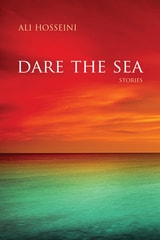
Dare the Sea
StoriesAli Hosseini
Northwestern University Press, 2023
The stories in Dare the Sea explore Iran’s landscape, culture, and the undercurrent of change affecting its people—both in Iran and the United States. The stories in the first half of the collection are set in Iran in the time before and just after the Iranian Revolution of 1979. Each tale discloses the obstacles rural Iranians lived with on a daily basis and the exigencies of survival: petty theft, corruption, drug trafficking, religion, and love. Stories in the second half take place in exile, where characters are seemingly dropped into American locales like the Midwest or Hawaii, taking in their situation with only the survival skills they’ve learned in their own land and enduring the hardships of being strangers in a new country.
Loosely interconnected by reappearing characters, the stories in Dare the Sea are strongly linked by the country of Iran, its landscape, its history, and its hold on its people.
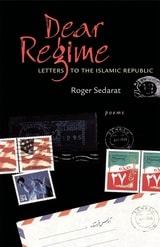
Dear Regime
Letters to the Islamic RepublicRoger Sedarat
Ohio University Press, 2007
In his provocative, brave, and sometimes brutal first book of poems, Roger Sedarat directly addresses the possibility of political change in a nation that some in America consider part of “the axis of evil.” Iranianon his father’s side, Sedarat explores the effects of the Islamic Revolution of 1979—including censorship, execution, and pending war—on the country as well as on his understanding of his own origins. Written in a style that is as sure-footed as it is experimental, Dear Regime: Letters to the Islamic Republic confronts the past and current injustices of the Iranian government while retaining a sense of respect and admiration for the country itself. Woven into this collection are the author’s vividdescriptions of the landscape as well as the people of Iran. Throughout, Sedarat exhibits a keen appreciation for the literary tradition of Iran, and inmaking it new, attempts to preserve the culture of a country he still claims as his own.
Thigh
With honesty of homemade butter,
paddle-churned cream (eshta in Arabic,
ecstasy foaming to the brim), a woman
river-bathes, sheet of oil-black hair breaking
in rapids, cut lemon scintillating
olive skin free of tree-stumped chador, skirts
within skirts, peal of her bell-body rung
muffled in Iran heat—a splash of white.
The rhythm of pumice scraping her feet,
sandbar against warm current, frothy cape
a bee-bubbled hive, honeyed trace curling
to her bare knees, thick transparent lather.
At a Tehran bazaar endless gold-stores
could never return me anywhere pure.
Debating Muslims
Cultural Dialogues in Postmodernity and TraditionMichael M. J. Fischer and Mehdi Abedi
University of Wisconsin Press, 1990
In a world of multinational commerce, satellite broadcasting, migration, terrorism, and global arms dealing, what is said and how it is said in one society can no longer be isolated from what is said and how it is said in another. Debating Muslims focuses on Iranian culture, Shi’ite Islam, and Iranians in the United States, offering an experiment in postmodern ethnography and an invitation to think in a multifaceted way about Islam in the contemporary world.
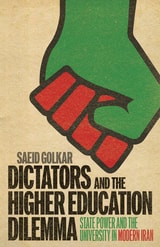
Dictators and the Higher Education Dilemma
State Power and the University in Modern IranSaeid Golkar
Rutgers University Press, 0
Dictators and the Higher Education Dilemma explores a powerful contradiction at the heart of modern authoritarian regimes: While universities are essential for producing skilled labor and projecting national progress, they also cultivate critical thinkers who can challenge state power. Drawing on Iran’s modern history, from the Pahlavi monarchy to the Islamic Republic, Saeid Golkar shows how dictators use universities not only to train technocrats and showcase development but also as tools for shaping ideology, suppressing dissent, and co-opting academics. In authoritarian systems, education becomes a double-edged sword, essential for growth yet dangerous when it empowers independent thought. Golkar reveals how regimes manipulate admissions, censor curricula, and reward loyalty to create compliant intellectuals and loyal elites. Blending personal experience with rich historical and political analysis, this book exposes the tactics used to turn universities into instruments of social control. It speaks to a growing trend worldwide, offering vital insights into the clash between authoritarian power and academic freedom from Iran to China, Russia, and beyond.

Directory of World Cinema
IranEdited by Parviz Jahed
Intellect Books, 2012
Iranian cinema has an extraordinary history that has been marked by religion and ever-shifting political, economic, and social environments. This addition to Intellect’s Directory of World Cinema series turns the spotlight on the award-winning cinema of that nation, with particular attention to the major movements, historical turning points, and prominent figures that have helped shape it. A wide range of genres are presented, including comedy, Film Farsi, new wave, children’s films, art house film, and women’s cinema. For the film studies scholar, students working on alternative or national cinema, or for all those who love Persian cinema and wish to learn more, Directory of World Cinema: Iran will be an essential companion to this prolific and prominent film industry.
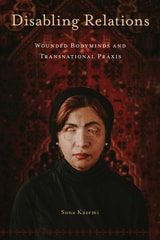
Disabling Relations
Wounded Bodyminds and Transnational PraxisSona Kazemi
Temple University Press, 2026
Kazemi focuses on the disabled dissidents who were incarcerated and tortured by the Islamic regime in the aftermath of the 1979 revolution in Iran, the disabled veterans and civilians wounded during and after the Iran–Iraq War, the disabled survivors of state-sanctioned punitive limb amputation, and the disabled women survivors of acid attacks as a form of gender-based violence. Disabling Relations explains how disabled bodyminds are produced and sustained through the violence of patriarchal, capitalist-imperialist, nationalist, and theocratic social relations. Kazemi uses the theoretical concept of “wounding” as a historical process of becoming and remaining disabled mediated by unequal power relations and “disability consciousness” to show how these survivors come to terms with their disability.
Thinking about critical disability theory in a new way, Kazemi investigates how disability is produced transnationally and the impact that this new theorization can make globally.
In the series Dis/color
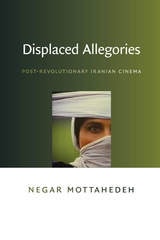
Displaced Allegories
Post-Revolutionary Iranian CinemaNegar Mottahedeh
Duke University Press, 2008
Mottahedeh asserts that, in response to the prohibitions against the desiring look, a new narrative cinema emerged as the displaced allegory of the constraints on the post-Revolutionary Iranian film industry. Allegorical commentary was not developed in the explicit content of cinematic narratives but through formal innovations. Offering close readings of the work of the nationally popular and internationally renowned Iranian auteurs Bahram Bayza’i, Abbas Kiarostami, and Mohsen Makhmalbaf, Mottahedeh illuminates the formal codes and conventions of post-Revolutionary Iranian films. She insists that such analyses of cinema’s visual codes and conventions are crucial to the study of international film. As Mottahedeh points out, the discipline of film studies has traditionally seen film as a medium that communicates globally because of its dependence on a (Hollywood) visual language assumed to be universal and legible across national boundaries. Displaced Allegories demonstrates that visual language is not necessarily universal; it is sometimes deeply informed by national culture and politics.
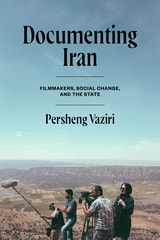
Documenting Iran
Filmmakers and Social ChangePersheng Vaziri
University of Texas Press, 2026
An ethnographic study of how Iranian documentary filmmakers navigate censorship and creativity to shape civic discourse.
Iranian filmmakers have overcome significant obstacles to create a distinctive, globally renowned cinema. Filmmaker and educator Persheng Vaziri explores how documentarians, in particular, have developed a dynamic and creative environment by negotiating limited resources and official constraints. Through their films, they share hard truths—and artful narratives—with fellow Iranians and viewers the world over.
Documenting Iran introduces key historical foundations of documentary filmmaking amid generations of political change—first under the shah and later the Islamic government—with a focus on contemporary filmmakers between 2000 and 2022. Drawing on interviews and ethnographic encounters, Vaziri describes the creative practices and pragmatic choices that provide documentarians relative independence from state censorship and other restrictions on artistic production. Relying on poetic aesthetics, observational filmmaking, international connections, and the accumulated knowledge of a tight-knit local community, filmmakers engage with controversial topics like women’s rights, marriage and divorce laws, environmental degradation, and encounters with Western culture. Documentarians have thus created an activist cinema both subtle and persuasive enough to challenge dogmatic rule and uphold progressive elements of Iranian society.