Results by title
82 books match the query 'Japanese Americans' and 4 start with d
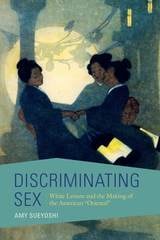
Discriminating Sex
White Leisure and the Making of the American "Oriental"Amy Sueyoshi
University of Illinois Press, 2018
Amy Sueyoshi draws on everything from newspapers to felony case files to oral histories in order to examine how whites' pursuit of gender and sexual fulfillment gave rise to racial caricatures. As she reveals, white reporters, writers, artists, and others conflated Chinese and Japanese, previously seen as two races, into one. There emerged the Oriental—a single pan-Asian American stereotype weighted with sexual and gender meaning. Sueyoshi bridges feminist, queer, and ethnic studies to show how the white quest to forge new frontiers in gender and sexual freedom reinforced—and spawned—racial inequality through the ever evolving Oriental.
Informed and fascinating, Discriminating Sex reconsiders the origins and expression of racial stereotyping in an American city.
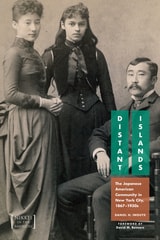
Distant Islands
The Japanese American Community in New York City, 1876-1930sDaniel H. Inouye
University Press of Colorado, 2018
The New York Japanese American community was a composite of several micro communities divided along status, class, geographic, and religious lines. Using a wealth of primary sources—oral histories, memoirs, newspapers, government documents, photographs, and more—Daniel H. Inouye tells the stories of the business and professional elites, mid-sized merchants, small business owners, working-class families, menial laborers, and students that made up these communities. The book presents new knowledge about the history of Japanese immigrants in the United States and makes a novel and persuasive argument about the primacy of class and status stratification and relatively weak ethnic cohesion and solidarity in New York City, compared to the pervading understanding of nikkei on the West Coast. While a few prior studies have identified social stratification in other nikkei communities, this book presents the first full exploration of the subject and additionally draws parallels to divisions in German American communities.
Distant Islands is a unique and nuanced historical account of an American ethnic community that reveals the common humanity of pioneering Japanese New Yorkers despite diverse socioeconomic backgrounds and life stories. It will be of interest to general readers, students, and scholars interested in Asian American studies, immigration and ethnic studies, sociology, and history.
Winner- Honorable Mention, 2018 Immigration and Ethnic History Society First Book Award
Doing Fieldwork
Warnings and AdviceRosalie Wax
University of Chicago Press, 1971
Double Cross
Japanese Americans In Black And White ChicagoJacalyn D. Harden
University of Minnesota Press, 2003
Examines relations between peoples of color to offer a compelling new approach to understanding race in America
Since the Great Migration of the early twentieth century, Chicago has been a cauldron of race relations, symbolizing the tenacity of discrimination and segregation. But as in other cities with significant populations of Latinos and Asians, Arabs and Jews, this image belies complex racial dynamics. In Double Cross, Jacalyn D. Harden provides an essential rethinking of the ways we understand and talk about race, using an examination of the Japanese American community of Chicago’s Far North Side to form an innovative new framework for looking at race, identity, and political change.
The Japanese American community in Chicago rapidly expanded between 1940 and 1950 in the aftermath of wartime internment and government relocation programs. Harden tells their story through archival research and interviews with some of the first Japanese Americans who were relocated to Chicago in the 1940s, incorporating her own experiences as an African American scholar who has lived in Japan. The result is a compelling and surprising account of racial interactions, one that clarifies the complex interweaving between black and Asian lives and reclaims a lost history of solidarity between the two groups.Moving from the Great Migration to the “great relocation” to gentrification, Harden explores the shared history of civil rights struggles that firmly links Japanese and African Americans, most importantly the issue of reparations (for internment during World War II and slavery, respectively). She describes the efforts of Japanese Americans to “double-cross the color line” by building coalitions across race, age, and class boundaries, and their vexed position as sometimes “colored,” sometimes white (for example, the Japanese American soldier who was instructed to use the white washrooms at boot camp in Alabama during World War II, while thousands were being relocated to internment camps).Double Cross is a major contribution to our thought about race relations, challenging orthodoxy and shedding new light on the complex identities, conflicting interests, and external forces that have defined the concept of race in the United States.