Results by title
92 books match the query 'Judges' and 3 start with d

David Davis, Abraham Lincoln's Favorite Judge
Raymond J. McKoski
University of Illinois Press, 2025
One of Abraham Lincoln’s staunchest and most effective allies, Judge David Davis masterminded the floor fight that gave Lincoln the presidential nomination at the 1860 Republican National Convention. This history-changing event emerged from a long friendship between the two men. It also altered the course of Davis’s career, as Lincoln named him to the U.S. Supreme Court in 1862.
Raymond J. McKoski offers a biography of Davis’s public life, his impact on the presidency and judiciary, and his personal, professional, and political relationships with Lincoln. Davis lent his vast network of connections, organizational and leadership abilities, and personal persuasiveness to help Lincoln’s political rise. When Davis became a judge, he honed an ability to hear each case with complete impartiality, a practice that endeared him to Lincoln but one day put him at odds with the president over important Civil War–era rulings. McKoski details these cases while providing an in-depth account of Davis’s role in Lincoln’s two unsuccessful campaigns for U.S. Senate and the fateful run for the presidency.
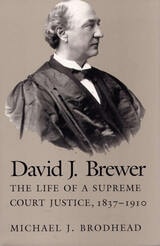
David J Brewer
The Life of a Supreme Court Justice, 1837-1910Michael J. Brodhead
Southern Illinois University Press, 1994
This is the first biography of David J. Brewer, an Associate Justice of the United States Supreme Court from 1889 to 1910.
Prior to rising to the nation’s highest tribunal, Brewer served as a county probate judge, a state district judge, a Kansas State Supreme Court justice, and a federal circuit court judge. He was known not only for his long tenure on the Supreme Court but also for his numerous off-the-bench statements as an orator and writer.
Many of Brewer’s judicial opinions and nonjudicial utterances created controversy, particularly when he confronted the reform issues of his day. The court, then presided over by Chief Justice Melville W. Fuller, has been seen as reactionary, determined to infuse the law with social Darwinism and laissez-faire ideology. Yet, contrary to this assessment of the Fuller Court as a whole, Brewer accepted most of his generation’s reform goals. He championed many forms of social legislation, the regulation of business, the rights of women and minorities, the support of charities, educational reform, and world peace.
Michael J. Brodhead contends that until recently historians have carelessly and inaccurately created a false image of Brewer, partly by citing a small sample of his opinions and public statements as representative of his alleged conservatism. They have also assumed that the disputable decisions of Brewer and his contemporaries were based on ideological predilections and that precedent and recognized legal principles played no role.
During his term, Brewer was the author of such notable court opinions as In re Debs, Muller v. Oregon, and Kansas v. Colorado. He supported property rights, admired honest entrepreneurial activity, and opposed the concentration of power in any form. Brewer favored the individual in all instances, whether that individual was the initiator of a great economic enterprise or a farmer struggling to extend agriculture into the western plains.

Death and Dissymmetry
The Politics of Coherence in the Book of JudgesMieke Bal
University of Chicago Press, 1988
Counter to standard readings of Judges, Bal's interpretation demonstrates that the book has a political and ideological coherence in which the treatment of women plays a pivotal role. Bal concentrates here not on the assassinations and battles that rage through Judges but on the violence in the domestic lives of individual characters, particularly sexual violence directed at women. Her skillful reading reveals that murder, in this text, relates to gender and reflects a social structure that is inherently contradictory. By foregrounding the stories of women and subjecting them to subtle narrative analysis, she is able to expose a set of preoccupations that are essential to the sense of these stories but are not articulated in them. Bal thereby develops a "countercoherence" in conflict with the apparent emphases of Judges—the politics, wars, and historiography that have been the constant focus of commentators on the book.
Death and Dissymmetry makes an important contribution to the development of a feminist method of interpreting ancient texts, with consequences for religious studies, ancient history, literary theory, and gender studies.