Results by title
50 books match the query 'Justice, Administration of' and 2 start with d

Dies Irae
Jean-Luc Nancy
University of Westminster Press, 2019
Edited by Angela Condello, Carlo Grassi and Andreas Philippopoulos-Mihalopoulos
With an introduction by Carlo Grassi
Translated by Cadenza Academic Translations and Angela Condello
What does it mean to judge when there is no general and universal norm to define what is right and what is wrong? Can laws be absent and is law always necessary?
This is the first English translation published of Jean- Luc Nancy’s acclaimed consideration of the law’s most pervasive principles in the context of actual systems and contemporary institutions, power, norms, laws. In a world where it is impossible to imagine the realisation of an ideal of justice that corresponds to every person’s ideal of justice, Nancy probes the limits of legal normativity. Moreover, the question is asked: how can legal normativity be legitimised? A legal order based on performativity and formal validity is questionable and other forces than juridical normativity are at the heart of Dies Irae. Such leads inevitably to the processes of inclusion and exclusion that characterise contemporary juridical systems and those issues of identity, hostility and self-representation central to contemporary political and legal debates
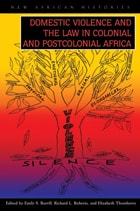
Domestic Violence and the Law in Colonial and Postcolonial Africa
Emily S. Burrill
Ohio University Press, 2010
Domestic Violence and the Law in Colonial and Postcolonial Africa reveals the ways in which domestic space and domestic relationships take on different meanings in African contexts that extend the boundaries of family obligation, kinship, and dependency. The term domestic violence encompasses kin-based violence, marriage-based violence, gender-based violence, as well as violence between patrons and clients who shared the same domestic space. As a lived experience and as a social and historical unit of analysis, domestic violence in colonial and postcolonial Africa is complex.
Using evidence drawn from Sub-saharan Africa, the chapters explore the range of domestic violence in Africa’s colonial past and its present, including taxation and the insertion of the household into the broader structure of colonial domination.
African histories of domestic violence demand that scholars and activists refine the terms and analyses and pay attention to the historical legacies of contemporary problems. This collection brings into conversation historical, anthropological, legal, and activist perspectives on domestic violence in Africa and fosters a deeper understanding of the problem of domestic violence, the limits of international human rights conventions, and local and regional efforts to address the issue.