936 books match the query 'LGBTQ+ Studies' and 35 start with d

cover of Dancing Ledge

Dancing Ledge

Derek Jarman

University of Minnesota Press, 2010
From his sexual awakening in postwar England to life in the sixties and beyond, Derek Jarman tells his life story with the in-your-face immediacy that became his trademark style in both his films and writing. Accompanied by nearly one hundred photographs of Jarman, his friends, lovers, and inspirations, the candid accounts in Dancing Ledge provide intimate and incredibly vivid glimpses into this iconoclastic filmmaker's life and times.
[more]
cover of Dancing Opacity: Contemporary Dance, Transnationalism, and Queer Possibility in Senegal

Dancing Opacity

Contemporary Dance, Transnationalism, and Queer Possibility in Senegal

Amy E. Swanson

University of Michigan Press, 2025
Amy Swanson’s Dancing Opacity chronicles the ways in which contemporary dancers in Senegal navigate the global contemporary dance circuit while challenging heteropatriarchal ideologies at home. A longstanding hub of African performing arts, Senegal was at the forefront of the explosion of contemporary dance across the continent at the turn of the twenty-first century. Drawing on ethnographic and historical research, Swanson demonstrates how Senegalese choreographers and dancers contend with entrenched racialized prejudices about Africa outside the continent, while pushing back against repressive regulations of gender and sexuality within Senegal. Swanson employs the concept of opacity, defined as a refusal to adhere to the colonial logic of transparency for dominant gazes and argues that artists create work with multiple layers of meaning that are not meant to be immediately transparent to all viewers. By doing so, these artists evade cultural norms that govern gender and sexual expression in Senegal, while challenging their international audiences to expand their perceptions of African dance. Dancing Opacity highlights the artists’ accounts of their pedagogies, performances, aesthetics, and lived realities, as well as Africanist conceptions of gender, sexuality, and queerness that have yet to be applied to contemporary dance.
[more]
cover of Dancing with the Modernist City: Metropolitan Dance Texts around 1900

Dancing with the Modernist City

Metropolitan Dance Texts around 1900

Wesley Lim

University of Michigan Press, 2024

As the 20th century dawned, authors, artists, and filmmakers flocked to cities like Paris and Berlin for a chance to experience a bustling urban life and engage with other artists and intellectuals. Among them were German-speaking authors and filmmakers such as Harry Graf Kessler, Rainer Maria Rilke, August Endell, Alfred Döblin, Else Lasker-Schüler, Segundo de Chomón, and the brothers Max and Emil Skladanowsky. In their writing and artistic work from that period, they depicted the perpetual influx of stimuli caused by urban life—including hordes of pedestrians, bustling traffic, and a barrage of advertisements—as well as how these encounters repeatedly paralleled their experiences of watching early twentieth-century dance performances by Loïe Fuller, Ruth St. Denis, and Vaslav Nijinsky. The convergence these writers and filmmakers saw between the unexpected encounters during their urban strolls and experimental dance performances led to writings that interwove the two motifs.

Drawing on cultural, literary, dance, performance, and queer studies, Dancing with the Modernist City analyzes an array of material from 1896 to 1914—essays, novels, short stories, poetry, newspaper articles, photographs, posters, drawings, and early film. It argues that these writers and artists created a genre called the metropolitan dance text, which depicts dancing figures not on a traditional stage, but with the streets, advertising pillars, theaters, cafes, squares, and even hospitals of an urban setting. Breaking away from the historically male, heteronormative view, this posthumanist mode of writing highlights the visual and episodic unexpectedness of urban encounters. These literary depictions question traditional conceptualizations of space and performance by making the protagonist and the reader feel like they embody the dancer and the movement. In doing so, they upset the conventional depictions of performance and urban spaces in ways paralleling modern dance.

[more]
cover of Dangerous Intimacies: Toward a Sapphic History of the British Novel

Dangerous Intimacies

Toward a Sapphic History of the British Novel

Lisa L. Moore

Duke University Press, 1997

Refuting commonly held beliefs within women’s and lesbian history, feminist theory, and histories of the novel, Dangerous Intimacies challenges the idea that sex between women was unimaginable in British culture before the late nineteenth century. Lisa L. Moore argues that literary representations of female sexual agency—and in particular "sapphic" relationships between women—were central to eighteenth-century debates over English national identity. Moore shows how the novel’s representation of women’s "romantic friendships"—both platonic and sexual—were encoded within wider social concerns regarding race, nation, and colonialist ventures.
Moore demonstrates that intimacy between women was vividly imagined in the British eighteenth century as not only chaste and virtuous, but also insistently and inevitably sexual. She looks at instances of sapphism in such novels as Millenium Hall, Memoirs of a Woman of Pleasure, Belinda, and Emma and analyzes how the new literary form of the novel made the bourgeois heroine’s successful negotiation of female friendship central to the establishment of her virtue. Moore also examines representations of sapphism through the sweeping economic and political changes of the period and claims that middle-class readers’ identifications with the heroine’s virtue helped the novel’s bourgeois audience justify the violent bases of their new prosperity, including slavery, colonialism, and bloody national rivalry.
In revealing the struggle over sapphism at the heart of these novels of female friendship—and at the heart of England’s national identity—Moore shows how feminine sexual agency emerged as an important cultural force in post-Enlightenment England

[more]
cover of Darger's Resources

Darger's Resources

Michael Moon

Duke University Press, 2012

Henry Darger (1892–1973) was a hospital janitor and an immensely productive artist and writer. In the first decades of adulthood, he wrote a 15,145-page fictional epic, In the Realms of the Unreal. He spent much of the rest of his long life illustrating it in astonishing drawings and watercolors. In Darger's unfolding saga, pastoral utopias are repeatedly savaged by extreme violence directed at children, particularly girls. Given his disturbing subject matter and the extreme solitude he maintained throughout his life, critics have characterized Darger as eccentric, deranged, and even dangerous, as an outsider artist compelled to create a fantasy universe. Contesting such pathologizing interpretations, Michael Moon looks to Darger's resources, to the narratives and materials that inspired him and often found their way into his writing, drawings, and paintings. Moon finds an artist who reveled in the burgeoning popular culture of the early twentieth century, in its newspaper comic strips, pulp fiction, illustrated children's books, and mass-produced religious art. Moon contends that Darger's work deserves and rewards comparison with that of contemporaries of his, such as the "pulp historians" H. P. Lovecraft and Robert Howard, the Oz chronicler L. Frank Baum, and the newspaper cartoonist Bud Fisher.
[more]
cover of Dayneford's Library: American Homosexual Writing, 1900-1913

Dayneford's Library

American Homosexual Writing, 1900-1913

James Gifford

University of Massachusetts Press, 1995

The modern homosexual is often seen as having emerged fully formed out of the Oscar Wilde trials. This work disputes such a view, presenting images of homosexuality in early 20th-century American literature and attempting to establish the meanings of homosexuality as then understood by homosexuals.
[more]
cover of Days of Twilight, Nights of Frenzy: A Memoir

Days of Twilight, Nights of Frenzy

A Memoir

Werner Schroeter and Claudia Lenssen

University of Chicago Press, 2017

Werner Schroeter was a leading figure of New German Cinema. In more than forty films made between 1967 and 2008, including features, documentaries, and shorts, he ignored conventional narrative, creating instead dense, evocative collages of image and sound. For years, his work was eclipsed by contemporaries such as Wim Wenders, Rainer Werner Fassbinder, Werner Herzog, and Alexander Kluge. Yet his work has become known to a wider audience through several recent retrospectives, including at the Museum of Modern Art, New York.

Written in the last years of his life, Days of Twilight, Nights of Frenzy sees Schroeter looking back at his life with the help of film critic and friend Claudia Lenssen. Born in 1945, Schroeter grew up near Heidelberg and spent just a few weeks in film school before leaving to create his earliest works. Over the years, he would work with acclaimed artists, including Marianne Hopps, Isabelle Huppert, Candy Darling, and Christine Kaufmann. In the 1970s, Schroeter also embarked on prolific parallel careers in theater and opera, where he worked in close collaboration with the legendary diva Maria Callas. His childhood; his travels in Italy, France, and Latin America; his coming out and subsequent life as an gay man in Europe; and his run-ins with Hollywood are but a few of the subjects Schroeter recalls with insights and characteristic understated humor.

A sharp, lively, even funny memoir, Days of Twilight, Nights of Frenzy captures Schroeter’s extravagant life vividly over a vast prolific career, including many stories that might have been lost were it not for this book. It is sure to fascinate cinephiles and anyone interested in the culture around film and the arts.
 
[more]
cover of Death beyond Disavowal: The Impossible Politics of Difference

Death beyond Disavowal

The Impossible Politics of Difference

Grace Kyungwon Hong

University of Minnesota Press, 2015

Death beyond Disavowal utilizes “difference” as theorized by women of color feminists to analyze works of cultural production by people of color as expressing a powerful antidote to the erasures of contemporary neoliberalism.

According to Grace Kyungwon Hong, neoliberalism is first and foremost a structure of disavowal enacted as a reaction to the successes of the movements for decolonization, desegregation, and liberation of the post–World War II era. It emphasizes the selective and uneven affirmation and incorporation of subjects and ideas that were formerly categorically marginalized, particularly through invitation into reproductive respectability. It does so in order to suggest that racial, gendered, and sexualized violence and inequity are conditions of the past, rather than the foundations of contemporary neoliberalism’s exacerbation of premature death. Neoliberal ideologies hold out the promise of protection from premature death in exchange for complicity with this pretense.

In Audre Lorde’s Sister Outsider, Cherríe Moraga’s The Last Generation and Waiting in the Wings, Oscar Zeta Acosta’s The Revolt of the Cockroach People, Ana Castillo’s So Far from God, Gayl Jones’s Corregidora, Isaac Julien’s Looking for Langston, Inge Blackman’s B. D. Women, Rodney Evans’s Brother to Brother, and the work of the late Barbara Christian, Death beyond Disavowal finds the memories of death and precarity that neoliberal ideologies attempt to erase.

Hong posits cultural production as a compelling rejoinder to neoliberalism’s violences. She situates women of color feminism, often dismissed as narrow or limited in its effect, as a potent diagnosis of and alternative to such violences. And she argues for the importance of women of color feminism to any critical engagement with contemporary neoliberalism.

[more]
cover of Decolonizing the Sodomite: Queer Tropes of Sexuality in Colonial Andean Culture

Decolonizing the Sodomite

Queer Tropes of Sexuality in Colonial Andean Culture

By Michael J. Horswell

University of Texas Press, 2006

Early Andean historiography reveals a subaltern history of indigenous gender and sexuality that saw masculinity and femininity not as essential absolutes. Third-gender ritualists, Ipas, mediated between the masculine and feminine spheres of culture in important ceremonies and were recorded in fragments of myths and transcribed oral accounts. Ritual performance by cross-dressed men symbolically created a third space of mediation that invoked the mythic androgyne of the pre-Hispanic Andes. The missionaries and civil authorities colonizing the Andes deemed these performances transgressive and sodomitical.

In this book, Michael J. Horswell examines alternative gender and sexuality in the colonial Andean world, and uses the concept of the third gender to reconsider some fundamental paradigms of Andean culture. By deconstructing what literary tropes of sexuality reveal about Andean pre-Hispanic and colonial indigenous culture, he provides an alternative history and interpretation of the much-maligned aboriginal subjects the Spanish often referred to as "sodomites." Horswell traces the origin of the dominant tropes of masculinist sexuality from canonical medieval texts to early modern Spanish secular and moralist literature produced in the context of material persecution of effeminates and sodomites in Spain. These values traveled to the Andes and were used as powerful rhetorical weapons in the struggle to justify the conquest of the Incas.

[more]
cover of Deep Are the Roots: Memoirs of a Black Expatriate

Deep Are the Roots

Memoirs of a Black Expatriate

Gordon Heath

University of Massachusetts Press, 1992
In these pages we meet a man, meet him as a child, an actor in training, an actor in performance. We meet a black man born in the United States in 1918 who fashioned a life for himself that kept him mostly abroad, mostly in Paris. Gordon Heath can be counted among such distinguished black expatriates as Ira Aldridge, Paul Robeson, Richard Wright, and James Baldwin. Their names have been written larger than his in the record books, but with the publication of his memoirs Gordon Heath moves from footnote status to deserved inclusion in the text itself.
[more]
cover of Deep Gossip

Deep Gossip

Henry Abelove

University of Minnesota Press, 2005
Henry Abelove, literary critic, astute historian, and pioneer in queer studies, offers interdisciplinary views on the connections between politics, culture, and sexuality. Deep Gossip addresses the willful misreading of Freud's views on homosexuality among American psychoanalysts; reconsiders sexual practice during England's eighteenth century; assesses the contemporary relevance of Thoreau's Walden, particularly to queer politics; and traces the emergence of a queer critique of previous approaches to lesbian and gay history. Abelove uncovers the origins of American studies as a scholarly discipline and evaluates the impact of literature - specifically the same-sex eroticism found in works by such writers as James Baldwin, Elizabeth Bishop, Paul Bowles, and Ned Rorem - on the gay liberation movement of the 1970s. The essays gathered in Deep Gossip confirm Henry Abelove's reputation as one of America's leading thinkers on the cultural politics of sexuality.
[more]
cover of Defiant Bodies: Making Queer Community in the Anglophone Caribbean

Defiant Bodies

Making Queer Community in the Anglophone Caribbean

Nikoli A. Attai

Rutgers University Press, 2023

In the Anglophone Caribbean, international queer human rights activists strategically located within and outside of the region have dominated interventions seeking to address issues affecting people across the region; a trend that is premised on an idea that the Caribbean is extremely homophobic and transphobic, resulting in violence and death for people who defy dominant sexual and gender boundaries. Human rights activists continue to utilize international financial and political resources to influence these interventions and the region’s engagement on issues of homophobia, transphobia, discrimination, and the HIV/AIDS epidemic. This focus, however, elides the deeply complex nature of queerness across different spaces and places, and fails to fully account for the nuances of queer sexual and gender politics and community making across the Caribbean. Defiant Bodies: Making Queer Community in the Anglophone Caribbean problematizes the neocolonial and homoimperial nature of queer human rights activism in in four Anglophone Caribbean nations -- Barbados, Guyana, Jamaica, and Trinidad and Tobago -- and thinks critically about the limits of human rights as a tool for seeking queer liberation. It also offers critical insight into the ways that queer people negotiate, resist, and disrupt homophobia, transphobia, and discrimination by mobilizing “on the ground” and creating transgressive communities within the region.
 
[more]
cover of Departing from Deviance: A History of Homosexual Rights and Emancipatory Science in America

Departing from Deviance

A History of Homosexual Rights and Emancipatory Science in America

Henry L. Minton

University of Chicago Press, 2001

The struggle to remove the stigma of sickness surrounding same-sex love has a long history. In 1973, the American Psychiatric Association removed homosexuality from its diagnostic classification of mental illness, but the groundwork for this pivotal decision was laid decades earlier. In this new study, Henry L. Minton looks back at the struggle of the American gay and lesbian activists who chose scientific research as a path for advancing homosexual rights. He traces the history of gay and lesbian emancipatory research from its early beginnings in the late nineteenth century to its role in challenging the illness model in the 1970s. By examining archival sources and unpublished manuscripts, Minton reveals the substantial accomplishments made by key researchers and relates their life stories. He also considers the contributions of mainstream sexologists such as Alfred C. Kinsey and Evelyn Hooker, who supported the cause of homosexual rights through the advancement of scientific knowledge. By uncovering this hidden chapter in the story of gay liberation, Departing from Deviance makes an important contribution to both the history of science and the history of sexuality.
[more]
cover of Depression: A Public Feeling

Depression

A Public Feeling

Ann Cvetkovich

Duke University Press, 2012

In Depression: A Public Feeling, Ann Cvetkovich combines memoir and critical essay in search of ways of writing about depression as a cultural and political phenomenon that offer alternatives to medical models. She describes her own experience of the professional pressures, creative anxiety, and political hopelessness that led to intellectual blockage while she was finishing her dissertation and writing her first book. Building on the insights of the memoir, in the critical essay she considers the idea that feeling bad constitutes the lived experience of neoliberal capitalism.

Cvetkovich draws on an unusual archive, including accounts of early Christian acedia and spiritual despair, texts connecting the histories of slavery and colonialism with their violent present-day legacies, and utopian spaces created from lesbian feminist practices of crafting. She herself seeks to craft a queer cultural analysis that accounts for depression as a historical category, a felt experience, and a point of entry into discussions about theory, contemporary culture, and everyday life. Depression: A Public Feeling suggests that utopian visions can reside in daily habits and practices, such as writing and yoga, and it highlights the centrality of somatic and felt experience to political activism and social transformation.

[more]
cover of Desire Work: Ex-Gay and Pentecostal Masculinity in South Africa

Desire Work

Ex-Gay and Pentecostal Masculinity in South Africa

Melissa Hackman

Duke University Press, 2018

In postapartheid Cape Town—Africa's gay capital—many Pentecostal men turned to "ex-gay" ministries in hopes of “curing” their homosexuality in order to conform to conservative Christian values and African social norms. In Desire Work Melissa Hackman traces the experiences of predominantly white ex-gay men as they attempt to forge a heterosexual masculinity and enter into heterosexual marriage through emotional, bodily, and religious work. These men subjected themselves to daily self-surveillance and followed prescribed behaviors such as changing how they talked and walked. Ex-gay men also saw themselves as participating in the redemption of the nation, because South African society was perceived as suffering from a crisis of masculinity in which the country lacked enough moral heterosexual men. By tying the experience of ex-gay men to the convergence of social movements and public debates surrounding race, violence, religion, and masculinity in South Africa, Hackman offers insights into the construction of personal identities in the context of sexuality and spirituality.
[more]
cover of Desiring Arabs

Desiring Arabs

Joseph A. Massad

University of Chicago Press, 2007
Sexual desire has long played a key role in Western judgments about the value of Arab civilization. In the past, Westerners viewed the Arab world as licentious, and Western intolerance of sex led them to brand Arabs as decadent; but as Western society became more sexually open, the supposedly prudish Arabs soon became viewed as backward. Rather than focusing exclusively on how these views developed in the West, in Desiring Arabs Joseph A. Massad reveals the history of how Arabs represented their own sexual desires. To this aim, he assembles a massive and diverse compendium of Arabic writing from the nineteenth century to the present in order to chart the changes in Arab sexual attitudes and their links to Arab notions of cultural heritage and civilization.
           
A work of impressive scope and erudition, Massad’s chronicle of both the history and modern permutations of the debate over representations of sexual desires and practices in the Arab world is a crucial addition to our understanding of a frequently oversimplified and vilified culture.
 
“A pioneering work on a very timely yet frustratingly neglected topic. . . . I know of no other study that can even begin to compare with the detail and scope of [this] work.”—Khaled El-Rouayheb, Middle East Report
 
“In Desiring Arabs, [Edward] Said’s disciple Joseph A. Massad corroborates his mentor’s thesis that orientalist writing was racist and dehumanizing. . . . [Massad] brilliantly goes on to trace the legacy of this racist, internalized, orientalist discourse up to the present.”—Financial Times
[more]
cover of Desiring Disability: Queer Theory Meets Disability Studies, Volume 9

Desiring Disability

Queer Theory Meets Disability Studies, Volume 9

Robert McRuer and Abby L. Wilkerson, eds.

Duke University Press, 0

In multiple locations, activists and scholars are mapping the intersections of queer theory and disability studies, moving issues of embodiment and desire to the center of cultural and political analyses. The two fields are premised on the idea that the categories of heterosexual/homosexual and able-bodied/disabled are historically and socially constructed. Desiring Disability: Queer Theory Meets Disability Studies explores how the frameworks for queer theory and disability studies suggest new possibilities for one another, for other identity-based frameworks of activism and scholarship, and for cultural studies in general.

Topics include the study of "crip theory" and queer/disabled performance artists; the historical emergence of normalcy and parallel notions of military fitness that require both the production and the containment of queerness and disability; and butch identity, transgressive sexual practices, and rheumatoid arthritis.

Contributors. Sarah E. Chinn, Eli Clare, Naomi Finkelstein, Catherine Lord, Cris Mayo, Robert McRuer, Todd Ramlow, Jo Rendell, Ellen Samuels, Carrie Sandahl, David Serlin, Patrick White

[more]
cover of Deviations: A Gayle Rubin Reader

Deviations

A Gayle Rubin Reader

Gayle S. Rubin

Duke University Press, 2012

Deviations is the definitive collection of writing by Gayle S. Rubin, a pioneering theorist and activist in feminist, lesbian and gay, queer, and sexuality studies since the 1970s. Rubin first rose to prominence in 1975 with the publication of “The Traffic in Women,” an essay that had a galvanizing effect on feminist thinking and theory. In another landmark piece, “Thinking Sex,” she examined how certain sexual behaviors are constructed as moral or natural, and others as unnatural. That essay became one of queer theory’s foundational texts. Along with such canonical work, Deviations features less well-known but equally insightful writing on subjects such as lesbian history, the feminist sex wars, the politics of sadomasochism, crusades against prostitution and pornography, and the historical development of sexual knowledge. In the introduction, Rubin traces her intellectual trajectory and discusses the development and reception of some of her most influential essays. Like the book it opens, the introduction highlights the major lines of inquiry pursued for nearly forty years by a singularly important theorist of sex, gender, and culture.
[more]
cover of Diasporic Intimacies: Queer Filipinos and Canadian Imaginaries

Diasporic Intimacies

Queer Filipinos and Canadian Imaginaries

Edited by Robert Diaz, Marissa Largo, and Fritz Pino

Northwestern University Press, 2018

Diasporic Intimacies: Queer Filipinos and Canadian Imaginaries is the first edited volume of its kind, featuring the works of leading scholars, artists, and activists who reflect on the contributions of queer Filipinos to Canadian culture and society.

Addressing a wide range of issues beyond the academy, the authors present a rich and under-studied archive of personal reflections, in-depth interviews, creative works, and scholarly essays. Their trandsdisciplinary approach highlights the need for queer, transgressive, and utopian practices that render visible histories of migration, empire building, settler colonialism, and globalization.

Timely, urgent, and fascinating, Diasporic Intimacies offers an accessible entry point for readers who seek to pursue critically engaged community work, arts education, curatorial practice, and socially inflected research on sexuality, gender, and race in this ever-changing world.
[more]
cover of Digital Me: Trans Students Exploring Future Possible Selves Online

Digital Me

Trans Students Exploring Future Possible Selves Online

Z Nicolazzo

Rutgers University Press, 2023
The internet is where trans people have come to become. Creating an identity in digital space can be important for how trans people learn about themselves, their communities, and the possibilities available to them. While the internet and digital space is not the only way of coming to understand oneself in a community, it is a space of liberatory possibility and creativity. There is room to invent what may not yet exist for gender on the edges of what many consider to be “real.” For many, digital life can be the site of play, joy, and connection –even while the internet is not a harm-free space nor universally available. This book seeks to understand the complexities at play in the digital realm and the implications that have for gender, digital life, and higher education.
[more]
cover of Disciplining Gender: Rhetorics of Sex Identity in Contemporary U.S. Culture

Disciplining Gender

Rhetorics of Sex Identity in Contemporary U.S. Culture

John M. Sloop

University of Massachusetts Press, 2004

An expert on the rhetoric of the mass media, John M. Sloop has written several books on how the spoken and written word can influence political and cultural debate. In Disciplining Gender, he turns his attention to a topic that has attracted widespread public discussion—the treatment of gender ambiguity in American culture. He offers critical readings of five cases, showing the extent to which, in each instance, public discourse and media representations have served to reinforce dominant norms and constrain or “discipline” any behavior that blurs or subverts conventional gender boundaries. 

The five cases include John/Joan or David Reimer, Brandon Teena, k.d. lang, Janet Reno, and Barry Winchell/Calpernia Addams. Sloop draws on queer theory and research in the field of critical rhetoric to examine representations of “gender trouble” in these much-publicized stories. In each case, he provides a comprehensive analysis of the public discussions of their significance. In short, rather than simply study the people and circumstances involved in each case, he examines the public meanings attached to them and the implications of those meanings for how contemporary culture comes to understand what “man” and “woman” mean and which sexual behaviors are appropriate and inappropriate. 

In highlighting the ideological constraints imposed by our society, Sloop also suggests the ways that these constraints might be loosened and understandings of gender and sexuality diversified.

[more]
cover of Disorienting Phenomenology: Queer Space and Trans Life

Disorienting Phenomenology

Queer Space and Trans Life

Eden Kinkaid

University of Minnesota Press, 2026

Rethinking space from the ground up through trans theory, philosophy, and radical possibility

Disorienting Phenomenology takes as its point of departure the trans mundane: entering a public restroom, moving through airport security, navigating professional spaces. These ordinary yet unsettling encounters become portals into urgent philosophical questions about space, embodiment, perception, power, and violence. Attending closely to how trans people experience everyday life, Eden Kinkaid shows that space is never neutral. It is felt, negotiated, and contested at the level of the body, shaping one’s capacities, safety, and sense of self.

Weaving together philosophy, queer and trans studies, geography, and personal narrative, Kinkaid develops an intersectional theory of space grounded in lived experience. They bring the foundational spatial theories of Henri Lefebvre together with critical phenomenologies of gender, race, and disability to demonstrate how systems of oppression are built into the environments we inhabit, configuring movement and constraining possibility for minoritized people. Bold and interdisciplinary, Disorienting Phenomenology offers vital conceptual tools for understanding—and transforming—the worlds we move through each day.

Retail e-book files for this title are screen-reader friendly.
[more]
cover of Displacing Homophobia

Displacing Homophobia

Ronald R. Butters, John M. Clum, and Michael Moon, eds.

Duke University Press, 1989
The editors have gathered essays that not only make a major contribution to the effort to replace homophobic discourse, but also speak persuasively to all readers interested in literature or literary history, contemporary theory, and popular culture.
[more]
cover of Disruptive Situations: Fractal Orientalism and Queer Strategies in Beirut

Disruptive Situations

Fractal Orientalism and Queer Strategies in Beirut

Ghassan Moussawi

Temple University Press, 2020

Disruptive Situations challenges representations of contemporary Beirut as an exceptional space for LGBTQ people by highlighting everyday life in a city where violence is the norm. Ghassan Moussawi, a Beirut native, seeks to uncover the underlying processes of what he calls “fractal orientalism,” a relational understanding of modernity and cosmopolitanism that illustrates how transnational discourses of national and sexual exceptionalism operate on multiple scales in the Arab world.

Moussawi’s intrepid ethnography features the voices of women, gay men and genderqueers in Beirut to examine how queer individuals negotiate life in this uncertain region. He examines “al-wad’,” or “the situation,” to understand the practices that form these strategies and to raise questions about queer-friendly spaces in and beyond Beirut. 

Disruptive Situations alsoshows how LGBTQ Beirutis resist reconciliation narratives and position their identities and visibility at different times as ways of simultaneously managing their multiple positionalities and al-wad’. Moussawi argues that the daily survival strategies in Beirut are queer—and not only enacted by LGBTQ people—since Beirutis are living amidst an already queer situation of ongoing precarity.
[more]
cover of Dissident Genders and Sexualities in the Andes: Truth, Justice, and Reparations

Dissident Genders and Sexualities in the Andes

Truth, Justice, and Reparations

Pascha Bueno-Hansen

Rutgers University Press, 2027

Dissident Genders and Sexualities in the Andes: Truth, Justice, and Reparations reveals how people of non-normative genders and sexualities fight for truth, justice, and reparations in the aftermath of armed conflict and authoritarian regimes in Peru, Ecuador and Colombia. A focus on body politics flips the transitional justice model that focuses on nation-states to investigate massive human rights violations. How and why are harms against people of non-normative genders and sexualities included or excluded in Peruvian, Ecuadorian and Colombian transitional justice efforts? What strategies do activists use in the ongoing struggle for the recognition of their humanity through truth, justice and reparations? To answer these questions, Dissident Genders and Sexualities in the Andes focuses on activists and their embodied knowledge.

[more]
cover of Disturbing Attachments: Genet, Modern Pederasty, and Queer History

Disturbing Attachments

Genet, Modern Pederasty, and Queer History

Kadji Amin

Duke University Press, 2017

Jean Genet (1910–1986) resonates, perhaps more than any other canonical queer figure from the pre-Stonewall past, with contemporary queer sensibilities attuned to a defiant non-normativity. Not only sexually queer, Genet was also a criminal and a social pariah, a bitter opponent of the police state, and an ally of revolutionary anticolonial movements. In Disturbing Attachments, Kadji Amin challenges the idealization of Genet as a paradigmatic figure within queer studies to illuminate the methodological dilemmas at the heart of queer theory. Pederasty, which was central to Genet's sexuality and to his passionate cross-racial and transnational political activism late in life, is among a series of problematic and outmoded queer attachments that Amin uses to deidealize and historicize queer theory. He brings the genealogy of Genet's imaginaries of attachment to bear on pressing issues within contemporary queer politics and scholarship, including prison abolition, homonationalism, and pinkwashing. Disturbing Attachments productively and provocatively unsettles queer studies by excavating the history of its affective tendencies to reveal and ultimately expand the contexts that inform the use and connotations of the term queer.
[more]
cover of Disturbing Practices: History, Sexuality, and Women's Experience of Modern War

Disturbing Practices

History, Sexuality, and Women's Experience of Modern War

Laura Doan

University of Chicago Press, 2013

For decades, the history of sexuality has been a multidisciplinary project serving competing agendas. Lesbian, gay, and queer scholars have produced powerful narratives by tracing the homosexual or queer subject as continuous or discontinuous. Yet organizing historical work around categories of identity as normal or abnormal often obscures how sexual matters were known or talked about in the past. Set against the backdrop of women’s work experiences, friendships, and communities during World War I, Disturbing Practices draws on a substantial body of new archival material to expose the roadblocks still present in current practices and imagine new alternatives.

In this landmark book, Laura Doan clarifies the ethical value and political purpose of identity history—and indeed its very capacity to give rise to innovative practices borne of sustained exchange between queer studies and critical history. Disturbing Practices insists on taking seriously the imperative to step outside the logic of identity to address questions as yet unasked about the modern sexual past.

[more]
cover of Documenting Intimate Matters: Primary Sources for a History of Sexuality in America

Documenting Intimate Matters

Primary Sources for a History of Sexuality in America

Edited by Thomas A. Foster

University of Chicago Press, 2012

Over time, sexuality in America has changed dramatically. Frequently redefined and often subject to different systems of regulation, it has been used as a means of control; it has been a way to understand ourselves and others; and it has been at the center of fierce political storms, including some of the most crucial changes in civil rights in the last decade. Edited by Thomas A. Foster, Documenting Intimate Matters features seventy-two documents that collectively highlight the broad diversity inherent in the history of American sexuality.
 
Complementing the third edition of Intimate Matters, by John D’Emilio and Estelle B. Freedman—often hailed as the definitive survey of sexual history in America—the multiple narratives presented by these documents reveal the complexity of this subject in US history. The historical moments captured in this volume will show that, contrary to popular misconception, the history of sexuality is not a simple story of increased freedoms and sexual liberation, but an ongoing struggle between change and continuity.

[more]
cover of Don't: A Reader's Guide to the Military's Anti-Gay Policy

Don't

A Reader's Guide to the Military's Anti-Gay Policy

Janet E. Halley

Duke University Press, 1999

In Don’t Janet E. Halley explains how the military's new anti-gay policy is fundamentally misdescribed by its common nickname, “Don't Ask/Don't Tell.” This ubiquitous phrase, she points out, implies that it discharges servicemembers not for who they are, but for what they do. It insinuates that, as long as military personnel keep quiet about their homosexual orientation and desist from “homosexual conduct,” no one will try to pry them out of their closets and all will be well.
Not so, reveals Halley. In order to work through the steps by which the new law was ultimately drafted, she opens with a close reading of the 1986 Supreme Court sodomy case which served as the legal and rhetorical model for the policy revisions made in 1993. Halley also describes how the Clinton administration’s attempts to offer Congress an opportunity to regulate conduct—and not status—were flatly rejected and not included in the final statute. Using cultural and critical theory seldom applied to explain the law, Halley argues that, far from providing privacy and an assurance that servicemembers' careers will be ruined only if they engage in illegal conduct, the rule activates a culture of minute surveillance in which every member must strictly avoid using any gesture in an ever-evolving lexicon of “conduct that manifests a propensity.” In other words, not only homosexuals but all military personnel are placed in danger by the new policy. After challenging previous pro-gay arguments against the policy that have failed to expose its most devious and dangerous elements, Halley ends with a persuasive discussion about how it is both unconstitutional and, politically, an act of sustained bad faith.
This knowledgeable and eye-opening analysis of one of the most important public policy debates of the 1990s will interest legal scholars, policymakers, activists, military historians and personnel, as well as citizens concerned about issues of discrimination.

[more]
cover of Dos X: Disability and Racial Dysphoria in Latinx and Filipinx Culture

Dos X

Disability and Racial Dysphoria in Latinx and Filipinx Culture

Sony Coráñez Bolton

University of Texas Press, 2025

An examination of the interconnectedness of brown-racialized people across multiple identities, told through case studies of television, literature, and writing.

As a Filipinx immigrant to the United States, Sony Coráñez Bolton has frequently been mistaken as Mexican. Dos X theorizes such misrecognition. What does it mean to exist in this liminal state, which Coráñez Bolton dubs the “racial uncanny”? What generative possibilities emerge from the presumed interchangeability of Latinx and Filipinx bodies—and from the in-betweenness of brownness as such?

Dos X tracks misrecognition through cultural products like the TV series Undone, Brian Ascalon Roley’s American Son, and the nonfiction work of Jose Antonio Vargas. Misrecognition, Coráñez Bolton argues, produces moments of uncanniness in which subjects experience dysphoric attachments to identities that aren’t supposed to be theirs. In the context of racial capitalism, racial dysphoria is a disability because it undermines certainty about what one’s body is and therefore what role one is meant to play as a laborer. But racial dysphoria can also be revealing. Coráñez Bolton identifies vast potential in this supposed disability, which compels its “sufferers” to confront their shared position within the social, political, and economic organization of capital’s empire, opening new avenues for liberatory solidarity.
[more]
cover of Drag Queens and Beauty Queens: Contesting Femininity in the World's Playground

Drag Queens and Beauty Queens

Contesting Femininity in the World's Playground

Laurie Greene

Rutgers University Press, 2021

The Miss America pageant has been held in Atlantic City for the past hundred years, helping to promote the city as a tourist destination. But just a few streets away, the city hosts a smaller event that, in its own way, is equally vital to the local community: the Miss’d America drag pageant.
 
Drag Queens and Beauty Queens presents a vivid ethnography of the Miss’d America pageant and the gay neighborhood from which it emerged in the early 1990s as a moment of campy celebration in the midst of the AIDS crisis. It examines how the pageant strengthened community bonds and activism, as well as how it has changed now that Rupaul’s Drag Race has brought many of its practices into the cultural mainstream. Comparing the Miss’d America pageant with its glitzy cisgender big sister, anthropologist Laurie Greene discovers how the two pageants have influenced each other in unexpected ways. 
 
Drag Queens and Beauty Queens deepens our understanding of how femininity is performed at pageants, exploring the various ways that both the Miss’d America and Miss America pageants have negotiated between embracing and critiquing traditional gender roles. Ultimately, it celebrates the rich tradition of drag performance and the community it engenders.

[more]
cover of Drag Queens at the 801 Cabaret

Drag Queens at the 801 Cabaret

Leila J. Rupp and Verta Taylor

University of Chicago Press, 2003

It's Saturday night in Key West and the Girlie Show is about to begin at the 801 Cabaret. The girls have been outside on the sidewalk all evening, seducing passersby into coming in for the show. The club itself is packed tonight and smoke has filled the room. When the lights finally go down, statuesque blonds and stunning brunettes sporting black leather miniskirts, stiletto heels, and see-through lingerie take the stage. En Vogue's "Free Your Mind" blares on the house stereo. The crowd roars in approval.

In this lively book, Leila J. Rupp and Verta Taylor take us on an entertaining tour through one of America's most overlooked subcultures: the world of the drag queen. They offer a penetrating glimpse into the lives of the 801 Girls, the troupe of queens who perform nightly at the 801 Cabaret for tourists and locals. Weaving together their fascinating life stories, their lavish costumes and eclectic music, their flamboyance and bitchiness, and their bawdy exchanges with one another and their audiences, the authors explore how drag queens smash the boundaries between gay and straight, man and woman, to make people think more deeply and realistically about sex and gender in America today. They also consider how the queens create a space that encourages camaraderie and acceptance among everyday people, no matter what their sexual preferences might be.

Based on countless interviews with more than a dozen drag queens, more than three years of attendance at their outrageous performances, and even the authors' participation in the shows themselves, Drag Queens at the 801 Cabaret is a witty and poignant portrait of gay life and culture. When they said life is a cabaret, they clearly meant the 801.
[more]
cover of Dragging Away: Queer Abstraction in Contemporary Art

Dragging Away

Queer Abstraction in Contemporary Art

Lex Morgan Lancaster

Duke University Press, 2022

In Dragging Away Lex Morgan Lancaster traces the formal and material innovations of contemporary queer and feminist artists, showing how they use abstraction as a queering tactic for social and political ends. Through a process Lancaster theorizes as a drag—dragging past aesthetics into the present and reworking them while pulling their work away from direct representation—these artists reimagine midcentury forms of abstraction and expose the violence of the tendency to reduce abstract form to a bodily sign or biographical symbolism. Lancaster outlines how the geometric enamel objects, grid paintings, vibrant color, and expansive installations of artists ranging from Ulrike Müller, Nancy Brooks Brody, and Lorna Simpson to Linda Besemer, Sheila Pepe, and Shinique Smith offer direct challenges to representational and categorical legibility. In so doing, Lancaster demonstrates that abstraction is not apolitical, neutral, or universal; it is a form of social praxis that actively contributes to queer, feminist, critical race, trans, and crip politics.
[more]
cover of Dreadful Desires: The Uses of Love in Neoliberal China

Dreadful Desires

The Uses of Love in Neoliberal China

Charlie Yi Zhang

Duke University Press, 2022
In Dreadful Desires Charlie Yi Zhang examines how the Chinese state deploys affective notions of love to regulate the population and secure China’s place in the global economy. Zhang shows how the state frames love as a set of desires that encompass heteronormative intimacy, familial and communal attachment, upward mobility, and private property ownership. These desires—as circulated in performance in the nationalistic ceremony, same-sex romantic fan fiction, the wildly popular reality television dating show If You Are the One, and the cult of patriarchal personality around Xi Jinping—are explicitly based in oppressive systems of gender, class, and sexuality. Zhang contends that such desires connect love to economic survival and gender normativity in ways that underwrite Chinese neoliberalism at the expense of individual flourishing. By outlining how state-framed forms of love create desires that cannot be fulfilled, Zhang places China at the forefront of using affective attachments to nation, leader, and family in the global shifts toward exploitation and authoritarianism.
[more]
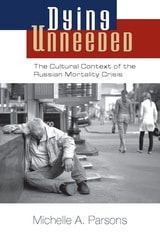
cover of Dying Unneeded: The Cultural Context of the Russian Mortality Crisis

Dying Unneeded

The Cultural Context of the Russian Mortality Crisis

Michelle A. Parsons

Vanderbilt University Press, 2014

In the early 1990s, Russia experienced one of the most extreme increases in mortality in modern history. Men's life expectancy dropped by six years; women's life expectancy dropped by three. Middle-aged men living in Moscow were particularly at risk of dying early deaths. While the early 1990s represent the apex of mortality, the crisis continues. Drawing on fieldwork in the capital city during 2006 and 2007, this account brings ethnography to bear on a topic that has until recently been the province of epidemiology and demography.


Middle-aged Muscovites talk about being unneeded (ne nuzhny), or having little to give others. Considering this concept of "being unneeded" reveals how political economic transformation undermined the logic of social relations whereby individuals used their position within the Soviet state to give things to other people. Being unneeded is also gendered--while women are still needed by their families, men are often unneeded by state or family. Western literature on the mortality crisis focuses on a lack of social capital, often assuming that what individuals receive is most important, but being needed is more about what individuals give. Social connections--and their influence on health--are culturally specific.


In Soviet times, needed people helped friends and acquaintances push against the limits of the state, crafting a sense of space and freedom. When the state collapsed, this sense of bounded freedom was compromised, and another freedom became deadly.


This book is a recipient of the annual Norman L. and Roselea J. Goldberg Prize for the best project in the area of medicine.

[more]