Results by title
169 books match the query 'Land' and 8 start with d
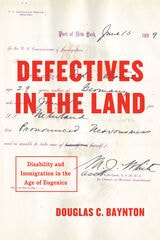
Defectives in the Land
Disability and Immigration in the Age of EugenicsDouglas C. Baynton
University of Chicago Press, 2016
In the late nineteenth and early twentieth centuries, Baynton explains, immigration restriction in the United States was primarily intended to keep people with disabilities—known as “defectives”—out of the country. The list of those included is long: the deaf, blind, epileptic, and mobility impaired; people with curved spines, hernias, flat or club feet, missing limbs, and short limbs; those unusually short or tall; people with intellectual or psychiatric disabilities; intersexuals; men of “poor physique” and men diagnosed with “feminism.” Not only were disabled individuals excluded, but particular races and nationalities were also identified as undesirable based on their supposed susceptibility to mental, moral, and physical defects.
In this transformative book, Baynton argues that early immigration laws were a cohesive whole—a decades-long effort to find an effective method of excluding people considered to be defective. This effort was one aspect of a national culture that was increasingly fixated on competition and efficiency, anxious about physical appearance and difference, and haunted by a fear of hereditary defect and the degeneration of the American race.
Defending the Land of the Jaguar
A History of Conservation in MexicoBy Lane Simonian
University of Texas Press, 1995
Mexican conservationists have sometimes observed that it is difficult to find a country less interested in the conservation of its natural resources than is Mexico. Yet, despite a long history dedicated to the pursuit of development regardless of its environmental consequences, Mexico has an equally long, though much less developed and appreciated, tradition of environmental conservation.
Lane Simonian here offers the first panoramic history of conservation in Mexico from pre-contact times to the current Mexican environmental movement. He explores the origins of conservation and environmental concerns in Mexico, the philosophies and endeavors of Mexican conservationists, and the enactment of important conservation laws and programs. This heretofore untold story, drawn from interviews with leading Mexican conservationists as well as archival research, will be important reading throughout the international community of activists, researchers, and concerned citizens interested in the intertwined issues of conservation and development.
Digging for Hope
A Feminist Ethnography in the Land of Mass GravesR. Aída Hernández Castillo
University of Arizona Press, 2026
Through physical and spiritual practices such as exhumation, mourning, and poetic remembrance, these women reclaim dignity for the dead and challenge a society that has normalized disappearance. At the heart of this book is a profound exploration of what Hernández Castillo calls a “pedagogy of love”—a political and ethical framework rooted in care, solidarity, and the refusal to forget. These women are not only searching for bodies; they are building emotional communities, crafting new languages of justice, and offering a reimagining of what it means to resist violence. Their practices, often overlooked by traditional scholarship, restore humanity and dignify the disappeared.
Digging for Hope is essential reading for anyone seeking to understand the gendered dimensions of violence and the grassroots movements that rise in response. With clarity and compassion, Hernández Castillo brings readers into the intimate spaces of grief and resistance, offering a model for feminist ethnography that is both rigorous and deeply humane.
Dispatches from the Land of Erasure
Essays and ConversationsPhilip Metres
University of Michigan Press, 2025
With keen insight into the lived experience of Arab Americans and other historically marginalized communities, the book explores the struggle for a just peace through reading Palestinian Arab and Israeli Jewish writers of conscience who contend with the wall of silence around the issue of Palestine. Further, Dispatches illuminates how to write a poetry of peace and justice, and how poetic activism and activist poets situate themselves in communities seeking change. Divided into four sections—Erasing the Erasures: Writing While Arab, The Poetics of Palestine, The Poetics of Justice, and The Poetics of Peacebuilding—Dispatches weaves personal essays, cultural criticism, group chats, interviews, literary analysis, reviews, and roundtables that include luminaries like Mosab Abu Toha, Hayan Charara, Sahar Khalifeh, Marwa Helal, Erika Meitner, Naomi Shihab Nye, Craig Santos Perez, and M. NourbeSe Philip. Together, the book models the crucial need for robust dialogue to overcome the echo chamber that limits the growth and reach of social movements and to dream of a future beyond the land of erasure.
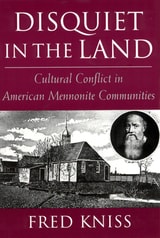
Disquiet in the Land
Cultural Conflict in American Mennonite CommunitiesKniss, Fred
Rutgers University Press, 1997
Mennonites have long referred to themselves as "The Quiet in the Land," but their actual historical experience has been marked by internal disquiet and contention over religious values and cultural practice. As Fred Kniss argues in his impressive study of Mennonite history, the story of this sectarian pacifist group is a story of conflict. How can we understand the ironic phenomenon of Mennonite conflict? How do ideas and symbols-both those of the American mainstream and those that are specifically Mennonite-influence the emergence and course of this conflict? What is the relationship betweenintra-Mennonite conflict and the changing historical context in which Mennonites are situated?
Through a rigorous analysis of a century of disputes over dress codes, congregational authority, and religious practice, Kniss offers the tools both to understand conflict within a specific religious group and to answer larger questions about culture, ideology, and social and historical change.
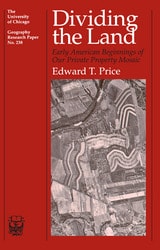
Dividing the Land
Early American Beginnings of Our Private Property MosaicEdward T. Price
University of Chicago Press, 1995
In this unprecedented study, Edward T. Price covers most areas of the United States in which the initial division of land was controlled by colonial governments—the original thirteen colonies, and Maine, Vermont, Kentucky, West Virginia, Tennessee, Louisiana, and Texas. By examining different land policies and the irregular pattern of property that resulted from them, Price chronicles the many ways colonies managed land to promote settlement, develop agriculture, defend frontiers, and attract investment. His analysis reveals as much about land planning techiniques carried to America from Europe as innovations spurred by the unique circumstances of the new world.
Price’s analysis draws on his thorough survey of property records from the first land plans in Virginia in 1607 to empresario grants in Texas in the 1820s. This breadth of data allows him to identify regional differences in allocating land, assess the impact of land planning by historical figures like William Penn of Pennsylvania and Lord Baltimore of Maryland, and trace changes in patterns of land division and ownership through transfers of power among Britain, the Netherlands, France, Spain, Mexico, and the Republic of Texas.
Dragons in the Land of the Condor
Writing Tusán in PeruIgnacio López-Calvo, Foreword by Eugenio Chang-Rodríguez
University of Arizona Press, 2014
While authors like Siu Kam Wen and Julia Wong often rely on their Chinese cultural heritage for inspiration, many others, like Pedro Zulen, Mario Wong, and Julio Villanueva Chang, choose other sources of inspiration and identification. López-Calvo studies the different strategies used by these writers to claim either their belonging in the Peruvian national project or their difference as a minority ethnic group within Peru. Whether defending the rights of indigenous Peruvians, revealing the intricacies of a life of self-exploitation among Chinese shopkeepers, exploring their identitarian dilemmas, or re-creating—beyond racial memory—life under the political violence in Lima of the 1980s, these authors provide their community with a voice and a collective agency, while concomitantly repositioning contemporary Peruvian culture as transnational.
López-Calvo bridges from his earlier study of Peruvian Nikkei’s testimonials and literature and raises this question: why are Chinese Peruvian authors seemingly more disconnected from their Asian heritage than Japanese Peruvian authors from theirs? The author argues that the Chinese arrival in Peru half a century earlier influenced a stronger identification with the criollo world. Yet he argues that this situation may soon be changing as the new geopolitical and economic influence of the People’s Republic of China in the world, particularly in Latin America and the Caribbean, affects the way Chinese and Sino–Latin American communities and their cultures are produced and perceived.
Drift Smoke
Loss and Renewal in a Land of FireDavid J. Strohmaier
University of Nevada Press, 2009
David Strohmaier’s long career as a firefighter has given him intimate knowledge of wildfire and its complex role in the natural world of the American West. It has also given him rare understanding of the painful losses that are a consequence of fire. Strohmaier addresses our ambivalence about fire and the realities of loss to it—of life, human and animal, of livelihoods, of beloved places. He also examines the process of renewal that is yet another consequence of fire, from the infusion of essential nutrients into the soil, to the sprouting of seeds that depend on fire for germination, to the renewal of species as the land restores itself. Ultimately, according to Strohmaier, living with fire is a matter of choices, of “seeing the connection between loss on a personal scale and loss on a landscape scale: in relationship with persons, and in relationship to and with the land.” We must cultivate a longer perspective, he says, accepting that loss is a part of life and that “humility and empathy and care are not only core virtues between humans but are also essential virtues in our attitudes and actions toward the earth.” Drift Smoke is a powerful and moving meditation on wildfire by someone who has seen it in all its terror and beauty, who has lost colleagues and beloved terrain to its ferocity, and who has also seen the miracle of new life sprouting in the ashes. The debate over the role and control of fire in the West will not soon end, but Strohmaier’s contribution to the debate will help all of us better appreciate both the complexity of the issues and the possibilities of hitherto unconsidered solutions that will allow us to inhabit a place where fire is a natural, and needed, part of life.