Results by title
138 books match the query 'Logic' and 5 start with d
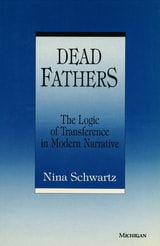
Dead Fathers
The Logic of Transference in Modern NarrativeNina Schwartz
University of Michigan Press, 1994
Reading modernist literature through the lenses of feminist and psychoanalytic theory, Dead Fathers: The Logic of Transference in Modern Narrative examines the reproduction of passions and passionate conflicts—in individual behavior, in literary representations of such behavior, and in the critical responses to the literature.Through readings of four canonical modernist texts—Heart of Darkness, The Wings of the Dove, The Sun Also Rises, and A Room of One's Own—Nina Schwartz analyzes representations of rebellion against social forces. Arguing that modernist narratives frequently recuperate precisely those forms of authority they wish to undermine, Schwartz demonstrates that their representations of rebellion follow this pattern as well, promoting the very social forces they critique. This is an ever-widening circle, a pattern of repetition compulsion at the levels of character, textual authority, and literary criticism. The books tell stories of people locked into patterns they wish to escape, but the very depiction of entrapment reenacts the doublebind, as the oppressive forms of cultural authority are still the source of coherence in the text. The compulsion is further reproduced in the critical response to the books when readers repeat the structures, language, or concerns of the authors.It is this relation between reading and the desire for authority that Schwartz examines as an example of the psychological phenomenon of transference. Drawing on the work of Lacanian theorist Slavov Žižek to articulate a complex linkage of agency, authority, and desire in writing, this book examines how canonical modernist texts have functioned for readers as transferential objects, repositories of authoritative knowledge, and subjects that know and embody the truth of the modern.
[more]
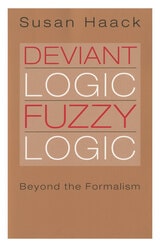
Deviant Logic, Fuzzy Logic
Beyond the FormalismSusan Haack
University of Chicago Press, 1996
Initially proposed as rivals of classical logic, alternative logics have become increasingly important in areas such as computer science and artificial intelligence. Fuzzy logic, in particular, has motivated major technological developments in recent years.
Susan Haack's Deviant Logic provided the first extended examination of the philosophical consequences of alternative logics. In this new volume, Haack includes the complete text of Deviant Logic, as well as five additional papers that expand and update it. Two of these essays critique fuzzy logic, while three augment Deviant Logic's treatment of deduction and logical truth. Haack also provides an extensive new foreword, brief introductions to the new essays, and an updated bibliography of recent work in these areas.
Deviant Logic, Fuzzy Logic will be indispensable to students of philosophy, philosophy of science, linguistics, mathematics, and computer science, and will also prove invaluable to experienced scholars working in these fields.
[more]
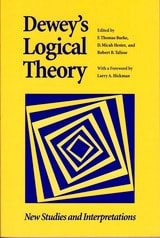
Dewey's Logical Theory
New Studies and InterpretationsF. Thomas Burke
Vanderbilt University Press, 2002
Despite the resurgence of interest in the philosophy of John Dewey, his work on logical theory has received relatively little attention. Ironically, Dewey's logic was his "first and last love." The essays in this collection pay tribute to that love by addressing Dewey's philosophy of logic, from his work at the beginning of the twentieth century to the culmination of his logical thought in the 1938 volume, Logic: The Theory of Inquiry. All the essays are original to this volume and are written by leading Dewey scholars. Ranging from discussions of propositional theory to logic's social and ethical implications, these essays clarify often misunderstood or misrepresented aspects of Dewey's work, while emphasizing the seminal role of logic to Dewey's philosophical endeavors.
This collection breaks new ground in its relevance to contemporary philosophy of logic and epistemology and pays special attention to applications in ethics and moral philosophy.
[more]
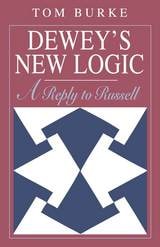
Dewey's New Logic
A Reply to RussellTom Burke
University of Chicago Press, 1994
Although John Dewey is celebrated for his work in the philosophy of education and acknowledged as a leading proponent of American pragmatism, he might also have enjoyed more of a reputation for his philosophy of logic had Bertrand Russell not attacked him so fervently on the subject. In Dewey's New Logic, Tom Burke analyzes the debate between Russell and Dewey that followed the 1938 publication of Dewey's Logic: The Theory of Inquiry. Here, he argues that Russell failed to understand Dewey's logic as Dewey intended, and despite Russell's resistance, Dewey's logic is surprisingly relevant to recent developments in philosophy and cognitive science.
Burke demonstrates that Russell misunderstood crucial aspects of Dewey's theory and contends that logic today has progressed beyond Russell and is approaching Dewey's broader perspective.
"[This] book should be of substantial interest not only to Dewey scholars and other historians of twentieth-century philosophy, but also to devotees of situation theory, formal semantics, philosophy of mind, cognitive science, and Artificial Intelligence."—Georges Dicker, Transactions of the C.S. Peirce Society
"No scholar, thus far, has offered such a sophisticated and detailed version of central themes and contentions in Dewey's Logic. This is a pathbreaking study."—John J. McDermott, editor of The Philosophy of John Dewey
[more]
Duns Scotus on Time and Existence
John Duns Scotus
Catholic University of America Press, 2014
An English translation of John Duns Scotus's The Questions on Aristotle's "De Interpretatione" including an extensive commentary on some of Scotus's more difficult ideas.
[more]