100 books match the query 'London' and 6 start with d
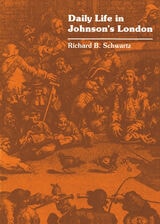
cover of Daily Life in Johnson's London

Daily Life in Johnson's London

Richard B. Schwartz

University of Wisconsin Press, 1983

"Rich in facts and anecdotes, this is the perfect introduction to 18th-century London and a wonderful companion for readers of Johnson and Boswell. . . . Schwartz starts with the sights, sound, and smells of the metropolis—a city of steeples, chimneys, coal smoke, and intolerable street noise—and surveys in succession Work and Money, Pastimes and Pleasures, Daily Routines and Domestic Life, Travel and Transportation, and Health and Hygiene and concludes with a gallery of street 'Londoners,' an independent and assertive lot, notably insolent to foreigners, especially those in French clothes."—Washington Post Book World

"Outstanding. . . . The author packs a remarkable quantity of detail into a small space, even including a discussion of price and wage figures that will be intelligible to Americans [today]. . . . His prose is lucid, graceful, lively. Generously illustrated, the book also includes an extensive bibliography."—Choice

"An excellent source for English Literature and history students studying this period or Samuel Johnson."—Booklist
[more]
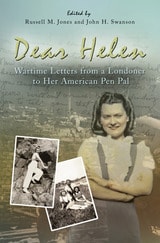
cover of Dear Helen: Wartime Letters from a Londoner to Her American Pen Pal

Dear Helen

Wartime Letters from a Londoner to Her American Pen Pal

Edited by Russell M. Jones & John H. Swanson

University of Missouri Press, 2009
In 1937, Betty Swallow was a young London secretary enjoying the social whirl of the world’s most sophisticated metropolis. She came to know fellow movie buff Helen Bradley of Kansas City through a movie magazine, and their initially lighthearted correspondence about film stars came to encompass a world war—and reflect Betty’s unique view of it.
            Today there are countless descriptions of wartime Britain from historians and journalists; Dear Helen depicts World War II—from its buildup to its aftermath—from the perspective of an average London citizen, with details of daily life that few other documents provide. In letters written from 1937 to 1950 and now housed at the Winston Churchill Memorial and Library at Westminster College in Fulton, Missouri, Betty shares accounts of the Blitz and wartime deprivations, then of the postwar austerity programs, in passages that interweave daily terror with talk about theater, clothes, and family outings.
Betty is the epitome of English pluck: patriotic, practical, and romantic despite the bombs falling about her. She laments the lack of ingredients for a proper Christmas pudding, but Helen’s holiday package of candy, nylons, and cosmetics helps make up for the shortages. She shares graphic descriptions of the relentless attacks on London but tells also of how silk stockings or a trip to the cinema could take the edge off nights spent in an underground shelter—where “lying about on wet and cold stone floors, breathing bad air” took a toll on her health.
            These letters do more than document headlines and daily life: they candidly convey British attitudes toward American isolationism prior to Pearl Harbor and reveal how the English felt about taking on the Nazis alone. They also tell of the social changes that transformed English society—including Betty’s transformation from Tory to Socialist—and how the cold war had a different impact on British citizens than on Americans. Throughout the exchange, the haven that Betty and Helen shared in the world of movies becomes a frequent counterpoint to the stress of the war.
            Dear Helen is a book of rich personal drama that further attests to the British-American “special relationship.” Through this sustained correspondence spanning the war years, we meet a real person whose reflections shed light on British opinion during the harshest times and whose experiences give us new insight into the horror of the Blitz.
[more]
cover of Death and the Pearl Maiden: Plague, Poetry, England

Death and the Pearl Maiden

Plague, Poetry, England

David K. Coley

The Ohio State University Press, 2019

The plague first arrived in the English port of Weymouth in the summer of 1348. Two years later, half of Britain was dead, but the Black Death was just beginning. In the decades to come, England would suffer recurring outbreaks, social and cultural upheaval, and violent demographic shifts. The pandemic was, by any measure, a massive cultural trauma; however, within the vernacular English literature of the fourteenth century, the response to the disease appears muted, particularly compared to contemporaneous descriptions emerging from mainland Europe.
Death and the Pearl Maiden: Plague, Poetry, England asks why one of the singular historical traumas of the later Middle Ages appears to be evoked so fleetingly in fourteenth-century Middle English poetry, a body of work as daring and socially engaged as any in English literary history. By focusing on under-recognized pestilential discourses in Pearl, Cleanness, Patience, and Sir Gawain and the Green Knight—the four poems uniquely preserved British Library MS Cotton Nero A.x —this study resists the idea that the Black Death had only a slight impact on medieval English literature, and it strives to account for the understated shape of England’s literary response to the plague and our contemporary understandings of it.
 
[more]
cover of Destination London: The Expansion of the Visitor Economy

Destination London

The Expansion of the Visitor Economy

Andrew Smith and Anne Graham

University of Westminster Press, 2019

“A welcome addition to the field of urban tourism research... its content could prove useful not only to students and academic, but also to policymakers interested in better understanding the implications of tourism development and the expansion of the visitor economy in large cities.” - https://www.sciencedirect.com/science/article/abs/pii/S0261517719301785

London is one of the world’s most popular destinations and visitors contribute approximately £14.9 billion of expenditure to the city every year. Its tourism and events sectors are growing and over the last few years London has received more visitors than ever before. However, detailed accounts of the city’s visitor economy are conspicuously absent.

This book analyses how the capital is developing as a destination through the expansion of tourism and events into new urban spaces. The book outlines how parts of London not previously regarded as tourist territory are now subject to the visitor gaze with tourism spreading beyond established central zones into peripheral, suburban and residential areas – in part propelled by a big rise in peer to peer accommodation use. Simultaneously, London’s airports and sports stadiums and their surrounds are becoming destinations in their own right. New vantage points have been created, allowing tourists to explore the city: from above, at night-time or through tours given by the homeless; via the opening up of the River Thames; or through the transformation of local parks into eventscapes. 

The book explores these trends and shows how urban destinations expand. In doing so, it enhances our understanding of London and highlights the growing significance of tourism and events in global cities.

[more]
cover of Dickens's London

Dickens's London

Peter Clark

Haus Publishing, 2012

Marking the 150th anniversary of Charles Dickens’s death, Dickens’s London leads us in the footsteps of the author through this beloved city. Few novelists have written so intimately about a place as Dickens wrote about London, and, from a young age, his near-photographic memory rendered his experiences there both significant and in constant focus. Virginia Woolf maintained that “we remodel our psychological geography when we read Dickens,” as he produces “characters who exist not in detail, not accurately or exactly, but abundantly in a cluster of wild yet extraordinarily revealing remarks.” The most enduring “character” Dickens was drawn back to throughout his novels was London itself, in all its aspects, from the coaching inns of his early years to the taverns and watermen of the Thames. These were the constant cityscapes of his life and work.

In five walks through central London, Peter Clark explores “The First Suburbs”—Camden Town, Chelsea, Greenwich, Hampstead, Highgate and Limehouse—as they feature in Dickens’s writing and illuminates the settings of Dickens’s life and his greatest works of journalism and fiction. Describing these storied spaces of today’s central London in intimate detail, Clark invites us to experience the city as it was known to Dickens and his characters. These walks take us through the locations and buildings that he interacted with and wrote about, creating an imaginative reconstruction of the Dickensian world that has been lost to time.
 
[more]
cover of Disrupting the Speculative City: Property, Power and Community Resistance in London

Disrupting the Speculative City

Property, Power and Community Resistance in London

Amy Horton and Joe Penny

University College London, 2024

Analyzes urban land value extraction and the resulting community displacement in London.

Disrupting the Speculative City tells the story of how the Haringey Development Vehicle community coalition, defeated one of the most ambitious programs of state-led gentrification in London. Drawing on the accounts of those at the heart of local statecraft and grassroots organizations, and analyzing crucial developments in property investment, this book explores a significant and inspirational success for campaigners in London, where social cleansing has become the default outcome of redevelopment.
[more]