Results by title
98 books match the query 'Marginality, Social' and 8 start with d
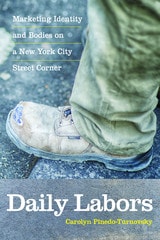
Daily Labors
Marketing Identity and Bodies on a New York City Street CornerCarolyn Pinedo-Turnovsky
Temple University Press, 2019
On street corners throughout the country, men stand or sit together patiently while they wait for someone looking to hire un buen trabajador (a good worker). These day laborers are visible symbols of the changing nature of work—and the demographics of workers—in the United States.
Carolyn Pinedo-Turnovsky spent nearly three years visiting with African American men and Latino immigrant men who looked for work as day laborers at a Brooklyn street intersection. Her fascinating ethnography, Daily Labors, considers these immigrants and citizens as active participants in their social and economic life. They not only work for wages but also labor daily to institute change, create knowledge, and contribute new meanings to shape their social world.
Daily Labors reveals how ideologies about race, gender, nation, and legal status operate on the corner and the vulnerabilities, discrimination, and exploitation workers face in this labor market. Pinedo-Turnovsky shows how workers market themselves to conform to employers’ preconceptions of a “good worker” and how this performance paradoxically leads to a more precarious workplace experience. Ultimately, she sheds light on belonging, community, and what a “good day laborer” for these workers really is.

Dance for Me When I Die
Cristian Alarcón
Duke University Press, 2019
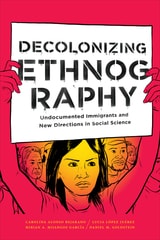
Decolonizing Ethnography
Undocumented Immigrants and New Directions in Social ScienceCarolina Alonso-Bejarano, Lucia López Juárez, Mirian A. Mijangos García, and Daniel M. Goldstein
Duke University Press, 2019

Democratic Theorizing from the Margins
Marla Brettschneider
Temple University Press, 2007

Discriminating Sex
White Leisure and the Making of the American "Oriental"Amy Sueyoshi
University of Illinois Press, 2018
Amy Sueyoshi draws on everything from newspapers to felony case files to oral histories in order to examine how whites' pursuit of gender and sexual fulfillment gave rise to racial caricatures. As she reveals, white reporters, writers, artists, and others conflated Chinese and Japanese, previously seen as two races, into one. There emerged the Oriental—a single pan-Asian American stereotype weighted with sexual and gender meaning. Sueyoshi bridges feminist, queer, and ethnic studies to show how the white quest to forge new frontiers in gender and sexual freedom reinforced—and spawned—racial inequality through the ever evolving Oriental.
Informed and fascinating, Discriminating Sex reconsiders the origins and expression of racial stereotyping in an American city.

Domestic Violence at the Margins
Readings on Race, Class, Gender, and CultureSokoloff, Natalie J.
Rutgers University Press, 2005
"An exciting and powerful collection that eloquently critiques some of the current thinking in domestic violence and raises key concerns for advocates and scholars working in the area."—Sujata Warrier, president, board of directors, Manavi: An organization for South Asian women
"Sokoloff has assembled an impressive array of authors who challenge us to ‘think outside of our contemporary domestic violence box.’"—Angela M. Moore Parmley, chief, violence and victimization research division, National Institute of Justice
This groundbreaking anthology reorients the field of domestic violence research by bringing long-overdue attention to the structural forms of oppression in communities marginalized by race, ethnicity, religion, sexuality, or social class.
Reprints of the most influential recent work in the field as well as more than a dozen newly commissioned essays explore theoretical issues, current research, service provision, and activism among Latinos, African Americans, Asian Americans, Jewish Americans, and lesbians. The volume rejects simplistic analyses of the role of culture in domestic violence by elucidating the support systems available to battered women within different cultures, while at the same time addressing the distinct problems generated by that culture. Together, the essays pose a compelling challenge to stereotypical images of battered women that are racist, homophobic, and xenophobic.
The most up-to-date and comprehensive picture of domestic violence available, this anthology is an essential text for courses in sociology, criminology, social work, and women’s studies. Beyond the classroom, it provides critical information and resources for professionals working in domestic violence services, advocacy, social work, and law enforcement.

Drag Queens at the 801 Cabaret
Leila J. Rupp and Verta Taylor
University of Chicago Press, 2003
In this lively book, Leila J. Rupp and Verta Taylor take us on an entertaining tour through one of America's most overlooked subcultures: the world of the drag queen. They offer a penetrating glimpse into the lives of the 801 Girls, the troupe of queens who perform nightly at the 801 Cabaret for tourists and locals. Weaving together their fascinating life stories, their lavish costumes and eclectic music, their flamboyance and bitchiness, and their bawdy exchanges with one another and their audiences, the authors explore how drag queens smash the boundaries between gay and straight, man and woman, to make people think more deeply and realistically about sex and gender in America today. They also consider how the queens create a space that encourages camaraderie and acceptance among everyday people, no matter what their sexual preferences might be.
Based on countless interviews with more than a dozen drag queens, more than three years of attendance at their outrageous performances, and even the authors' participation in the shows themselves, Drag Queens at the 801 Cabaret is a witty and poignant portrait of gay life and culture. When they said life is a cabaret, they clearly meant the 801.
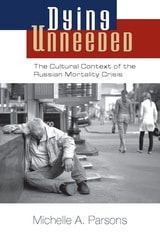
Dying Unneeded
The Cultural Context of the Russian Mortality CrisisMichelle A. Parsons
Vanderbilt University Press, 2014
Middle-aged Muscovites talk about being unneeded (ne nuzhny), or having little to give others. Considering this concept of "being unneeded" reveals how political economic transformation undermined the logic of social relations whereby individuals used their position within the Soviet state to give things to other people. Being unneeded is also gendered--while women are still needed by their families, men are often unneeded by state or family. Western literature on the mortality crisis focuses on a lack of social capital, often assuming that what individuals receive is most important, but being needed is more about what individuals give. Social connections--and their influence on health--are culturally specific.
In Soviet times, needed people helped friends and acquaintances push against the limits of the state, crafting a sense of space and freedom. When the state collapsed, this sense of bounded freedom was compromised, and another freedom became deadly.
This book is a recipient of the annual Norman L. and Roselea J. Goldberg Prize for the best project in the area of medicine.