Results by title
175 books match the query 'Marriage' and 4 start with d
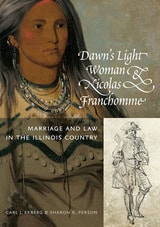
Dawn's Light Woman & Nicolas Franchomme
Marriage and Law in the Illinois CountryCarl J. Ekberg and Sharon K. Person
Southern Illinois University Press, 2022
Native women’s marital rights and roles in colonial Illinois society
Kaskaskia, Illinois, once the state’s capital, torn from the state by flood waters, and now largely forgotten, was once the home to a couple who helped transform the region in the 1720s from a frontier village to a civil society. In the heart of France’s North American empire, the village was a community of French-Canadian fur traders and Kaskaskia Indians who not only lived together but often intermarried. These Indigenous and French intermarriages were central to colonial Illinois society, and the coupling of Marguerite 8assecam8c8e (Dawn’s Light Woman) and Nicolas Franchomme, in particular, was critical to expanding the jurisdiction of French law.
While the story of Marguerite and Nicolas is unknown today, it is the story of how French customary law (Coutume de Paris) governed colonial marriage, how mixed Indian-French marriages stood at the very core of early colonial Illinois society, and how Illinois Indian women benefited, socially and legally, from being married to French men. All of this came about due to a lawsuit in which Nicolas successfully argued that his wife had legal claim to her first husband’s estate—a legal decision that created a precedent for society in the Illinois Country.
Within this narrative of a married couple and their legal fight—based on original French manuscripts and supported by the comprehensively annotated 1726 Illinois census—is also the story of the village of Kaskaskia during the 1720s, of the war between Fox Indians and French settlers, with their Indian allies, in Illinois, and of how the spread of plow agriculture dramatically transformed the Illinois Country’s economy from largely fur trade–based to expansively agricultural.
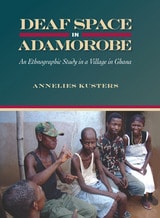
Deaf Space in Adamorobe
An Ethnographic Study in a Village in GhanaAnnelies Kusters
Gallaudet University Press, 2015
Deaf Space in Adamorobe reveals one example of the considerable variation in shared signing communities regarding rates of sign language proficiency and use, deaf people’s marriage rates, deaf people’s participation in village economies and politics, and the role of deaf education. Kusters describes spaces produced by both deaf and hearing people as a cohesive community where living together is an integral fact of their sociocultural environments. At the same time, Kusters identifies tension points between deaf and hearing perspectives and also between outside perspectives and discourses that originated within the community. Because of these differences and the relatively high number of deaf people in the community, Kusters concludes it is natural that they form deaf spaces within the shared space of the village community.
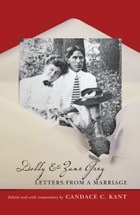
Dolly and Zane Grey
Letters from a MarriageCandace C. Kant
University of Nevada Press, 2011
Popular western writer Zane Grey was a literary celebrity during his lifetime and the center of a huge enterprise based on his writing, which included books, magazine serials, film and stage versions of his stories, even comic strips. His wife, Dolly, closely guided Grey's career almost from its beginning, editing and sometimes revising his work, negotiating with publishers and movie studios, and skillfully managing the considerable fortune derived from these activities.
Dolly maintained the facade of a conventional married life that was essential to Grey's public image and the traditional middle-class values his work reflected. This facade was constantly threatened by Grey's numerous affairs with other women. The stress of hiding these dalliances placed a huge strain on their relationship, and much of Zane and Dolly's union was sustained largely by correspondence. Their letters--thousands of them--reveal the true nature of this complex partnership. As edited by Candace Kant, the letters offer an engrossing portrait of an extremely unorthodox marriage and its times.

Domestic Broils
Shakers, Antebellum Marriage, and the Narratives of Mary and Joseph DyerElizabeth De Wolfe
University of Massachusetts Press, 2010