Results by title
51 books match the query 'Methods & Strategies' and 4 start with d
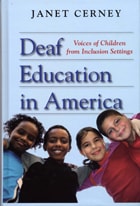
Deaf Education in America
Voices of Children from Inclusion SettingsJanet Cerney
Gallaudet University Press, 2007
Deaf Education in America: Voices of Children from Inclusion Settings provides a detailed examination of the complex issues surrounding the integration of deaf students into the general classroom. Author Janet Cerney begins her comprehensive work by stressing to parents, educators, and policymakers the importance of learning the circumstances in which mainstreaming and inclusion can be successful for deaf students. This process requires stakeholders to identify and evaluate the perceived benefits and risks before making placement and implementation decisions. The influences of the quality of communication and the relationships built by and with the students are of paramount importance in leading to success.
In conjunction with these principles, this thorough study examines the theory and history behind inclusion, including the effects of the No Child Left Behind education act. Cerney incorporates this knowledge with interviews of the deaf students themselves as well as with their interpreters and teachers. To ensure complete candidness, the students were surveyed in their homes, and the interpreters and educators were questioned separately. Through these exchanges, Cerney could determine what worked well for the deaf students, what barriers interfered with their access to communication, and what support structures were needed to eliminate those barriers. As a result, Deaf Education in America offers concrete information on steps that can be taken to ensure success in an inclusion setting, results that reverberate through the voices of the deaf students.
Design and Discomfort
Teaching Shakespeare and RaceEdited by Laura B. Turchi
Arizona Center for Medieval and Renaissance Studies, 2025
Design and Discomfort confronts the complexities of teaching Shakespeare in today’s classrooms, where discussions of race, bias, and historical legacies can provoke discomfort—but also transformation. Edited by Laura B. Turchi, this collection brings together educators and teaching artists who share innovative strategies for rethinking Shakespeare’s role in education.
Rather than treating Shakespeare as an untouchable authority, the contributors explore how his works can be a springboard for broader conversations about identity and justice. They advocate for performance-based and student-driven approaches that help students see themselves—their communities, their families, and their lived experiences—in the complex and seemingly distant world of Shakespeare.
This open-access volume provides both conceptual essays and practical lesson designs for educators navigating the intersections of Shakespeare and race. By embracing discomfort as part of the learning process, Design and Discomfort reframes how Shakespeare should be taught in classrooms today.

Dewey's Dream
Universities and Democracies in an Age of Education ReformLee Benson
Temple University Press, 2007
This timely, persuasive, and hopeful book reexamines John Dewey's idea of schools, specifically community schools, as the best places to grow a democratic society that is based on racial, social, and economic justice. The authors assert that American colleges and universities bear a responsibility for-and would benefit substantially from-working with schools to develop democratic schools and communities.
Dewey's Dream opens with a reappraisal of Dewey's philosophy and an argument for its continued relevance today. The authors-all well-known in education circles-use illustrations from over 20 years of experience working with public schools in the University of Pennsylvania's local ecological community of West Philadelphia, to demonstrate how their ideas can be put into action. By emphasizing problem-solving as the foundation of education, their work has awakened university students to their social responsibilities. And while the project is still young, it demonstrates that Dewey's "Utopian ends" of creating optimally participatory democratic societies can lead to practical, constructive school, higher education and community change, development, and improvement.
Disrupting Colonial Pedagogies
Theories and TransgressionsEdited by Jillian Ford and Nathalia Jaramillo
University of Illinois Press, 2023
Jillian Ford and Nathalia E. Jaramillo edit a collection of writings by women that examine womanist worldviews in philosophy, theory, curriculum, public health, and education. Drawing on thinkers like bell hooks and Cynthia Dillard, the essayists challenge the colonizing hegemonies that raise and sustain patriarchal and male-centered systems of teaching and learning. Part One examines how womanist theorizing and creative activity offer a space to study the impact of conquest and colonization on the Black female body and spirit. In Part Two, the contributors look at ways of using text, philosophy, and research methodologies to challenge colonizing and colonial definitions of womanhood, enlightenment, and well-being. The essays in Part Three undo the colonial pedagogical project and share the insights they have gained by freeing themselves from its chokehold.
Powerful and interdisciplinary, Disrupting Colonial Pedagogies challenges colonialism and its influence on education to advance freer and more just forms of knowledge making.
Contributors: Silvia García Aguilár, Khalilah Ali, Angela Malone Cartwright, Adriana Diego, LeConté Dill, Sameena Eidoo, Genevieve Flores-Haro, Jillian Ford, Leena Her, Nathalia E. Jaramillo, Patricia Krueger-Henney, Claudia Lozáno, Liliana Manriquez, Alberta Salazár, León Salazár, and Lorri Santamaría