Results by title
321 books match the query 'Mexican Americans' and 13 start with d

Dancing with the Devil
Society and Cultural Poetics in Mexican-American South TexasJose Limon
University of Wisconsin Press, 1994
Combining shrewd applications of current cultural theory with compelling autobiography and elegant prose, José E. Limón works at the intersection of anthropology, folklore, popular culture, history, and literary criticism. A native of South Texas, he renders a historical and ethnographic account of its rich Mexican-American folk culture. This folk culture, he shows—whether expressed through male joking rituals, ballroom polka dances, folk healing, or eating and drinking traditions—metaphorically dances with the devil, both resisting and accommodating the dominant culture of Texas.
Critiquing the work of his precursors— John Gregory Bourke, J. Frank Dobie, Jovita Gonzalez, and Americo Paredes—Limón deftly demonstrates that their accounts of Mexican-Americans in South Texas contain race, class, and gender contradictions, revealed most clearly in their accounts of the folkloric figure of the devil. Limón's own field-based ethnography follows, and again the devil appears as a recurrent motif, signaling the ideological contradictions of folk practices in a South Texas on the verge of postmodernity.
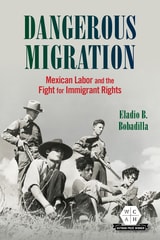
Dangerous Migration
Mexican Labor and the Fight for Immigrant RightsEladio B. Bobadilla
University of Illinois Press, 2026
Beginning with Mexican American opposition to the Bracero Program, Eladio Bobadilla traces the movement’s fault lines that formed around the issue of undocumented workers. Bobadilla reveals how internationalist and human rights discourse influenced the rise of the Chicano movement and its defense of Mexican undocumented immigrants. As time passed, anti-Mexican social, political, and legislative forces produced a nativist backlash that put immigration at the center of the United States’ culture wars and created the fantasy of undocumented workers as an existential threat.
Engaging and vivid, Dangerous Migration illuminates the history of debates over Mexican labor, the emergence of the immigrant rights activism, and the nativist movements that united Latinos with right-wing white Americans.
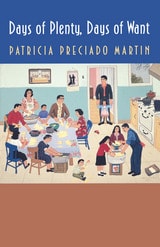
Days of Plenty, Days of Want
Patricia Preciado Martin
University of Arizona Press, 1999
In the pages of this book are people so real you'll swear you've met them, situations so familiar you'll nod in recognition. Two of these stories have won prizes in Chicano literary contests; all will win the hearts of readers. Through them, Patricia Preciado Martin reminds us that freedom and self-expression are important in fulfilling our potential—and, more important, that a large part of this process requires acknowledging our heritage as a priceless gift whose relevance in our lives cannot be ignored.
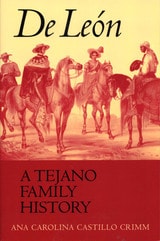
De León, a Tejano Family History
By Ana Carolina Castillo Crimm
University of Texas Press, 2003
Winner, Presidio La Bahia Award, 2004
San Antonio Conservation Society Citation, 2005
La familia de León was one of the foundation stones on which Texas was built. Martín de León and his wife Patricia de la Garza left a comfortable life in Mexico for the hardships and uncertainties of the Texas frontier in 1801. Together, they established family ranches in South Texas and, in 1824, the town of Victoria and the de León colony on the Guadalupe River (along with Stephen F. Austin's colony, the only completely successful colonization effort in Texas). They and their descendents survived and prospered under four governments, as the society in which they lived evolved from autocratic to republican and the economy from which they drew their livelihood changed from one of mercantile control to one characterized by capitalistic investments.
Combining the storytelling flair of a novelist with a scholar's concern for the facts, Ana Carolina Castillo Crimm here recounts the history of three generations of the de León family. She follows Martín and Patricia from their beginnings in Mexico through the establishment of the family ranches in Texas and the founding of the de León colony and the town of Victoria. Then she details how, after Martín's death in 1834, Patricia and her children endured the Texas Revolution, exile in New Orleans and Mexico, expropriation of their lands, and, after returning to Texas, years of legal battles to regain their property. Representative of the experiences of many Tejanos whose stories have yet to be written, the history of the de León family is the story of the Tejano settlers of Texas.
Del Otro Lado
Literacy and Migration across the U.S.-Mexico BorderSusan V. Meyers
Southern Illinois University Press, 2014
In Del OtroLado: Literacy and Migration across the U.S.-Mexico Border, author Susan V. Meyers draws on her year-long ethnographic study in Mexico and the United States to analyze the literacy practices of Mexican-origin students on both sides of the border.
Meyers begins by taking readers through the historical development of the rural Mexican town of Villachuato. Through a series of case studies spanning the decades between the Mexican Revolution and the modern-day village, Meyers explores the ever-widening gulf between the priorities of students and the ideals of the public education system. As more and more of Villachuato’s families migrate in an effort to find work in the wake of shifting transnational economic policies like NAFTA, the town’s public school teachers find themselves frustrated by spiraling drop-out rates. Meyers discovers that students often consider the current curriculum irrelevant and reject the established value systems of Mexico’s public schools. Meyers debunks the longstanding myth that literacy is tied to economic development, arguing that a “literacy contract” model, in which students participate in public education in exchange for access to increased earning potential, better illustrates the situation in rural Mexico.
Meyers next explores literacy on the other side of the border, traveling to Marshalltown, Iowa, where many former citizens of Villachuato have come to reside because of the availability of jobs for unskilled workers at the huge Swift meat-packing plant there. Here she discovers that Mexican-origin families in the United States often consider education a desirable end in itself rather than a means to an end. She argues that migration has a catalyzing effect on literacy, particularly as Mexican migrant families tend to view education as a desirable form of prestige.
Meyers reveals the history and policies that have shaped the literacy practices of Mexican-origin students, and she raises important questions about not only the obligation of the United States to educate migrant students, but also those students’ educational struggles and ways in which these difficulties can be overcome. This transnational study is essential reading for scholars, students, educators and lawmakers interested in shaping the future of educational policy.
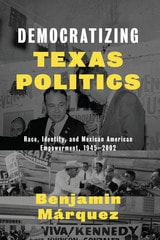
Democratizing Texas Politics
Race, Identity, and Mexican American Empowerment, 1945-2002By Benjamin Márquez
University of Texas Press, 2014
Winner, Outstanding Book Award, NACCS Tejas Foco Award for Non-Fiction, National Association for Chicana and Chicano Studies Tejas, 2015
By the beginning of the twenty-first century, Texas led the nation in the number of Latino officeholders, despite the state’s violent history of racial conflict. Exploring this and other seemingly contradictory realities of Texas’s political landscape since World War II, Democratizing Texas Politics captures powerful, interrelated forces that drive intriguing legislative dynamics. These factors include the long history of Mexican American activism; population growth among Mexican American citizens of voting age; increased participation among women and minorities at state and national levels in the Democratic Party, beginning in the 1960s; the emergence of the Republican Party as a viable alternative for Southern conservatives; civil rights legislation; and the transition to a more representative two-party system thanks to liberal coalitions.
Culling extensive archival research, including party records and those of both Latino activists and Anglo elected officials, as well as numerous interviews with leading figures and collected letters of some of Texas’s most prominent voices, Benjamin Márquez traces the slow and difficult departure from a racially uniform political class to a diverse one. As Texas transitioned to a more representative two-party system, the threat of racial tension and political exclusion spurred Mexican Americans to launch remarkably successful movements to ensure their incorporation. The resulting success and dilemmas of racially based electoral mobilization, embodied in pivotal leaders such as Henry B. Gonzalez and Tony Sanchez, is vividly explored in Democratizing Texas Politics.
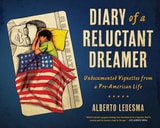
Diary of a Reluctant Dreamer
Undocumented Vignettes from a Pre-American LifeAlberto Ledesma
The Ohio State University Press, 2017
Exploring Ledesma’s experiences from immigrant to student to academic, Diary of a Reluctant Dreamer presents a humorous, gritty, and multilayered portrait of undocumented immigrant life in urban America. Ledesma’s vignettes about life in the midst of ongoing social trauma give voice to a generation that has long been silent about its struggles. Delving into the key moments of cultural transition throughout his childhood and adulthood—police at the back door waiting to deport his family, the ex-girlfriend who threatens to call INS and report him, and the interactions with law enforcement even after he is no longer undocumented—Ledesma, through his art and his words, provides a glimpse into the psychological and philosophical concerns of undocumented immigrant youth who struggle to pinpoint their identity and community.
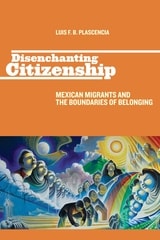
Disenchanting Citizenship
Mexican Migrants and the Boundaries of BelongingLuis F. B. Plascencia
Rutgers University Press, 2012
The book explores the meaning of U.S. citizenship through the experience of a unique group of Mexican migrants who were granted Temporary Status under the “legalization” provisions of the 1986 IRCA, attained Lawful Permanent Residency, and later became U.S. citizens. Plascencia integrates an extensive and multifaceted collection of interviews, ethnographic fieldwork, ethno-historical research, and public policy analysis in examining efforts that promote the acquisition of citizenship, the teaching of citizenship classes, and naturalization ceremonies. Ultimately, he unearths citizenship’s root as a Janus-faced construct that encompasses a simultaneous process of inclusion and exclusion. This notion of citizenship is mapped on to the migrant experience, arguing that the acquisition of citizenship can lead to disenchantment with the very status desired. In the end, Plascencia expands our understanding of the dynamics of U.S. citizenship as a form of membership and belonging.
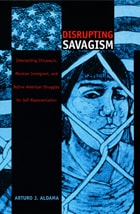
Disrupting Savagism
Intersecting Chicana/o, Mexican Immigrant, and Native American Struggles for Self-RepresentationArturo J. Aldama
Duke University Press, 2001
Arturo J. Aldama begins by presenting a genealogy of the term “savage,” looking in particular at the work of American ethnologist Lewis Henry Morgan and a sixteenth-century debate between Juan Ginés de Sepúlveda and Bartolomé de las Casas. Aldama then turns to more contemporary narratives, examining ethnography, fiction, autobiography, and film to illuminate the historical ideologies and ethnic perspectives that contributed to identity formation over the centuries. These works include anthropologist Manuel Gamio’s The Mexican Immigrant: His Life Story, Leslie Marmon Silko’s Ceremony, Gloria Anzaldúa’s Borderlands/La Frontera, and Miguel Arteta’s film Star Maps. By using these varied genres to investigate the complex politics of racialized, subaltern, feminist, and diasporic identities, Aldama reveals the unique epistemic logic of hybrid and mestiza/o cultural productions.
The transcultural perspective of Disrupting Savagism will interest scholars of feminist postcolonial processes in the United States, as well as students of Latin American, Native American, and literary studies.

Dissonant Divas in Chicana Music
The Limits of La OndaDeborah R. Vargas
University of Minnesota Press, 2012
Musical sound has been central to heteromasculinist productions of nation and homeland, whether Chicano, Tejano, Texan, Mexican, or American. If this assertion holds true, as Deborah R. Vargas suggests, then what are we to make of those singers and musicians whose representations of gender and sexuality are irreconcilable with canonical Chicano/Tejano music or what Vargas refers to as “la onda”? These are the “dissonant divas” Vargas discusses, performers who stimulate our listening for alternative borderlands imaginaries that are inaudible within the limits of “la onda.”
Dissonant Divas in Chicana Music focuses on the Texan monument of the Alamo and its association with Rosita Fernandez; Tejano corrido folklore and its musical antithesis in Chelo Silva; the female accordion-playing bodies of Ventura Alonza and Eva Ybarra as incompatible with the instrumental labor of conjunto music; geography as national border, explored through the multiple national music scales negotiated by Eva Garza; and racialized gender, viewed through Selena’s integration of black diasporic musical sound. Vargas offers a feminist analysis of these figures’ contributions by advancing a notion of musical dissonance—a dissonance that recognizes the complexity of gender, sexuality, and power within Chicana/o culture.
Incorporating ethnographic fieldwork, oral history, and archival research, Vargas’s study demonstrates how these singers work together to explode the limits of Texan, Chicano, Tejano, Mexican, and American identities.
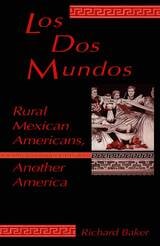
Dos Mundos
Rural Mexican Americans, Another AmericaRichard Baker
Utah State University Press, 1995
Mexican Americans make up the largest minority in Idaho, yet they seemingly live in a different world from the dominant Anglo population, and because of pervasive stereotypes and exclusive policies, their participation in the community's social, economic, and political life is continually impeded.
This unique ethnographic study of a small Idaho community with a large Hispanic population examines many dimensions of the impact race relations have on everyday life for rural Mexican Americans.
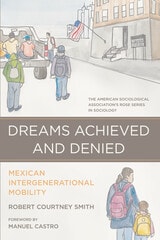
Dreams Achieved and Denied
Mexican Intergenerational MobilityRobert Courtney Smith
Russell Sage Foundation, 2024
For over twenty years, Smith followed the lives and mobility of nearly one hundred children of Mexican immigrants in New York City. Smith’s longitudinal, ethnographic data enabled him to intimately describe how specific mechanisms blocked or promoted mobility for years as his participants moved from adolescence through early adulthood and into established adulthood. Smith documents how having or gaining legal status made certain New York City or New York State policies and practices more efficacious in supporting individual and family efforts and strategies for mobility. Such immigrant-inclusive and mobility-promoting measures include enabling undocumented people to attend public colleges at in-state tuition rates, and later to get driver’s licenses, offering healthcare to all in New York City, and the City’s subway and school choice systems, which enabled students to attend better schools or take opportunities outside their neighborhoods.
Smith finds that keeping the immigrant bargain – whereby children of immigrants redeem their parents’ sacrifice by doing well in school, helping their parents and siblings, and becoming “good” people (in their parents’ words) – helped them towards better adult outcomes and lives. Having mentors, picking academically stronger schools and friends, and using second chance mechanisms also promoted more adult mobility. However, lacking legal status blocked mobility, by preventing them from benefiting from these same mobility-promoting city and state policies, from mentors, or from working hard and keeping the immigrant bargain.
Dreams Achieved and Denied deeply analyzes the historic upward mobility of U.S.-born Mexicans in New York City. Itcounters the dominant story research and public discourse tell about Mexican mobility in the U.S. and shows how thoughtful public policy can improve the lives of young immigrants and families.

Duval County Tejanos
An Epic narrative of Liberty and DemocracyAlfredo Cardenas
University of North Texas Press, 2024