Results by title
159 books match the query 'Minnesota' and 8 start with d
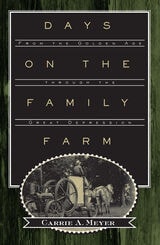
Days on the Family Farm
From the Golden Age through the Great DepressionCarrie A. Meyer
University of Minnesota Press, 2007
From the beginning of the twentieth century to World War II, farm wife May Lyford Davis kept a daily chronicle that today offers a window into a way of life that has all but disappeared. May and her husband Elmo lived through two decades of prosperity, the Great Depression, and two World Wars in their Midwestern farming community. Like many women of her time, Davis kept diaries that captured the everyday events of the family farm; she also kept meticulous farming accounts. In doing so, she left an extraordinary record that reflects not only her own experiences but also the history of early twentieth-century American agriculture.
May and Elmo’s story, engagingly told by Carrie A. Meyer, showcases the large-scale evolution of agriculture from horses to automobile and tractors, a surprisingly vibrant family and community life, and the business of commercial farming. Details such as what items were bought and sold, what was planted and harvested, the temperature and rainfall, births and deaths, and the direction of the wind are gathered to reveal a rich picture of a world shared by many small farmers.
With sustainable and small-scale farming again on the rise in the United States, Days on the Family Farm resonates with both the profound and mundane aspects of rural life—past and present—in the Midwest.
Carrie A. Meyer is associate professor of economics at George Mason University.
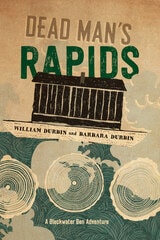
Dead Man's Rapids
William Durbin
University of Minnesota Press, 2018
When 13-year-old Ben Ward left school to work with his Pa in a logging camp, a winter of peeling potatoes and setting tables wasn’t the adventure he had in mind. Still, come spring, he signs up for the log drive with his friend Nevers, wishing the head cook on the wanigan (the floating cook shack) could be someone other than his crabby Pa. Fate, with a wink, complies, and Pa quits—only to be replaced by someone far worse: Pete Sardman, aka Old Sard, a cantankerous character complete with a greasy apron, an eye patch, one deaf ear, and plenty to say.
Luckily, there’s also the rest of the crew—a colorful, sometimes outrageous company of men. Together Ben and Nevers endure freezing weather, dangerous rapids, logjams, storms and floods, and a number of gripping tall tales, along the way learning about logging on the river and a whole lot more about life.
Taking up where Blackwater Ben left off, Dead Man’s Rapids returns to the north woods of Minnesota in the late nineteenth century, and with warmth, humor, and attention to historical detail engages readers both young and old.

Deep Woods, Wild Waters
A MemoirDouglas Wood
University of Minnesota Press, 2025
A journey through the wilds of nature and the twists and turns of daily life with an icon of the North Woods—now in paperback
Wait, young Douglas’s grandfather says as the bobber twitches on the surface of Little Lake. Be patient. And so begins an encounter with the wonder and promise of nature that will last a lifetime. Deep Woods, Wild Waters traces the winding path that carried Douglas Wood from one marvel to the next, through a landscape of rocks, woods, and waters, with stops along the way for questions and reflections that link human nature to the larger mysteries of the natural world.
Like life itself, the author’s way is not linear. One landmark leads back to a favorite campsite, another prompts him to consider the “gospel of rocks,” another launches him into the wilderness beyond the stars—a contemplation of time and space and humanity’s place in all of it. The creator of thirty-four books, including the classic Old Turtle, and an expert woodsman and wilderness canoe guide, Wood brings all his storytelling and bushwhacking skills to bear as he takes us hurtling down wild rapids, crossing stormy lakes, or simply navigating the treacherous currents and twisty trails of everyday life.
A warm, generous, and knowing guide, Wood maps a journey that, as he says, “anyone can take, through a landscape anyone can know.” Turning the pages, hiking the portages, running the rapids, or scanning the wild country from a high promontory, he invites us to say, in a soul-satisfying moment of recognition, “I know that place.”
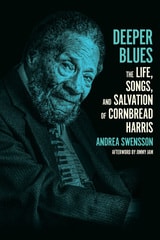
Deeper Blues
The Life, Songs, and Salvation of Cornbread HarrisAndrea Swensson
University of Minnesota Press, 2024
The emotional, epic story of James “Cornbread” Harris—a self-proclaimed “blessed dude” and one of Minneapolis’s most influential musicians
From the heart of the Minnesota blues comes the story of James “Cornbread” Harris Jr., the songwriter, pianist, and consummate bluesman whose seventy years making music helped to shape the Minneapolis Sound. “I am a blessed dude,” Cornbread tells Andrea Swensson, taking us along on his musical journey from a first “gig” entertaining his fellow soldiers during World War II to his subsequent years playing music for audiences across Minnesota. Following Cornbread’s extraordinary life story, Deeper Blues is a unique history of Minnesota music that evolves into a heartfelt tale of reconciliation and forgiveness, all to the tune of the legendary musician’s signature sound.
Cornbread’s career started in the 1950s, when he played with the Augie Garcia Quintet and cowrote their hit “Hi Ho Silver.” A tireless entertainer, he has been performing live ever since, influencing an entire generation of musicians credited with putting Minneapolis on the map in the 1980s—including his long-estranged son, Grammy-winning Rock and Roll Hall of Famer James “Jimmy Jam” Harris III. Going beyond the music, Deeper Blues turns toward family, atonement, and peace when Cornbread reunites with Jimmy Jam after a five-decade separation and they perform together on stage.
Through conversations with Cornbread, Jimmy Jam, and many others, Swensson reveals a story of perseverance and unfailing grace, a firsthand account of making music in the face of racism and segregation, and a hard-won acceptance of the personal sacrifices that are often required when dedicating one’s life to making music. As the man himself says, “All of my hardships ended up to be blessings.”
A rich mix of present-day anecdotes and historical vignettes, animated by voices from Cornbread’s life and the Twin Cities music scene, underscored by the bluesman’s original lyrics of heartache and hope, and featuring never-before-seen photographs of Cornbread and Jimmy Jam, Deeper Blues tells a singular story—one imprinted on the history, heart, and soul of the Minneapolis Sound.
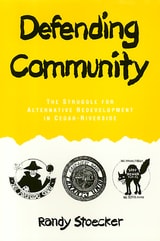
Defending Community
The Struggle for Alternative Redevelopment in Cedar-RiversideRandy Stoecker
Temple University Press, 1994
Randy Stoecker's intimate biography of Cedar-Riverside, nationally known for a period as "the Haight-Ashbury of the Mid-West," contains important lessons about the conflicts between the needs of capitalism and the needs of community. While attending graduate school at the University of Minnesota, the author moved to Cedar-Riverside, a Minneapolis neighborhood known for its determination to enact values of peace, justice, wholeness, participation, and community in its truest sense. There he experienced first-hand the clashes between a radical community and state-backed urban developers.
His narrative tells the story of a community that overcame the odds against its own survival. Slated for total demolition, the neighborhood was saved by a powerful grass-roots movement. Citizens stopped a state-capital coalition from entombing the community in concrete and went on to create one of the largest community controlled urban redevelopment projects in the country After more than twenty years of struggle, Cedar-Riverside continues to experience citizen-controlled urban redevelopment on its own terms, setting an example for other communities, urban planners, and policymakers.
In the series Conflicts in Urban and Regional Development, edited by John R. Logan and Todd Swanstrom.
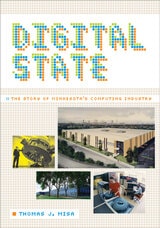
Digital State
The Story of Minnesota's Computing IndustryThomas J. Misa
University of Minnesota Press, 2013
Accounts of the early events of the computing industry—the Turing machine, the massive Colossus, the ENIAC computer—are well-told tales, and equally well known is the later emergence of Silicon Valley and the rise of the personal computer. Yet there is an extraordinary untold middle history—with deep roots in Minnesota. From the end of World War II through the 1970s, Minnesota was home to the first computing-centered industrial district in the world.
Drawing on rare archival documents, photographs, and a wealth of oral histories, Digital State unveils the remarkable story of computer development in the heartland after World War II. These decades found corporations—concentrated in large part in Minnesota—designing state-of-the-art mainframe technologies, revolutionizing new methods of magnetic data storage, and, for the first time, truly integrating software and hardware into valuable products for the American government and public. Minnesota-based companies such as Engineering Research Associates, Univac, Control Data, Cray Research, Honeywell, and IBM Rochester were major international players and together formed an unrivaled epicenter advancing digital technologies. These companies not only brought vibrant economic growth to Minnesota, they nurtured the state’s present-day medical device and software industries and possibly even tomorrow’s nanotechnology.
Thomas J. Misa’s groundbreaking history shows how Minnesota recognized and embraced the coming information age through its leading-edge companies, its workforce, and its prominent institutions. Digital State reveals the inner workings of the birth of the digital age in Minnesota and what we can learn from this era of sustained innovation.
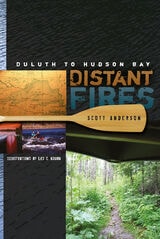
Distant Fires
Duluth to Hudson BayScott Anderson
University of Minnesota Press, 2008
"Distant Fires, a true-life adventure, describes a 1,700-mile canoe trip from Duluth to York Factory on Hudson Bay. Anderson and a companion retraced the paddles taken by Eric Sevareid and a companion almost sixty years earlier. Their trials and tribulations, plus Anderson’s sense of humor, make the trip fun in book form. Pen-and-ink illustrations are by noted Minnesota wildlife artist Les Kouba." —Minneapolis Star Tribune
"Distant Fires is a voyage of discovery. Scott Anderson is an inquisitive traveler, and when he sees something that piques his interest, he stops for a chat. He also has a marvelous eye for the natural world that surrounds him in his summerlong journey. He is a natural-born writer." —Duluth News Tribune
"Some of [Anderson’s] phrasing is very happy indeed: ‘the resting place of the rivers.’ I wish I had written that." —Eric Sevareid

Divided Loyalties
Young Somali Americans and the Lure of ExtremismJoseph Weber
Michigan State University Press, 2020