Results by title
50 books match the query 'Music and race' and 3 start with d
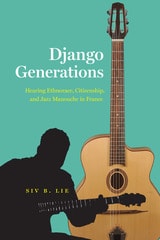
Django Generations
Hearing Ethnorace, Citizenship, and Jazz Manouche in FranceSiv B. Lie
University of Chicago Press, 2021
Django Generations shows how relationships between racial identities, jazz, and national belonging become entangled in France.
Jazz manouche—a genre known best for its energetic, guitar-centric swing tunes—is among France’s most celebrated musical practices of the twentieth and twenty-first centuries. It centers on the recorded work of famed guitarist Django Reinhardt and is named for the ethnoracial subgroup of Romanies (also known, often pejoratively, as “Gypsies”) to which Reinhardt belonged. French Manouches are publicly lauded as bearers of this jazz tradition, and many take pleasure and pride in the practice while at the same time facing pervasive discrimination. Jazz manouche uncovers a contradiction at the heart of France’s assimilationist republican ideals: the music is portrayed as quintessentially French even as Manouches themselves endure treatment as racial others.
In this book, Siv B. Lie explores how this music is used to construct divergent ethnoracial and national identities in a context where discussions of race are otherwise censured. Weaving together ethnographic and historical analysis, Lie shows that jazz manouche becomes a source of profound ambivalence as it generates ethnoracial difference and socioeconomic exclusion. As the first full-length ethnographic study of French jazz to be published in English, this book enriches anthropological, ethnomusicological, and historical scholarship on global jazz, race and ethnicity, and citizenship while showing how music can be an important but insufficient tool in struggles for racial and economic justice.
[more]
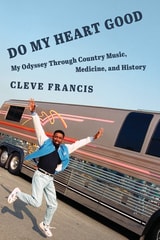
Do My Heart Good
My Odyssey Through Country Music, Medicine, and HistoryCleve Francis
University of Illinois Press, 2026
Born to a struggling family in Jim Crow–era Louisiana, Cleve Francis followed his love for music and passion for science into parallel careers as a singer-songwriter and cardiologist. One of the few Black artists to record for a major country music label, Francis had four Billboard hits as a Capitol Nashville/Liberty Records artist in the 1990s.
Francis’s account follows his “multidimensional life” through two milieus that rarely welcome Black men: country music and medicine. Merging rich storytelling with thoughtful insights, Francis shares the obstacles and triumphs he experienced through his lifelong love of performing music and writing songs, his abiding interest in science and medicine, and his determination to overcome racial barriers. He also offers an insider’s view of the 1990s country music world—the discipline of finding songs and recording in Nashville, the fight to get his music on the radio, and a whirlwind of shows and encounters with country music legends.
Engaging and inspiring, Do My Heart Good is the story of how resolve, hard work, and joy composed a uniquely American success story.
[more]
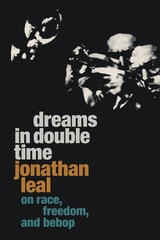
Dreams in Double Time
On Race, Freedom, and BebopJonathan Leal
Duke University Press, 2023
In Dreams in Double Time Jonathan Leal examines how the musical revolution of bebop opened up new futures for racialized and minoritized communities. Blending lyrical nonfiction with transdisciplinary critique and moving beyond standard Black/white binary narratives of jazz history, Leal focuses on the stories and experiences of three musicians and writers of color: James Araki, a Nisei multi-instrumentalist, soldier-translator, and literature and folklore scholar; Raúl Salinas, a Chicano poet, jazz critic, and longtime activist who endured the US carceral system for over a decade; and Harold Wing, an Afro-Chinese American drummer, pianist, and songwriter who performed with bebop pioneers before working as a public servant. Leal foregrounds that for these men and their collaborators, bebop was an affectively and intellectually powerful force that helped them build community and dream new social possibilities. Bebop’s complexity and radicality, Leal contends, made it possible for those like Araki, Salinas, and Wing who grappled daily with state-sanctioned violence to challenge a racially supremacist, imperial nation, all while hearing and making the world anew.
[more]