Results by title
166 books match the query 'Native American' and 5 start with d
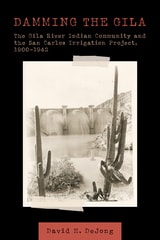
Damming the Gila
The Gila River Indian Community and the San Carlos Irrigation Project, 1900–1942David H. DeJong
University of Arizona Press, 2024
This volume continues to chronicle the history of water rights and activities on the Gila River Indian Reservation. Centered on the San Carlos Irrigation Project and Coolidge Dam, it details the history and development of the project, including the Gila Decree and the Winters Doctrine. Embedded in the narrative is the underlying tension between tribal growers on the Gila River Indian Reservation and upstream users. Told in seven chapters, the story underscores the idea that the Gila River Indian Community believed the San Carlos Irrigation Project was first and foremost for their benefit and how the project and the Gila Decree fell short of restoring their water and agricultural economy.
Damming the Gila is the third in a trio of important documentary works, beginning with DeJong’s Stealing the Gila and followed by Diverting the Gila. It continues the story of the Gila River Indian Community’s fight to regain access to their water.
Dancing Ghosts
Native American And Christian Syncretism In Mary Austin's WorkMark T. Hoyer
University of Nevada Press, 1998
A significant and innovative contribution to Austin studies. How did an Illinois Methodist homesteader in the West come to create one of the most significant cosmological syntheses in American literature? In this study, Hoyer draws on his own knowledge of biblical religion and Native American cultures to explore Austin's creation of the "mythology of the American continent" she so valued. Austin lived in and wrote about "the land of little rain," semiarid and arid parts of California and Nevada that were home to the Northern Paiute, Shoshone, Interior Chumash, and Yokut peoples. Hoyer makes new and provocative connections between Austin and spiritual figures like Wovoka, the prophet of the Ghost Dance religion, and writers like Zitkala-sa and Mourning Dove, and he provides a particularly fine reading of Cogowea.
Dark Thirty
Santee Frazier
University of Arizona Press, 2009
Dark Thirty takes us on a loosely autobiographical trip through Cherokee country, the backwoods towns and the big cities, giving us clear-eyed portraits of Native people surviving contemporary America. In Frazier’s world, there is no romanticizing of Native American life. Here cops knock on the door of a low-rent apartment after a neighbor has been stabbed. Here a poem’s narrator recalls firing a .38 pistol—“barrel glowing like oil in a gutter-puddle”—for the first time. Here a young man catches a Greyhound bus to Flagstaff after his ex-girlfriend tells him he has fathered a child. Yet even in the midst of violence and despair there is time for the beauty of the world to shine through: “The Cutlass rattling out / the last fumes of gas, engine stops, / the night dimly lit by the moon / hung over the treetops; / owls calling each other from / hilltop to valley bend.”
Like viewing photographs that repel us even as they draw us in, we are pulled into these poems. We’re compelled to turn the page and read the next poem. And the next. And each poem rewards us with a world freshly seen and remade for us of sound and image and voice.
Doubters and Dreamers
Janice Gould
University of Arizona Press, 2011
In the first half of the book, “Tribal History,” Gould ingeniously repurposes the sonnet form to preserve the stories of her mother and aunt, who grew up when “muleback was the customary mode / of transport” and the “spirit world was present”—stories of “old ways” and places claimed in memory but lost in time. Elsewhere, she remembers her mother’s “ferocious, upright anger” and her unexpected tenderness (“Like a miracle, I was still her child”), culminating in the profound expression of loss that is the poem “Our Mother’s Death.”
In the second half of the book, “It Was Raining,” Gould tells of the years of lonely self-making and “unfulfilled dreams” as she comes to terms with what she has been told are her “crazy longings” as a lesbian: “It’s been hammered into me / that I’ll be spurned / by a ‘real woman,’ / the only kind I like.” The writing here commemorates old loves and relationships in language that mingles hope and despair, doubt and devotion, veering at times into dreamlike moments of consciousness. One poem and vignette at a time, Doubters and Dreamers explores what it means to be a mixed-blood Native American who grew up urban, lesbian, and middle class in the West.
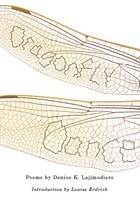
Dragonfly Dance
Denise K. Lajimodiere
Michigan State University Press, 2010
Dragonfly Dance is a collection of poems remarkable for their candor and sense of catharsis. Writing from the vantage point of an American Indian women, Denise Lajimodiere opens a door into the lives of Native girls and women. Her poems often reflect the deep tensions between Native culture and white culture.
Reflected in Lajimodiere's poems, life is sometimes beautiful but rarely easy. "The Necklace," the narrator details how her mother repaired a favorite beaded necklace, "her arthritic fingers patiently / threading beads / on the long thin needle, weaving / night after night." When the necklace is finally repaired, she wears it to school where
At recess a White boy
ran by, yanked
it off my neck and threw it.
I watched as it ascended
high above the blacktop,
the beads glittered, scattering their light,
a rainbow against gray skies.
Unadorned, direct, and often raw, these riveting poems sear their way into our imaginations, inviting us into a world we might never have known. We are richer for the knowledge.