Results by title
129 books match the query 'Natural resources' and 6 start with d
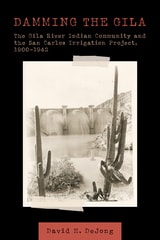
Damming the Gila
The Gila River Indian Community and the San Carlos Irrigation Project, 1900–1942David H. DeJong
University of Arizona Press, 2024
Unraveling a complex web of tension, distrust, and political maneuvering, Damming the Gila continues the story of the Gila River Indian Community’s struggle for the restoration of its water rights.
This volume continues to chronicle the history of water rights and activities on the Gila River Indian Reservation. Centered on the San Carlos Irrigation Project and Coolidge Dam, it details the history and development of the project, including the Gila Decree and the Winters Doctrine. Embedded in the narrative is the underlying tension between tribal growers on the Gila River Indian Reservation and upstream users. Told in seven chapters, the story underscores the idea that the Gila River Indian Community believed the San Carlos Irrigation Project was first and foremost for their benefit and how the project and the Gila Decree fell short of restoring their water and agricultural economy.
Damming the Gila is the third in a trio of important documentary works, beginning with DeJong’s Stealing the Gila and followed by Diverting the Gila. It continues the story of the Gila River Indian Community’s fight to regain access to their water.
[more]

Deforestation in the Postwar Philippines
David M. Kummer
University of Chicago Press, 1992
The only quantitative deforestation study to focus on one country, this case analysis of the Philippines since 1946 yields more concrete data than previous cross-national studies. David Kummer's close examination of the interactions among political, economic, and cultural factors and their environmental consequences sheds light on similar situations in other countries.
[more]
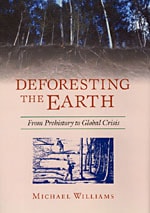
Deforesting the Earth
From Prehistory to Global CrisisMichael Williams
University of Chicago Press, 2002
Since humans first appeared on the earth, we've been cutting down trees for fuel and shelter. Indeed, the thinning, changing, and wholesale clearing of forests are among the most important ways humans have transformed the global environment. With the onset of industrialization and colonization the process has accelerated, as agriculture, metal smelting, trade, war, territorial expansion, and even cultural aversion to forests have all taken their toll.
Michael Williams surveys ten thousand years of history to trace how, why, and when human-induced deforestation has shaped economies, societies, and landscapes around the world. Beginning with the return of the forests to Europe, North America, and the tropics after the Ice Ages, Williams traces the impact of human-set fires for gathering and hunting, land clearing for agriculture, and other activities from the Paleolithic through the classical world and the Middle Ages. He then continues the story from the 1500s to the early 1900s, focusing on forest clearing both within Europe and by European imperialists and industrialists abroad, in such places as the New World and India, China, Japan, and Latin America. Finally, he covers the present-day and alarming escalation of deforestation, with the ever-increasing human population placing a possibly unsupportable burden on the world's forests.
Accessible and nonsensationalist, Deforesting the Earth provides the historical and geographical background we need for a deeper understanding of deforestation's tremendous impact on the environment and the people who inhabit it.
[more]
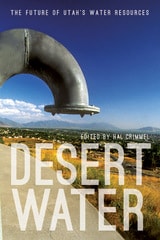
Desert Water
The Future of Utah's Water ResourcesHal Crimmel
University of Utah Press, 2014
Hal Crimmel has brought the findings of science together with the experienced voices of environmental social scientists, humanists, and activists to provide perspective on Utah water issues. The matters discussed are relevant beyond this one state, as similar conditions and concerns, especially over supply and demand in the face of demographic and climate change, exist throughout the West. Some of the essays are scientific and analytical; others literary and personal. Together they draw attention to problems that Utah residents and policy makers must address but also emphasize ways to build solutions. Desert Water will help citizens, policy makers, and anyone interested in Utah’s water supply and use—as everyone in the state should be—understand the real challengesand ethicsinvolved in managing this vital, finite resource. By awareness, these essays should create a sense of urgency for finding workable solutions.
[more]
Discourses of Weakness and Resource Regimes
Trajectories of a New Research ProgramEdited by Iwo Amelung, Hartmut Leppin and Christian A. Müller
Campus Verlag, 2018
The acquisition and deployment of resources—natural and otherwise—will always be at the forefront of geopolitical discourse. At a time when the finite nature of these resources becomes clearer every day, that’s especially true. This book uses a humanities-influenced lens to examine how ideas of weakness affect the stockpiling and usage of resources, delving into the question of self-assessments by people and states alike can influence their handling of resources.
[more]
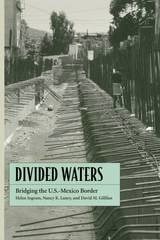
Divided Waters
Bridging the U.S.-Mexico BorderHelen Ingram, Nancy K. Laney, and David M. Gillilan
University of Arizona Press, 1995
Among all natural resource and environmental problems between the United States and Mexico, water has been the most troublesome, with ongoing historic contests over water supply becoming superseded by new controversies over water quality. Divided Waters analyzes the politics of water management along the U.S.-Mexico border, using the case of Nogales, Arizona and Nogales, Sonora as a window on the problems and possibilities involved. The authors explore the water problems that Ambos Nogales shares with larger border communities—surface and groundwater contamination, inadequate and insecure supplies, inequitable distribution of resources, flooding, and endangered riparian habitats—considering both the physical characteristics of the water supply and the coping mechanisms of the people who make use of it. They review the prevailing confusion of laws, administrative practices, and political incentives, then recommend the design elements they believe must be included before successful improvements can occur at both the institutional and the resource management levels.
[more]