Results by title
58 books match the query 'Navajo Indians' and 4 start with d
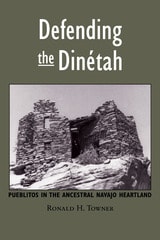
Defending The Dinetah
Ronald H Towner
University of Utah Press, 2003
Using a database of tree-ring dates taken from beams and wood used to construct these pueblitos, Ronald Towner shows in this volume that most pueblitos are unrelated to Puebloan immigration or the re-conquest. He concludes that Navajos constructed the masonry structures and hogans contemporaneously for protection against Ute raiders and later Spanish entradas. Further, most were occupied for relatively brief periods and population density was much lower than has been assumed.
Towner points to a new model of Navajo ethnogenesis, based on a revised early population distribution and a variety of other means of incorporating non-Athapaskan elements into Navajo culture, making Defending the Dinétah a major contribution to Navajo studies.
Diné Identity in a Twenty-First-Century World
Lloyd L. Lee
University of Arizona Press, 2020
Diné identity in the twenty-first century is distinctive and personal. It is a mixture of traditions, customs, values, behaviors, technologies, worldviews, languages, and lifeways. It is a holistic experience. Diné identity is analogous to Diné weaving: like weaving, Diné identity intertwines all of life’s elements together.
In this important new book, Lloyd L. Lee, a citizen of the Navajo Nation and an associate professor of Native American studies, takes up and provides insight on the most essential of human questions: who are we? Finding value and meaning in the Diné way of life has always been a hallmark of Diné studies. Lee’s Diné-centric approach to identity gives the reader a deep appreciation for the Diné way of life. Lee incorporates Diné baa hane’ (Navajo history), Sa’ą́h Naagháí Bik’eh Hózhǫ́ǫ́n (harmony), Diné Bizaad (language), K’é (relations), K’éí (clanship), and Níhi Kéyah (land) to address the melding of past, present, and future that are the hallmarks of the Diné way of life.
This study, informed by personal experience, offers an inclusive view of identity that is encompassing of cultural and historical diversity. To illustrate this, Lee shares a spectrum of Diné insights on what it means to be human. Diné Identity in a Twenty-First-Century World opens a productive conversation on the complexity of understanding and the richness of current Diné identities.
Diné Perspectives
Revitalizing and Reclaiming Navajo ThoughtEdited by Lloyd L. Lee; Foreword by Gregory Cajete
University of Arizona Press, 2014
All of the contributors are coming to personal terms with a phrase that underpins the matrix of Diné culture: Sa’ah Naagháí Bik’eh Hózhóón. Often referred to simply as SNBH, the phrase can be translated in many ways but is generally understood to mean “one’s journey of striving to live a long, harmonious life.” The book offers a variety of perspectives of Diné men and women on the Diné cultural paradigm that is embedded in SNBH. Their writings represent embodied knowledge grounded in a way of knowing that connects thought, speech, experience, history, tradition, and land. Some of the contributors are scholars. Some are Diné who are fighting for justice and prosperity for the Navajo Nation. Some are poets and artists. They are united in working to preserve both intellectual and cultural sovereignty for Diné peoples. And their contributions exemplify how Indigenous peoples are creatively applying tools of decolonization and critical research to re-create Indigenous thought and culture in a present day that rarely resembles the days of their ancestors.
More than 300,000 people self-identify as Diné today. Every one must grapple with how to make a life that acknowledges Sa’ah Naagháí Bik’eh Hózhóón. Diné Perspectives is unique in bringing such personal journeys to the public eye.
Dinéjí Na`nitin
Navajo Traditional Teachings and HistoryRobert S. McPherson
University Press of Colorado, 2012
Historian Robert McPherson discusses basic Navajo concepts such as divination, good and evil, prophecy, and metaphorical thought, as well as these topics' relevance in daily life, making these far-ranging ideas accessible to the contemporary reader. He also considers the toll of cultural loss on modern Navajo culture as many traditional values and institutions are confronted by those of dominant society. Using both historical and modern examples, he shows how cultural change has shifted established views and practices and illustrates the challenge younger generations face in maintaining the beliefs and customs their parents and grandparents have shared over generations.
This intimate look at Navajo values and customs will appeal not only to students and scholars of Native American studies, ethnic studies, and anthropology but to any reader interested in Navajo culture or changing traditional lifeways.