121 books match the query 'Neoliberalism' and 7 start with d
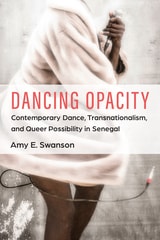
cover of Dancing Opacity: Contemporary Dance, Transnationalism, and Queer Possibility in Senegal

Dancing Opacity

Contemporary Dance, Transnationalism, and Queer Possibility in Senegal

Amy E. Swanson

University of Michigan Press, 2025

Amy Swanson’s Dancing Opacity chronicles the ways in which contemporary dancers in Senegal navigate the global contemporary dance circuit while challenging heteropatriarchal ideologies at home. A longstanding hub of African performing arts, Senegal was at the forefront of the explosion of contemporary dance across the continent at the turn of the twenty-first century. Drawing on ethnographic and historical research, Swanson demonstrates how Senegalese choreographers and dancers contend with entrenched racialized prejudices about Africa outside the continent, while pushing back against repressive regulations of gender and sexuality within Senegal. Swanson employs the concept of opacity, defined as a refusal to adhere to the colonial logic of transparency for dominant gazes and argues that artists create work with multiple layers of meaning that are not meant to be immediately transparent to all viewers. By doing so, these artists evade cultural norms that govern gender and sexual expression in Senegal, while challenging their international audiences to expand their perceptions of African dance. Dancing Opacity highlights the artists’ accounts of their pedagogies, performances, aesthetics, and lived realities, as well as Africanist conceptions of gender, sexuality, and queerness that have yet to be applied to contemporary dance.
[more]
cover of Dark Academia: How Universities Die

Dark Academia

How Universities Die

Peter Fleming

Pluto Press, 2021

“Fleming's books are sparklingly sardonic and hilariously angry”—Guardian
“An excellent and important book''—Journal of Education, Innovation, and Communication

To Professor Peter Fleming, there is a strong link between the neo-liberalization of higher education over the last 20 years and the psychological hell now endured by its staff and students. He believes that impersonal and unforgiving management hierarchies have supplanted academic judgement, collegiality, and professional common sense. He bemoans the modern system of higher education and shines a spotlight on what’s gone wrong and why.

While academia was once thought of as the best job in the world, one that fosters autonomy, craft, intrinsic job satisfaction, and vocational zeal, you would be hard-pressed to find a lecturer who believes that now.

Fleming delves into this new metrics-obsessed, overly hierarchical world to bring out the hidden underbelly of what he terms the 'zombie university'. He examines:

*Commercialization
*Mental illness and self-harm
*The rise of managerialism
*Students as consumers and evaluators
*The competitive individualism which casts a dark sheen of alienation over departments
*And much more!

Arguing that time has almost run out to reverse this decline, this book shows how academics and students need to act now if they are to begin to fix this broken system.
[more]
cover of Democracy and Other Neoliberal Fantasies: Communicative Capitalism and Left Politics

Democracy and Other Neoliberal Fantasies

Communicative Capitalism and Left Politics

Jodi Dean

Duke University Press, 2009

Democracy and Other Neoliberal Fantasies is an impassioned call for the realization of a progressive left politics in the United States. Through an assessment of the ideologies underlying contemporary political culture, Jodi Dean takes the left to task for its capitulations to conservatives and its failure to take responsibility for the extensive neoliberalization implemented during the Clinton presidency. She argues that the left’s ability to develop and defend a collective vision of equality and solidarity has been undermined by the ascendance of “communicative capitalism,” a constellation of consumerism, the privileging of the self over group interests, and the embrace of the language of victimization. As Dean explains, communicative capitalism is enabled and exacerbated by the Web and other networked communications media, which reduce political energies to the registration of opinion and the transmission of feelings. The result is a psychotic politics where certainty displaces credibility and the circulation of intense feeling trumps the exchange of reason.

Dean’s critique ranges from her argument that the term democracy has become a meaningless cipher invoked by the left and right alike to an analysis of the fantasy of free trade underlying neoliberalism, and from an examination of new theories of sovereignty advanced by politicians and left academics to a look at the changing meanings of “evil” in the speeches of U.S. presidents since the mid-twentieth century. She emphasizes the futility of a politics enacted by individuals determined not to offend anyone, and she examines questions of truth, knowledge, and power in relation to 9/11 conspiracy theories. Dean insists that any reestablishment of a vital and purposeful left politics will require shedding the mantle of victimization, confronting the marriage of neoliberalism and democracy, and mobilizing different terms to represent political strategies and goals.
[more]
cover of Desiring China: Experiments in Neoliberalism, Sexuality, and Public Culture

Desiring China

Experiments in Neoliberalism, Sexuality, and Public Culture

Lisa Rofel

Duke University Press, 2007

Through window displays, newspapers, soap operas, gay bars, and other public culture venues, Chinese citizens are negotiating what it means to be cosmopolitan citizens of the world, with appropriate needs, aspirations, and longings. Lisa Rofel argues that the creation of such “desiring subjects” is at the core of China’s contingent, piece-by-piece reconfiguration of its relationship to a post-socialist world. In a study at once ethnographic, historical, and theoretical, she contends that neoliberal subjectivities are created through the production of various desires—material, sexual, and affective—and that it is largely through their engagements with public culture that people in China are imagining and practicing appropriate desires for the post-Mao era.

Drawing on her research over the past two decades among urban residents and rural migrants in Hangzhou and Beijing, Rofel analyzes the meanings that individuals attach to various public cultural phenomena and what their interpretations say about their understandings of post-socialist China and their roles within it. She locates the first broad-based public debate about post-Mao social changes in the passionate dialogues about the popular 1991 television soap opera Yearnings. She describes how the emergence of gay identities and practices in China reveals connections to a transnational network of lesbians and gay men at the same time that it brings urban/rural and class divisions to the fore. The 1999–2001 negotiations over China’s entry into the World Trade Organization; a controversial women’s museum; the ways that young single women portray their longings in relation to the privations they imagine their mothers experienced; adjudications of the limits of self-interest in court cases related to homoerotic desire, intellectual property, and consumer fraud—Rofel reveals all of these as sites where desiring subjects come into being.
[more]
cover of Dialectical Imaginaries: Materialist Approaches to U.S. Latino/a Literature in the Age of Neoliberalism

Dialectical Imaginaries

Materialist Approaches to U.S. Latino/a Literature in the Age of Neoliberalism

Marcial González and Carlos Gallego, editors

University of Michigan Press, 2018

Dialectical Imaginaries brings together essays that analyze the effects of class conflict and capitalist ideology on contemporary works of U.S. Latino/a literature. The editors argue that recent global events have compelled contemporary scholars to reexamine traditional interpretive models that center on identity politics and an ethics of multiculturalism. The volume seeks to demonstrate that materialist methodologies have a greater critical reach than other methods, and that Latino/a literary criticism should be more attuned to interpretive approaches that draw on Marxism and other globalizing social theories. The contributors analyze a wide range of literary works in fiction, poetry, drama, and memoir by writers including Rudolfo Anaya, Gloria Anzaldúa, Daniel Borzutzky, Angie Cruz, Sergio de la Pava, Mónica de la Torre, Sergio Elizondo, Juan Felipe Herrera, Rolando Hinojosa, Quiara Alegría Hudes, Lin-Manuel Miranda, Óscar Martínez, Cherríe Moraga, Urayoán Noel, Emma Pérez, Pedro Pietri, Miguel Piñero, Ernesto Quiñónez, Ronald Ruiz, Hector Tobar, Rodrigo Toscano, Alfredo Véa, Helena María Viramontes, and others.
[more]
cover of Dreadful Desires: The Uses of Love in Neoliberal China

Dreadful Desires

The Uses of Love in Neoliberal China

Charlie Yi Zhang

Duke University Press, 2022
In Dreadful Desires Charlie Yi Zhang examines how the Chinese state deploys affective notions of love to regulate the population and secure China’s place in the global economy. Zhang shows how the state frames love as a set of desires that encompass heteronormative intimacy, familial and communal attachment, upward mobility, and private property ownership. These desires—as circulated in performance in the nationalistic ceremony, same-sex romantic fan fiction, the wildly popular reality television dating show If You Are the One, and the cult of patriarchal personality around Xi Jinping—are explicitly based in oppressive systems of gender, class, and sexuality. Zhang contends that such desires connect love to economic survival and gender normativity in ways that underwrite Chinese neoliberalism at the expense of individual flourishing. By outlining how state-framed forms of love create desires that cannot be fulfilled, Zhang places China at the forefront of using affective attachments to nation, leader, and family in the global shifts toward exploitation and authoritarianism.
[more]
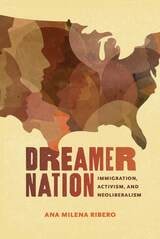
cover of Dreamer Nation: Immigration, Activism, and Neoliberalism

Dreamer Nation

Immigration, Activism, and Neoliberalism

Ana Milena Ribero

University of Alabama Press, 2023

Illustrates how the Dreamer community was created rhetorically—in the discourse, messages, actions, and visual representations of undocumented youth

Dreamer Nation tells the story of how Dreamers in the Obama era creatively confronted a complex sociopolitical landscape to advocate for immigrant rights and empower undocumented youth to proudly represent their lives and identities, all while under the ever-present threat of detention and deportation. Contributing to rhetorical studies of social movements, immigration, and minoritized rhetorics, Ribero argues that even though Dreamer rhetorics were reflective of the discursive limits of the neoliberal milieu, they also worked to disrupt neoliberal constraints through activism that troubled the primacy of the nation-state and citizenship, refused to adhere to respectability politics, forwarded embodied identity and transnational belonging, and looked for liberation in community—not solely in legislative action.

Each chapter presents a different rhetorical situation within the US “crisis” of immigration and the rhetoric that Dreamers used to respond to it. Organized chronologically, the chapters document Dreamer activism during the Obama presidency, from the 2010 hunger strikes advocating for the DREAM Act to undocuqueer “artivism” responding to Trump’s presidential campaign. The author draws not only on the methods and theories of rhetorical studies but also on women of color feminisms, ethnic studies, critical theory, and queer theory. In this way, the book looks across disciplines to illustrate the rhetorical savvy of one of the most important US social movements of our time.
 
[more]