Results by title
152 books match the query 'New York (N.Y.)' and 4 start with d
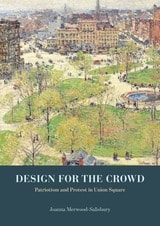
Design for the Crowd
Patriotism and Protest in Union SquareJoanna Merwood-Salisbury
University of Chicago Press, 2019
Situated on Broadway between Fourteenth and Seventeenth Streets, Union Square occupies a central place in both the geography and the history of New York City. Though this compact space was originally designed in 1830 to beautify a residential neighborhood and boost property values, by the early days of the Civil War, New Yorkers had transformed Union Square into a gathering place for political debate and protest. As public use of the square changed, so, too, did its design. When Frederick Law Olmsted and Calvert Vaux redesigned the park in the late nineteenth century, they sought to enhance its potential as a space for the orderly expression of public sentiment. A few decades later, anarchists and Communist activists, including Emma Goldman, turned Union Square into a regular gathering place where they would advocate for radical change. In response, a series of city administrations and business groups sought to quash this unruly form of dissidence by remaking the square into a new kind of patriotic space. As Joanna Merwood-Salisbury shows us in Design for the Crowd, the history of Union Square illustrates ongoing debates over the proper organization of urban space—and competing images of the public that uses it.
In this sweeping history of an iconic urban square, Merwood-Salisbury gives us a review of American political activism, philosophies of urban design, and the many ways in which a seemingly stable landmark can change through public engagement and design.
Published with the support of Furthermore: a program of the J. M. Kaplan Fund.
[more]
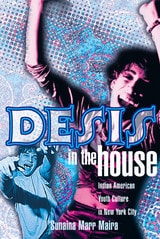
Desis In The House
Indian American Youth Culture In NycSunaina Maira
Temple University Press, 2002
She sports a nose-ring and duppata (a scarf worn by South Asian women) along with the latest fashion in slinky club wear; he's decked out in Tommy gear. Their moves on the crowded dance floor, blending Indian film dance with break-dancing, attract no particular attention. They are just two of the hundreds of hip young people who flock to the desi (i.e., South Asian) party scene that flourishes in the Big Apple.
New York City, long the destination for immigrants and migrants, today is home to the largest Indian American population in the United States. Coming of age in a city remarkable for its diversity and cultural innovation, Indian American and other South Asian youth draw on their ethnic traditions and the city's resources to create a vibrant subculture. Some of the city's hottest clubs host regular bhangra parties, weekly events where young South Asians congregate to dance to music that mixes rap beats with Hindi film music, bhangra (North Indian and Pakistani in origin), reggae, techno, and other popular styles. Many of these young people also are active in community and campus organizations that stage performances of "ethnic cultures."
In this book Sunaina Maira explores the world of second-generation Indian American youth to learn how they manage the contradictions of gender roles and sexuality, how they handle their "model minority" status and expectations for class mobility in a society that still racializes everyone in terms of black or white. Maira's deft analysis illuminates the ways in which these young people bridge ethnic authenticity and American "cool."
[more]

Distant Islands
The Japanese American Community in New York City, 1876-1930sDaniel H. Inouye
University Press of Colorado, 2018
Distant Islands is a modern narrative history of the Japanese American community in New York City between America's centennial year and the Great Depression of the 1930s. Often overshadowed in historical literature by the Japanese diaspora on the West Coast, this community, which dates back to the 1870s, has its own fascinating history.
The New York Japanese American community was a composite of several micro communities divided along status, class, geographic, and religious lines. Using a wealth of primary sources—oral histories, memoirs, newspapers, government documents, photographs, and more—Daniel H. Inouye tells the stories of the business and professional elites, mid-sized merchants, small business owners, working-class families, menial laborers, and students that made up these communities. The book presents new knowledge about the history of Japanese immigrants in the United States and makes a novel and persuasive argument about the primacy of class and status stratification and relatively weak ethnic cohesion and solidarity in New York City, compared to the pervading understanding of nikkei on the West Coast. While a few prior studies have identified social stratification in other nikkei communities, this book presents the first full exploration of the subject and additionally draws parallels to divisions in German American communities.
Distant Islands is a unique and nuanced historical account of an American ethnic community that reveals the common humanity of pioneering Japanese New Yorkers despite diverse socioeconomic backgrounds and life stories. It will be of interest to general readers, students, and scholars interested in Asian American studies, immigration and ethnic studies, sociology, and history.
Winner- Honorable Mention, 2018 Immigration and Ethnic History Society First Book Award
[more]
Dual City
Restructuring New YorkJohn H. Mollenkopf
Russell Sage Foundation, 1991
Have the last two decades produced a New York composed of two separate and unequal cities? As the contributors to Dual City reveal, the complexity of inequality in New York defies simple distinctions between black and white, the Yuppies and the homeless. The city's changing economic structure has intersected with an increasingly diversified population, providing upward mobility for some groups while isolating others. As race, gender, ethnicity, and class become ever more critical components of the postindustrial city, the New York experience illuminates not just one great city, or indeed all large cities, but the forces affecting most of the globe. "The authors constitute an impressive assemblage of seasoned scholars, representing a wide array of pertinent disciplines. Their product is a pioneering volume in the social sciences and urban studies...the 20-page bibliography is a major research tool on its own." —Choice
[more]