Results by title
71 books match the query 'North Carolina' and 4 start with d
Democracy, Dialogue, and Community Action
Truth and Reconciliation in GreensboroSpoma Jovanovic
University of Arkansas Press, 2012
On November 3, 1979, five protest marchers in Greensboro, North Carolina, were shot and killed by the Ku Klux Klan and the American Nazi Party. There were no police present, but television crews captured the shootings on video. Despite two criminal trials, none of the killers ever served time for their crimes, exposing what many believed to be the inadequacy of judicial, political, and economic systems in the United States. Twenty-five years later, in 2004, Greensboro residents, inspired by post-apartheid South Africa, initiated a Truth and Reconciliation Commission (TRC) to take public testimony and examine the causes, sequence of events, and consequences of the massacre. The TRC was to be a process and a tool by which citizens could feel confident about the truth of the city's history in order to reconcile divergent understandings of past and current city values, and it became the foundation for the first Truth and Reconciliation Commission in the United States. Spoma Jovanovic, who worked alongside other community members to document the grassroots effort to convene the first TRC in the United States, provides a resource and case study of how citizens in one community used their TRC as a way to understand the past and conceive the future. This book preserves the historical significance of a people's effort to seek truth and work for reconciliation, shows a variety of discourse models for other communities to use in seeking to redress past harms, and demonstrates the power of community action to promote participatory democracy.
[more]
Doing Good
Racial Tensions and Workplace Inequalities at a Community Clinic in El Nuevo SouthNatalia Deeb-Sossa
University of Arizona Press, 2013
Throughout the “New South,” relationships based on race, class, social status, gender, and citizenship are being upended by the recent influx of Latina/o residents. Doing Good examines these issues as they play out in the microcosm of a community health center in North Carolina that previously had served mostly African American clients but now serves predominantly Latina/o clients. Drawing on eighteen months of experience as a participant- observer in the clinic and in-depth interviews with clinic staff at all levels, Natalia Deeb-Sossa provides an informative and fascinating view of how changing demographics are profoundly affecting the new social order.
Deeb-Sossa argues persuasively that “moral identities” have been constructed by clinic staff. The high-status staff—nearly all of whom are white—see themselves as heroic workers. Mid- and lower-status Latina staff feel like they are guardians of people who are especially needy and deserving of protection. In contrast, the moral identity of African American staffers had previously been established in response to serving “their people.” Their response to the evolving clientele has been to create a self-image of superiority by characterizing Latina/o clients as “immoral,” “lazy,” “working the system,” having no regard for rules or discipline, and being irresponsible parents.
All of the health-care workers want to be seen as “doing good.” But they fail to see how, in constructing and maintaining their own moral identity in response to their personal views and stereotypes, they have come to treat each other and their clients in ways that contradict their ideals.
[more]
Don't Send Me Flowers When I'm Dead
Voices of Rural ElderlyEva J. Salber
Duke University Press, 1983
"This extraordinary book is yet another example of a growing tradition—a literature of compelling and edifying oral history. Dr. Salber has worked for years in one of North Carolina's rural areas, and doing so, has come to know certain elderly people rather well. She has attended their physical complaints, but she has also wanted to know how they live, what they hope for, and what they worry about. She has asked them to speak on the record, to declare to others what occurs to them in the waning hours of their particular lives. The result is a series of American voices reminding us what it has been like for relatively vulnerable, if not defenseless, southern country folk in this rapidly disappearing 20th century.
"They are men and women, blacks and whites, Dr. Salber's teachers. The North Carolinians in this book have no trouble giving us a good measure of open-eyed social comment, not to mention intelligent self-scrutiny and astute moral reflection. These pages glow with all that. . . . This book represents an intense and unyielding ethical as well as medical and literary commitment by a most impressive physician."—Robert Coles
"They are men and women, blacks and whites, Dr. Salber's teachers. The North Carolinians in this book have no trouble giving us a good measure of open-eyed social comment, not to mention intelligent self-scrutiny and astute moral reflection. These pages glow with all that. . . . This book represents an intense and unyielding ethical as well as medical and literary commitment by a most impressive physician."—Robert Coles
[more]
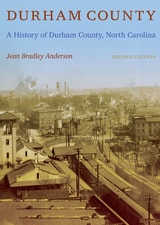
Durham County
A History of Durham County, North CarolinaJean Bradley Anderson
Duke University Press, 2011
In this revised and expanded second edition of Durham County, Jean Bradley Anderson extends her sweeping history of Durham from the seventeenth century to the end of the twentieth. Moving beyond traditional local histories, which tend to focus on powerful families, Anderson integrates the stories of well-known figures with those of ordinary men and women, blacks and whites, to create a complex and fascinating portrait of Durham’s economic, political, social, and labor history. Drawing on extensive primary research, she examines the origins of the town of Durham and recounts the growth of communities around mills, stores, taverns, and churches in the century before the rise of tobacco manufacturing. A historical narrative encompassing the coming of the railroad; the connection between the Civil War and the rise of the tobacco industry; the Confederate surrender at Bennett Place; the relocation of Trinity College to Durham and, later, its renaming as Duke University; and the growth of health-service and high-technology industries in the decades after the development of Research Triangle Park, this second edition of Durham County is a remarkably comprehensive work.
[more]