Results by title
527 books match the query 'Novel' and 21 start with d
Dark Company
A Novel in Ten Rainy NightsGert Loschütz
Seagull Books, 2012

Darktown Strutters
A NovelWesley Brown
University of Massachusetts Press, 2000
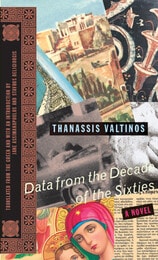
Data from the Decade of the Sixties
A NovelThanassis Valtinos
Northwestern University Press, 2000
Just as Greece today struggles to adapt to a shifting political landscape, so Greece in the 1960s was convulsed by the collision of tradition and cultural transformation. In Data from the Decade of the Sixties, Valtinos assembles voices, stories, and news clips that capture the transformation of Greece, the monarchy giving way to a republic via dictatorship, the industrialization of its agricultural society, and the replacement of arranged marriages with love matches.
The many voices in this tour de force coalesce in a bricolage of documents: personal letters between friends and family, news reports, advertisements, and other written ephemera. As governments fall, sexologists, fortune-tellers, garage owners, and lonely matrons advertise their specialties and fantasies in want ads, while the young and lonely find escape within the cheap novels, movies, and gossip columns that enliven their barren existence.
Together these testimonies illuminate the tumult of 1960s Greece, where generations and values clash and Greek society struggles to adapt. Valtinos captures the pulse of a decade, portraying the spirit of the century in Greece and throughout the world.
Daughters, Fathers, and the Novel
The Sentimental Romance of HeterosexualityLynda Zwinger
University of Wisconsin Press, 1991
Daughters, Fathers, and the Novel is a provocative study of the father-daughter story—a neglected dimension of the family romance. It has important implications for the history of the novel, for our understanding of key texts in that history, and for theories concerning the representation of gender, family relations, and heterosexuality in Western culture.
In the English and American novel, argues Lynda Zwinger, “the good woman” . . . is a father’s daughter, . . . constructed to the very particular specifications of an omnipresent and unvoiced paternal desire.” Zwinger supports her case with an analysis of both “high-brow” and “low-brow” novels and with ingenious textual analyses of five novels: Clarissa Harlowe, Dombey and Son, Little Women, The Golden Bowl, and The Story of O.
In the dominant discourse of Anglo-American culture, the father’s daughter provides the cornerstone for the patriarchal edifice of domesticity and the alibi for patriarchal desire. Zwinger’s analysis of the sexual politics embodied in the figure of this sentimental daughter raises compelling critical and cultural issues. Zwinger shows how different readings of Clarissa’s story form a sentimental composite that makes her available in perpetuity to heterosexual desire. Dombey and Son illuminates the erotic dimension of the sentimental, the titillation always inherent in the spectacle of virtue in distress. Zwinger’s analysis of Little Women in the context of Louisa May Alcott’s own life-text focuses upon the problems of a daughter trying to write the filial romance. The Golden Bowl deploys the daughter of sentiment as a “cover story” for a feminine version of the Oedipal story, founded on the daughter who can’t say yes, but doesn’t say no. The Story of O reveals the pornographic dimension in romantic and sentimental love.
In her conclusion, Zwinger offers an overview of the nineteenth-century novel, asking what difference it makes when the writer is a daughter. She shows how the daughter’s family romance pictures the father as inadequate, ironically requiring the sentimental daughter as a patriarchal prop. She develops a useful concept of hysteria and argues that generic “disorder” and hysterical “intrusions” mark the family romance novels of Jane Austen, Emily and Charlotte Brontë, and George Eliot. And finally, she makes the case that the daughter’s choice to stay home is not necessarily an act of simple complicity, for by staying home she comes as close as she can to disrupting the father-daughter romance.
Daydreamers
A NovelAlvin Lu
University of Alabama Press, 2025
A fragmented manuscript left unfinished, a voice inherited by time, a ghost lingering in the margins—Daydreamers is what remains when fiction forgets its fiction and when the story you’re translating becomes your own.
Upon the discovery of an unfinished manuscript left behind by his late father, a son’s act of literary translation quickly descends into a ghost story of family rumors, art, and the history we inherit, whether we want them or not. As the son translates the mysterious text, what emerges is a narrative haunted by betrayal, artistic rivalry, and a murder in California’s Chinese literary underground—one that was never solved but perhaps was fictionalized.
Cycling between San Francisco, Los Angeles, China, and Taiwan, the novel unfolds across generations of Chinese immigrants and diaspora artists, linked by tenuous friendships, publishing feuds, and the obscure threads of an act of violence. At the center: a spectral woman named Lena Wu, the object of literary fixation, political allegory, and real-life scandal.
Was the manuscript meant as a novel or a confession? Was the story’s central figure—Lena Wu—a real person or an idea and persona passed between generations of writers, each shaping her into their own myth? And what is the narrator’s responsibility when his father’s version of events begins to implicate those still living?
Told through letters, interviews, travelogues, and unclaimed fragments, Daydreamers moves through foggy cities, cluttered studios, desert highways, and vanished publishing circles—where stories are currency and silence is survival. Lu constructs a novel that is both noir and anti-noir, both memoir and anti-memoir—a mystery that resists solving, and a translation that becomes its own original work.

Death of a Department Chair
A NovelLynn C. Miller
University of Wisconsin Press, 2006
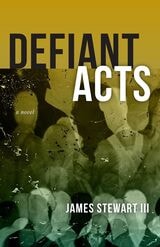
Defiant Acts
A NovelJames Stewart III
Acre Books, 2025
James Stewart III’s powerful debut novel documents the life of a working-class interracial couple and their children in a Chicago suburb in the early 1990s. The father, Jim, is a Black man married to Connie, a white woman with two white sons from a previous marriage. Connie and Jim have three more children together, and the entire family lives in a cramped two-bedroom apartment in a well-to-do, predominantly white community.
Defiant Acts follows the Stewarts through a year in which Jim fights to earn a promotion, the adolescent boys struggle to find themselves, one of the younger children becomes gravely ill, and the parents try to stay afloat in a shaky economy. Within the walls of the Stewarts’ home, race doesn’t factor, but when the family interacts with the outside world, it is inescapable, a basis for identity and inclusion as well as a spur for exclusion and abuse.
Rooted in the tradition of Black authors from Chicago and drawing on the author’s own experiences, Defiant Acts eschews a conventional plot, presenting a series of captured moments—past and present—and multiple perspectives to build a mosaic of the family’s lives. In clear, concise prose, Stewart focuses on the complexities of human relationships and on race relations both in and outside the domestic space, placing emphasis on the values that bind this tight-knit family together: solidarity, care, and hope.
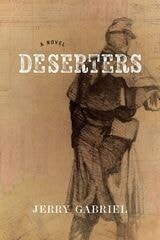
Deserters
A NovelJerry Gabriel
Acre Books, 2026
It is fall 1864, and Robert Riley has deserted his Army of the Potomac unit outside Petersburg, Virginia. Exhausted from years of war and worried about his motherless sons in Ohio, he returns to collect thirteen-year-old Michael and Sean, three years older, and flees to the Western territories. Along the way, he encounters Janey, an orphan at sixteen, who is also eager to go West. When Riley sees in her a quickness of mind, a brand of cunning that mirrors his own, he is persuaded to take her along.
Crossing the lower Midwest on horseback with little money and few possessions, the four are pursued by a wily private detective after the reward for turning in Riley. He manages to thwart the ragtag group, who abandon their plan of crossing the plains. They slip away by train to Chicago, and there, in that cold, stinking, dangerous metropolis, just before the 1864 election, they meet with problems beyond Riley’s ability to resolve. All four find themselves alone, at the mercy of fortune . . . and the fortune hunter, who finally gets the chance to face down his nemesis.
Deserters alternates between the perspectives of the four major characters as their relationships grow and shift, and as each of them strives to forge their way forward in the late war’s murky upheaval. A book whose antecedents include Charles Portis’s True Grit and Paulette Jiles’s News of the World, Gabriel’s immersive novel is an adventure story with psychological intricacy, emotional intensity, and historical heft.
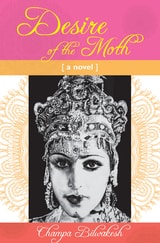
Desire of the Moth
a novelChampa Bilwakesh
UpSet Press, 2017
Hear Champa Bilwakesh reading from Desire of the Moth here: http://voicethread.com/myvoice/#thread/5863247/30058528/31699244

Dexterity
A NovelDouglas Bauer
University of Iowa Press, 2014
This darkly poetic novel is imbued with the same tough and tender understanding of the emotional lives of real people that distinguishes Bauer’s subsequent novels, The Very Air and The Book of Famous Iowans.
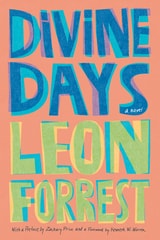
Divine Days
A NovelLeon Forrest; Foreword by Kenneth W. Warren, Preface by Zachary Price
Northwestern University Press, 2023
“I have an awful memory for faces, but an excellent one for voices,” muses Joubert Jones, the aspiring playwright at the center of Divine Days. A kaleidoscopic whorl of characters, language, music, and Black experience, this saga follows Jones for one week in 1966 as he pursues the lore and legends of fictional Forest County, a place resembling Chicago’s South Side. Joubert is a veteran, recently returned to the city, who works for his aunt Eloise’s newspaper and pours drinks at her Night Light Lounge. He wants to write a play about Sugar-Groove, a drifter, “eternal wunderkind,” and local folk hero who seems to have passed away. Sugar-Groove’s disappearance recalls the subject of one of Joubert’s earlier writing attempts—W. A. D. Ford, a protean, diabolical preacher who led a religious sect known as “Divine Days.” Joubert takes notes as he learns about both tricksters, trying to understand their significance.
Divine Days introduces readers to a score of indelible characters: Imani, Joubert’s girlfriend, an artist and social worker searching for her lost siblings and struggling to reconcile middle class life with her values and Black identity; Eloise, who raised Joubert and whose influence is at odds with his writerly ambitions; (Oscar) Williemain, a local barber, storyteller, and founder of the Royal Rites and Righteous Ramblings Club; and the Night Light’s many patrons. With a structure inspired by James Joyce and jazz, Leon Forrest folds references to African American literature and cinema, Shakespeare, the Bible, and classical mythology into a heady quest that embraces life in all its tumult and adventure.
This edition brings Forrest’s masterpiece back into print, incorporating hundreds of editorial changes that the author had requested from W. W. Norton, but were not made for their editions in 1993 and 1994. Much of the inventory from the original printing of the book by Another Chicago Press in 1992 had been destroyed in a disastrous warehouse fire.
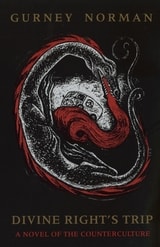
Divine Right's Trip
A Novel of the CountercultureGurney Norman
Ohio University Press, 1990
This first Gnomon Press edition was published in 1990.
Divine Right’s Trip is a countercultural classic that captures the spirit of the 1960s and early 1970s. The novel follows Divine Right (D. R.) Davenport, a restless young man on a journey of self-discovery, as he embarks on a cross-country road trip in his beloved but unreliable old Volkswagen bus, Urge. Accompanied at times by his free-spirited girlfriend, Estelle, D. R. embarks on an odyssey that takes him through communes, small towns, and encounters with eccentric characters, each offering insights into D. R.’s own struggles with identity, freedom, and belonging.
Originally published as a serial in the Last Whole Earth Catalog in 1971, Divine Right’s Trip is both a road novel and a coming-of-age story, reflecting the era’s tensions between individualism and community, rebellion and responsibility. Gurney Norman’s writing is infused with humor, sharp social observation, and a deep appreciation for the landscapes and people of Appalachia, where D. R. ultimately finds himself confronting his roots.
A defining work of Appalachian literature and the countercultural movement, Divine Right’sTrip remains a thought-provoking exploration of personal growth, societal change, and the search for meaning in an ever-shifting world.

Doctoring the Novel
Medicine and Quackery from Shelley to DoyleSylvia A. Pamboukian
Ohio University Press, 2012
Doctoring the Novel explores the ways in which language constructs and stabilizes these slippery terms by examining medical quackery and orthodoxy in works such as Mary Shelley’s Frankenstein, Charles Dickens’s Bleak House and Little Dorrit, Charlotte Brontë’s Villette, Wilkie Collins’s Armadale, and Arthur Conan Doyle’s Stark Munro Letters. Contextualized in both medical and popular publishing, literary analysis reveals that even supposedly medico-scientific concepts such as orthodoxy and quackery evolve not in elite laboratories and bourgeois medical societies but in the rough-and-tumble of the public sphere, a view that acknowledges the considerable, and often underrated, influence of language on medical practices.
Dog Eat Dog
A NovelNiq Mhlongo
Ohio University Press, 2012
Dongola
A Novel of NubiaIdris Ali
University of Arkansas Press, 1998
The University of Arkansas Press Award for Arabic Literature in Translation, 1997
In this, the first Nubian novel ever translated, Awad Shalali, a Nubian worker in modern Egypt, dreams of Dongola—the capital of medieval Nubia, now lost to the flood waters of the Aswan High Dam. In Dongola, the Nubians reached their zenith. They defeated and dominated Upper Egypt, and their archers, deadly accurate in battle, were renowned as “the bowman of the glance.
Helima, Awad’s wife, must deal with the reality of today’s Nubia, a poverty-stricken bottomland. Men like Awad now work in Cairo for good wages while the women remain at home in squalor, dominated by the Islam of their conquerors and ignorant of the glory now covered by the Nile’s water. Left to tend Awad’s sick mother and his dying country, Halima grows despondent and learns the truths behind the Upper Egyptian lyric: “Time, you are a traitor—what have you done with my love?
Through his characters’ pain and suffering, Idris Ali paints in vibrant detail, with wit and a keen sense of history’s absurdities, the story of cultures and hearts divided, of lost lands, impossible dreams, and abandoned lives.
Double Vision
A NovelGeorge Garrett
University of Alabama Press, 2007
A shotgun marriage of fact and fiction by one of the most highly regarded writers and teachers of our time
A writer named George Garrett, suffering from double vision as a result of a neurological disorder, is asked to review a recent, first biography of the late Peter Taylor, a renowned writer who has been his long-time friend and neighbor in Charlottesville. Reflecting on their relationship, Garrett conceives of a character—not unlike himself—a writer in his early 70s, ill and suffering from double vision, named Frank Toomer. He gives Toomer a neighbor, a distinguished short story writer named Aubrey Carver.
As the real George Garrett and Peter Taylor are replaced by two very different and imaginary writers, the story becomes a wise and insightful exploration of American literary life, the art of biography, the comical rivalries among writers and academics, notions of success, and the knotty relationship of art to life, fact to fiction, and life to death. Double Vision is a witty tour de force and an elegy for a gifted generation of writers.
Doña Barbara
A NovelRómulo Gallegos
University of Chicago Press, 2012
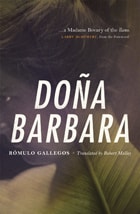
Rómulo Gallegos is best known for being Venezuela’s first democratically elected president. But in his native land he is equally famous as a writer responsible for one of Venezuela’s literary treasures, the novel Doña Barbara. Published in 1929 and all but forgotten by Anglophone readers, Doña Barbara is one of the first examples of magical realism, laying the groundwork for later authors such as Gabriel García Márquez and Mario Vargas Llosa.
Following the epic struggle between two cousins for an estate in Venezuela, Doña Barbara is an examination of the conflict between town and country, violence and intellect, male and female. Doña Barbara is a beautiful and mysterious woman—rumored to be a witch—with a ferocious power over men. When her cousin Santos Luzardo returns to the plains in order to reclaim his land and cattle, he reluctantly faces off against Doña Barbara, and their battle becomes simultaneously one of violence and seduction. All of the action is set against the stunning backdrop of the Venezuelan prairie, described in loving detail. Gallegos’s plains are filled with dangerous ranchers, intrepid cowboys, and damsels in distress, all broadly and vividly drawn. A masterful novel with an important role in the inception of magical realism, Doña Barbara is a suspenseful tale that blends fantasy, adventure, and romance.
Hailed as “the Bovary of the llano” by Larry McMurtry in his new foreword to this book, Doña Barbarais a magnetic and memorable heroine, who has inspired numerous adaptations on the big and small screens, including a recent television show that aired on Telemundo.
Drain
A NovelDavis Schneiderman
Northwestern University Press, 2010
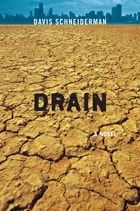
It’s the year 2039, and Lake Michigan is mysteriously emptied of water. The planet’s atmosphere and magnetic field are failing, and fires burn ominously throughout the empty lake bed. In this seemingly endless desert east of Chicago, three factions are locked in conflict: the original end-of-times cultist settlers who follow religious visionary Fulcrum Maneuvers and worship a giant World Worm they deem responsible for the drained lake; the megacorporation Quadrilateral, a mega-consumerist, planned-community combine of bourgeois city planners developing what is now called the Wildland-Urban Interface; and the Blackout Angels, landlocked punk pirates raised in Quadrilateral cities, who oppose everything and everyone.
In Davis Schneiderman’s shocking novel, Drain, freedom, creativity, and transgression wage war with forces of control, censorship, and conformity. The wordscapes of William S. Burroughs and Thomas Pynchon, the dystopic nightmares of Philip K. Dick, and the transgressive punch of Chuck Palahniuk and Georges Bataille together convene in this stunning and thrilling work.
Dream City
A NovelDouglas Unger
University of Nevada Press, 2024
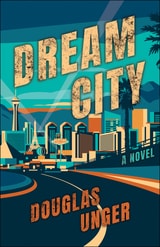
As the story progresses, C. D. comes to understand how his personal losses and the losses of his cohort of hard driving executives on the make—especially the tragic life of his work partner, Greta Olsson, the only woman to break through into their male dominated world—are a result of the make-believe environment he has helped to create, a world where representation replaces reality. Hoping to piece together his faltering marriage and family relationships, C. D. must find a new path as he struggles to hold onto his dreams.
In this fictionalized version of the city of glittering lights, author Douglas Unger pits the ideologies of marketing and consumerism in the casino economy of America against the erosion of individual and humane values that success in that world demands. Unger reveals the hard truth that Las Vegas, a blue-collar town considered by many to be “the most honest city,” can be a temple for self-deceptions, emblematic of a service economy that knows the price of everything and too often the value of little else. Dream City becomes both a love song and an elegy for Las Vegas that sets it apart from any other literary novel previously written about this global entertainment attraction that in so many ways represents postmodern America. Sooner or later, the challenge that faces everyone is to discover what matters most, and to learn how to bet on the better angels of our natures.
Due East
A NovelValerie Sayers
Northwestern University Press, 2013
Duty To Warn
A NovelSara Kersting
Acre Books, 2018
To aid him in the chase, Malden calls on his colleague, the awkward, remote, intimidatingly tall Sonja Nielsen. She reluctantly agrees to help, either because of or despite her previous entanglements with Malden.
Told from the perspectives of these three characters, the story swerves and jolts and switches back, much like Percy’s recollections of his upbringing. Kersting presents the interior struggles of her characters in a searingly spare style, all the while drawing the reader through an escalating series of events as Percy hitches rides and takes buses, searching the small towns of central Michigan, alternately helped and hindered by both old and new acquaintances.
While following disparate leads toward Percy’s final, surprising destination, all three conflicted souls are compelled to examine their loyalties, test their convictions, admit their frailties, and confront the ghosts lurking in their pasts, resulting in a revelatory climax.