Results by title
310 books match the query 'Performance' and 15 start with d
Dance and the Nation
Performance, Ritual, and Politics in Sri LankaSusan A. Reed
University of Wisconsin Press, 2010
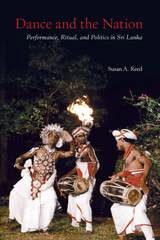
As the national dance of Sri Lanka, Kandyan dance is identified with the majority Sinhala ethnic group and heavily supported by the state. Derived from the kohomba kankariya—an elaborate village ritual performed by men of the hereditary drummer caste—the dance was adopted by the state as a symbol of traditional Sinhala culture in the post-independence period. When state officials introduced the dance into the school curriculum, it was opened to individuals of all castes, and high-caste women have emerged as prominent teachers and performers. Reed’s evocative account traces the history and consequences of this transition from ritual to stage, situating the dance in relation to postcolonial nationalism and ethnic politics and emphasizing the voices and perspectives of the hereditary dancers and of women performers.
Although Kandyan dance is related to other south Asian dance forms, it is unique, distinguished by an elegant, energetic style, and lively displays of acrobatics and agility. The companion DVD includes unparalleled footage of this vibrant dance in ritual, stage, and training contexts, and features the most esteemed performers of the Kandyan region.
Dancing with the Dead
Memory, Performance, and Everyday Life in Postwar OkinawaChristopher T. Nelson
Duke University Press, 2008
Nelson analyzes the practices of specific performers, showing how memories are recalled, bodies remade, and actions rethought as Okinawans work through fragments of the past in order to reconstruct the fabric of everyday life. Artists such as the popular Okinawan actor and storyteller Fujiki Hayato weave together genres including Japanese stand-up comedy, Okinawan celebratory rituals, and ethnographic studies of war memory, encouraging their audiences to imagine other ways to live in the modern world. Nelson looks at the efforts of performers and activists to wrest the Okinawan past from romantic representations of idyllic rural life in the Japanese media and reactionary appropriations of traditional values by conservative politicians. In his consideration of eisā, the traditional dance for the dead, Nelson finds a practice that reaches beyond the expected boundaries of mourning and commemoration, as the living and the dead come together to create a moment in which a new world might be built from the ruins of the old.
Dark Matter
Invisibility in Drama, Theater, and PerformanceAndrew Sofer
University of Michigan Press, 2013
Dark Mattermaps the invisible dimension of theater whose effects are felt everywhere in performance. Examining phenomena such as hallucination, offstage character, offstage action, sexuality, masking, technology, and trauma, Andrew Sofer engagingly illuminates the invisible in different periods of postclassical western theater and drama. He reveals how the invisible continually structures and focuses an audience’s theatrical experience, whether it’s black magic in Doctor Faustus, offstage sex in A Midsummer Night’s Dream, masked women in The Rover, self-consuming bodies in Suddenly Last Summer, or surveillance technology in The Archbishop’s Ceiling. Each discussion pinpoints new and striking facets of drama and performance that escape sight. Taken together, Sofer’s lively case studies illuminate how dark matter is woven into the very fabric of theatrical representation. Written in an accessible style and grounded in theater studies but interdisciplinary by design, Dark Matter will appeal to theater and performance scholars, literary critics, students, and theater practitioners, particularly playwrights and directors.
Death Tourism
Disaster Sites as Recreational LandscapeEdited by Brigitte Sion
Seagull Books, 2014
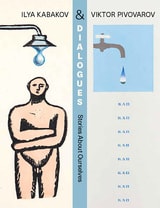
Dialogues
Ilya Kabakov and Viktor Pivovarov, Stories about OurselvesKsenia Nouril
Rutgers University Press, 2020
This exhibition catalog brings together Kabakov and Pivovarov’s key works for the first time, putting the two artists in dialogue and recreating their artistic community. It not only includes nearly hundred pages of full-color illustrations, but also provides complete English translations of the Russian texts that appear in the volume, plus new interviews with each artist. Taken together, they give viewers a new appreciation of the different aesthetic strategies each artist used to depict the absurdities of everyday life in the Soviet era. Published in partnership with the Zimmerli Museum.
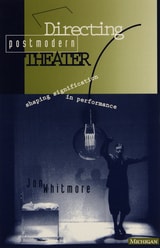
Directing Postmodern Theater
Shaping Signification in PerformanceJon Whitmore
University of Michigan Press, 1994

Disability Arts and Culture
Methods and ApproachesEdited by Petra Kuppers
Intellect Books, 2019
What does it mean to approach disability-focused cultural production and consumption as generative sites of meaning-making? Disability Arts and Culture seeks the answer to this question and more in an exploration of disability studies within the arts and beyond. In this collection, international scholars and practitioners use ethnographic and participatory action research approaches alongside textual and discourse analysis to discover how disability figures into our contemporary world. Chapters explore deaf theater productions, representations of disability on screen, community engagement projects, disabled bodies in dance, and more, in a comprehensive overview of disability studies that will benefit both practitioner and scholar.
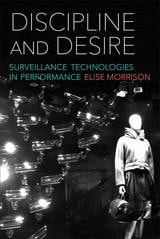
Discipline and Desire
Surveillance Technologies in PerformanceElise Morrison
University of Michigan Press, 2016
While the subject of surveillance continues to provoke fascination and debate in mainstream media and academia, opportunities to critically reflect upon and, more importantly, to imagine alternative, creative responses to living in a rapidly expanding surveillance society have been harder to find. Author Elise Morrison argues that such opportunities are being created through the growing genre of “surveillance art and performance,” defined as works that centrally employ technologies and techniques of surveillance to create theater, installation, and performance art. Introducing readers to a broad range of surveillance art works, including the work of artists and activists such as Surveillance Camera Players, Jill Magid, Steve Mann, Hasan Elahi, Wafaa Bilal, Blast Theory, Electronic Disturbance Theater, George Brant, Janet Cardiff, Mona Hatoum, and Zach Blas, Discipline and Desire provides a practical and analytical framework that can aid the diverse pursuits of new media-arts practitioners, performance scholars, activists, and hobbyists interested in critical and creative uses of surveillance technologies.
Distant Reading
Performance, Readership, and Consumption in Contemporary PoetryPeter Middleton
University of Alabama Press, 2005
A dynamic account of the history, practice, and theory of poetry as performance.
Distant Reading considers poetry as performance, offers new insights into its popularity, and proposes a new history of its origins. It also explores related issues concerning the reception of poetry, the impact of the computer on how we read poetry, the persistence of the letter "I" in poems by avant-garde poets, the strangeness of the line-break as a demand on the reader's attention, and the idea of the reader as consumer. These themes are connected by a historically contextualized and theoretically sophisticated discussion of contemporary American and British poets continuing to work in the modernist tradition.
The introductory essay establishes a new methodology that transforms close reading into what Middleton calls "distant reading," interpretive reading that acknowledges the distances that texts travel from their point of composition to readers in other geographical and historical locations. It indicates that poetic innovation is often driven by a desire on the part of the poet to make this distance do cultural work in the meanings that the poem generates.
Ultimately, Distant Reading treats poetry as a cultural practice that is always situated within specific sites of performance—recited on stage, displayed in magazines, laid out on a page, scrolled on the computer screen—rather than as a transcendent cloud of meaning tethered only to its words.
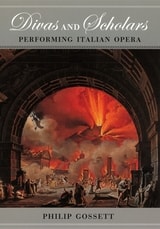
Divas and Scholars
Performing Italian OperaPhilip Gossett
University of Chicago Press, 2006
Winner of the 2007 Otto Kinkeldey Award from the American Musicological Society and the 2007 Deems Taylor Award from the American Society of Composers, Authors, and Publishers.
Divas and Scholars is a dazzling and beguiling account of how opera comes to the stage, filled with Philip Gossett’s personal experiences of triumphant—and even failed—performances and suffused with his towering and tonic passion for music. Writing as a fan, a musician, and a scholar, Gossett, the world's leading authority on the performance of Italian opera, brings colorfully to life the problems, and occasionally the scandals, that attend the production of some of our most favorite operas.
Gossett begins by tracing the social history of nineteenth-century Italian theaters in order to explain the nature of the musical scores from which performers have long worked. He then illuminates the often hidden but crucial negotiations opera scholars and opera conductors and performers: What does it mean to talk about performing from a critical edition? How does one determine what music to perform when multiple versions of an opera exist? What are the implications of omitting passages from an opera in a performance? In addition to vexing questions such as these, Gossett also tackles issues of ornamentation and transposition in vocal style, the matters of translation and adaptation, and even aspects of stage direction and set design.
Throughout this extensive and passionate work, Gossett enlivens his history with reports from his own experiences with major opera companies at venues ranging from the Metropolitan and Santa Fe operas to the Rossini Opera Festival at Pesaro. The result is a book that will enthrall both aficionados of Italian opera and newcomers seeking a reliable introduction to it—in all its incomparable grandeur and timeless allure.
Doing Nothing
James Currie
Duke University Press, 2026
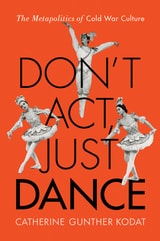
Don't Act, Just Dance
The Metapolitics of Cold War CultureCatherine Gunther Kodat
Rutgers University Press, 2014
Drama-based Pedagogy
Activating Learning Across the CurriculumKathryn Dawson and Bridget Kiger Lee
Intellect Books, 1995
Kathryn Dawson and Bridget Kiger Lee provide an extensive range of tried and tested strategies, planning processes, and learning experiences, in order to create a uniquely accessible manual for those who work, think, train, and learn in educational and/or artistic settings. It is the perfect companion for professional development and university courses, as well as for already established educators who wish to increase student engagement and ownership of learning.
Dramaturgy
An IntroductionCock Dieleman
Amsterdam University Press, 2021
'Dramaturgy. An Introduction' provides a broad overview of the concept of dramaturgy and the profession of the dramaturg. It is intended for students and teachers of theatre and performance studies, but also for directors, scenographers, actors and for all lovers of theatre.

Drop Dead
Performance in Crisis, 1970s New YorkHillary Miller
Northwestern University Press, 2016
Winner, 2017 American Theater and Drama Society John W. Frick Book Award
Winner, 2017 ASTR Barnard Hewitt Award for Outstanding Research in Theater History
Hillary Miller’s Drop Dead: Performance in Crisis, 1970s New York offers a fascinating and comprehensive exploration of how the city’s financial crisis shaped theater and performance practices in this turbulent decade and beyond.
New York City’s performing arts community suffered greatly from a severe reduction in grants in the mid-1970s. A scholar and playwright, Miller skillfully synthesizes economics, urban planning, tourism, and immigration to create a map of the interconnected urban landscape and to contextualize the struggle for resources. She reviews how numerous theater professionals, including Ellen Stewart of La MaMa E.T.C. and Julie Bovasso, Vinnette Carroll, and Joseph Papp of The Public Theater, developed innovative responses to survive the crisis.
Combining theater history and close readings of productions, each of Miller’s chapters is a case study focusing on a company, a production, or an element of New York’s theater infrastructure. Her expansive survey visits Broadway, Off-, Off-Off-, Coney Island, the Brooklyn Academy of Music, community theater, and other locations to bring into focus the large-scale changes wrought by the financial realignments of the day.
Nuanced, multifaceted, and engaging, Miller’s lively account of the financial crisis and resulting transformation of the performing arts community offers an essential chronicle of the decade and demonstrates its importance in understanding our present moment.