Results by title
221 books match the query 'Personal narratives' and 11 start with d
Dear Delia
The Civil War Letters of Captain Henry F. Young, Seventh Wisconsin InfantryHenry F. Young, edited by Micheal J. Larson and John David Smith
University of Wisconsin Press, 2019
Dialogue with Death
The Journal of a Prisoner of the Fascists in the Spanish Civil WarArthur Koestler
University of Chicago Press, 2011
In 1937 during the Spanish Civil War, Arthur Koestler, a German exile writing for a British newspaper, was arrested by Nationalist forces in Málaga. He was then sentenced to execution and spent every day awaiting death—only to be released three months later under pressure from the British government. Out of this experience, Koestler wrote Darkness at Noon, his most acclaimed work in the United States, about a man arrested and executed in a Communist prison.
Dialogue with Death is Koestler’s riveting account of the fall of Málaga to rebel forces, his surreal arrest, and his three months facing death from a prison cell. Despite the harrowing circumstances, Koestler manages to convey the stress of uncertainty, fear, and deprivation of human contact with the keen eye of a reporter.
Diaries of John Gregory Bourke Volume 1
November 20, 1872--July 28, 1876Charles M. Robinson III
University of North Texas Press, 2003
Diaries of John Gregory Bourke Volume 2
July 29, 1876--April 7, 1878Charles M. Robinson III
University of North Texas Press, 2003
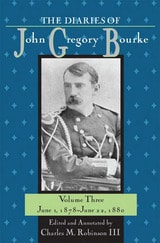
Diaries of John Gregory Bourke Volume 3
June 1, 1878--June 22, 1880Charles M. Robinson III
University of North Texas Press, 2003
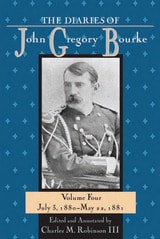
Diaries of John Gregory Bourke Volume 4
July 3, 1880--May 22, 1881Charles M. Robinson III
University of North Texas Press, 2003
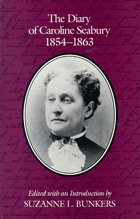
Diary of Caroline Seabury
Caroline Seabury
University of Wisconsin Press, 1991
In 1854 Caroline Seabury of Brooklyn, New York, set out for Columbus, Mississippi, to teach French at its Institute for Young Ladies. She lived in Columbus until 1863, through the years of mounting sectional bitterness that preceded the Civil War and through the turmoil and hardships of the war itself. During that time, her most intimate confidant was her diary. Discovered in the archives of the Minnesota State Historical Society, it is published here for the first time.
The diary is an illuminating account of southern plantation society and the “peculiar institution” of slavery on the eve of its destruction. Seabury also records her uneasy attempts to come to terms with her position as an unmarried, white, Northern woman whose job was to educate wealthy, white, Southern girls in a setting seemingly oblivious to the horrors of slavery. The diary is not simply a chronicle of daily happenings; Seabury concentrates on remarkable events and the memorable feelings and ideas they generate, shaping them into entries that reveal her as an accomplished writer. She frames her narrative with her journey south in 1854 and the hazardous and exhausting return north through battle lines in 1863.
Disapproving of slavery, yet deeply attached to friends and her life in Columbus and also painfully conscious of the fragility of her own economic and social position, Seabury condemned privately in her diary the evils that she endured silently in public. There are striking scenes of plantation life that depict the brutalities of slavery and benumbed responses to them. Seabury also successfully captures the mood of Mississippi as it changed from a fire-eating appetite to fight the Yankees to a grim apprehension of inexorable defeat. Most impressive of all is Seabury’s poignantly honest presentation of herself, caught in the middle.
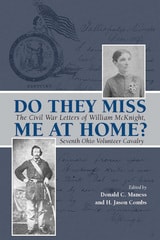
Do They Miss Me at Home?
The Civil War Letters of William McKnight, Seventh Ohio Volunteer CavalryDonald C. Maness
Ohio University Press, 2010
William McKnight was a member of the Seventh Ohio Volunteer Cavalry from September 1862 until his death in June of 1864. During his time of service, McKnight penned dozens of emotion-filled letters, primarily to his wife, Samaria, revealing the struggles of an entire family both before and during the war.
This collection of more than one hundred letters provides in-depth accounts of several battles in Kentucky and Tennessee, such as the Cumberland Gap and Knoxville campaigns that were pivotal events in the Western Theater. The letters also vividly respond to General John Hunt Morgan’s raid through Ohio and correct claims previously published that McKnight was part of the forces chasing Morgan. By all accounts Morgan did stay for a period of time at McKnight’s home in Langsville during his raid through Ohio, much to McKnight’s horror and humiliation, but McKnight was in Kentucky at the time. Tragically, McKnight was killed in action nearly a year later during an engagement with Morgan’s men near Cynthiana, Kentucky.
Dominguez Escalante Journal
Their Expedition Through Colorado Utah Az & N Mex 1776Ted J. Warner
University of Utah Press, 1995
Translated by Fray Angelico Chavez, Edited by Ted J. Warner
Western History
The chronicle of Fray Francisco Atanasio Domínguez and Fray Silvestre Vélez de Escalante’s most remarkable 1776 expedition through the Rocky Mountains, the eastern Great Basin, and the Colorado Plateau to inventory new lands for the Spanish crown and to find a route from Santa Fe to Monterey, California.
Escalante’s journal wonderfully describes every detail of the rugged and scenic country through which they journeyed, along the qualities and customs of its inhabitants. Working as far north as present-day Provo, Utah, the expedition finally returned south. An approaching severe winter and mishaps among the maze of the Grand Canyon forced the party to return to Santa Fe by way of the Hopi pueblos.
This journal provides a fascinating account of over a thousand miles of wilderness exploration.
Doomed in Afghanistan
A U.N. Officer's Memoir of the Fall of Kabul and Najibullah's Failed Escape, 1992Corwin, Phillip
Rutgers University Press, 2002
To understand more deeply the tragic events of September 11, 2001, it is critical to know Afghanistan’s recent and turbulent past. Doomed inAfghanistan provides a first-hand account of how failed diplomacy led to an Islamic fundamentalist victory in a war-torn country, and subsequently, to a Taliban takeover and a home for Osama bin Laden’s Al Qaeda terrorist network.
In April of 1992, Phillip Corwin was part of a United Nations team in Afghanistan whose mission was to help ensure the transfer of power from the Soviet-installed communist regime of President Najibullah to an interim government (that would prepare for elections). Without the support of the Soviet Union, Najibullah’s regime crumbled, and he was convinced to resign in favor of a national unity government, with the understanding that he would be evacuated to a neutral country (India). Due to a series of miscalculations and machinations, the U.N.’s diplomatic mission failed. Kabul fell to groups of mujahiddin before Najibullah could be evacuated. The inability of the various mujahiddin factions to unite led to their eventual defeat by the Taliban, who four years later routed Najibullah from his safe haven at the U.N. compound, and executed him.
Corwin gives a vivid account of the seminal event of Najibullah’s failed evacuation and the frenzied negotiations that were unable to forestall the anarchy and chaos that followed.
Double Duty in the Civil War
The Letters of Sailor and Soldier Edward W. BaconEdited by George S. Burkhardt
Southern Illinois University Press, 2009
In 1861 at the age of eighteen, Edward Woolsey Bacon, a Yale student and son of well-known abolitionist minister Leonard Bacon, left his home in New Haven, Connecticut, to fight for the United States. Over the next four years Bacon served in both the Union navy and army, which gave him a sweeping view of the Civil War. His postings included being a captain’s clerk on the USS Iroquois, a hospital clerk in his hometown, a captain in the 29th Connecticut Infantry (Colored), and a major in the 117th U.S. Colored Infantry, and he described these experiences in vibrant letters to his friends and family. Historian George S. Burkhardt has compiled these letters, as well as Bacon’s diary in the impressive Double Duty in the Civil War: The Letters of Sailor and Soldier Edward W. Bacon.
Bacon tells of hunting Confederate commerce raiders on the high seas, enduring the tedium of blockade duty, and taking part in riverine warfare on the Mississippi. He recalls sweating in South Carolina as an infantry officer during drill and picket duty, suffering constant danger in the battlefield trenches of Virginia, marching victoriously on fallen Richmond, and tolerating the boredom of occupation duty in Texas.
His highly entertaining letters shed new light on naval affairs and reveal a close-knit family life. The narrative of his duty with black troops is especially valuable, since few first-hand accounts from white officers of the U.S. Colored Troops exist. Furthermore, his beliefs about race, slavery, and the Union cause were unconventional for the time and stand in contrast to those held by many of his contemporaries.
Double Duty in the Civil War is filled with lively descriptions of the men Bacon met and the events he experienced. With Burkhardt’s careful editing and useful annotations, Bacon’s letters and diary excerpts give rare insight into areas of the Civil War that have been neglected because of a lack of available sources. Given the scarcity of eyewitness testimonies to navy life and life in African American regiments, this book is a rarity indeed.