Results by title
64 books match the query 'Pets' and 5 start with d

Dog's Best Friend
Annals of the Dog-Human RelationshipMark Derr
University of Chicago Press, 2004
A comprehensive, humane, and bemused tour of the dog-human relationship, Dog's Best Friend combines anecdote, research, and reportage to illuminate our complex rapport with our cherished canine companions. Tracking our national obsession with an animal that now outnumbers children in American households, Mark Derr chronicles the evolution of "the culture of the dog" from the prehistoric domestication of tamed wolves to the modern horrors of overbreeding and inbreeding.
Passionate about his subject and intent on sharing his zeal, Derr defends dogs with wit and flare, producing here a quirky, informative, and fitting tribute to our love affair with canines big and small.
Passionate about his subject and intent on sharing his zeal, Derr defends dogs with wit and flare, producing here a quirky, informative, and fitting tribute to our love affair with canines big and small.
[more]
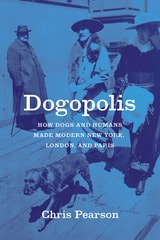
Dogopolis
How Dogs and Humans Made Modern New York, London, and ParisChris Pearson
University of Chicago Press, 2021
Dogopolis presents a surprising source for urban innovation in the history of three major cities: human-canine relationships.
Stroll through any American or European city today and you probably won’t get far before seeing a dog being taken for a walk. It’s expected that these domesticated animals can easily navigate sidewalks, streets, and other foundational elements of our built environment. But what if our cities were actually shaped in response to dogs more than we ever realized?
Chris Pearson’s Dogopolis boldly and convincingly asserts that human-canine relations were a crucial factor in the formation of modern urban living. Focusing on New York, London, and Paris from the early nineteenth century into the 1930s, Pearson shows that human reactions to dogs significantly remolded them and other contemporary western cities. It’s an unalterable fact that dogs—often filthy, bellicose, and sometimes off-putting—run away, spread rabies, defecate, and breed wherever they like, so as dogs became a more and more common in nineteenth-century middle-class life, cities had to respond to people’s fear of them and revulsion at their least desirable traits. The gradual integration of dogs into city life centered on disgust at dirt, fear of crime and vagrancy, and the promotion of humanitarian sentiments. On the other hand, dogs are some people’s most beloved animal companions, and human compassion and affection for pets and strays were equally powerful forces in shaping urban modernity. Dogopolis details the complex interrelations among emotions, sentiment, and the ways we manifest our feelings toward what we love—showing that together they can actually reshape society.
[more]
Dogopolis
How Dogs and Humans Made Modern New York, London, and ParisChris Pearson
University of Chicago Press, 2021
This is an auto-narrated audiobook version of this book.
Dogopolis presents a surprising source for urban innovation in the history of three major cities: human-canine relationships.
Stroll through any American or European city today and you probably won’t get far before seeing a dog being taken for a walk. It’s expected that these domesticated animals can easily navigate sidewalks, streets, and other foundational elements of our built environment. But what if our cities were actually shaped in response to dogs more than we ever realized?
Chris Pearson’s Dogopolis boldly and convincingly asserts that human-canine relations were a crucial factor in the formation of modern urban living. Focusing on New York, London, and Paris from the early nineteenth century into the 1930s, Pearson shows that human reactions to dogs significantly remolded them and other contemporary western cities. It’s an unalterable fact that dogs—often filthy, bellicose, and sometimes off-putting—run away, spread rabies, defecate, and breed wherever they like, so as dogs became a more and more common in nineteenth-century middle-class life, cities had to respond to people’s fear of them and revulsion at their least desirable traits. The gradual integration of dogs into city life centered on disgust at dirt, fear of crime and vagrancy, and the promotion of humanitarian sentiments. On the other hand, dogs are some people’s most beloved animal companions, and human compassion and affection for pets and strays were equally powerful forces in shaping urban modernity. Dogopolis details the complex interrelations among emotions, sentiment, and the ways we manifest our feelings toward what we love—showing that together they can actually reshape society.
[more]

Dogs
A New Understanding of Canine Origin, Behavior and EvolutionRaymond Coppinger and Lorna Coppinger
University of Chicago Press, 2002
Biologists, breeders and trainers, and champion sled dog racers, Raymond and Lorna Coppinger have more than four decades of experience with literally thousands of dogs. Offering a scientifically informed perspective on canines and their relations with humans, the Coppingers take a close look at eight different types of dogs—household, village, livestock guarding, herding, sled-pulling, pointing, retrieving, and hound. They argue that dogs did not evolve directly from wolves, nor were they trained by early humans; instead they domesticated themselves to exploit a new ecological niche: Mesolithic village dumps. Tracing the evolution of today's breeds from these village dogs, the Coppingers show how characteristic shapes and behaviors—from pointing and baying to the sleek shapes of running dogs—arise from both genetic heritage and the environments in which pups are raised.
For both dogs and humans to get the most out of each other, we need to understand and adapt to the biological needs and dispositions of our canine companions, just as they have to ours.
For both dogs and humans to get the most out of each other, we need to understand and adapt to the biological needs and dispositions of our canine companions, just as they have to ours.
[more]

Domestic Architecture In Andes
Mark S. Aldenderfer
University of Iowa Press, 1993
Domestic Architecture, Ethnicity, and Complementarity in the South-Central Andes is a comprehensive and challenging look at the burgeoning field of Andean domestic architecture. Aldenderfer and fourteen contributors use domestic architecture to explore two major topics in the prehistory of the south-central Andes: the development of different forms of complementary relationships between highland and lowland peoples and the definition of the ethnic affiliations of these peoples.
[more]