Results by title
210 books match the query 'Philosophy, Theory & Social Aspects' and 11 start with d
Dare the School Build a New Social Order?
George S. Counts. Preface by Wayne J. Urban
Southern Illinois University Press, 1978
George S. Counts was amajor figure in American education for almost fifty years. Republication of this early (1932) work draws special attention to Counts’s role as a social and political activist. Three particular themes make the book noteworthy because of their importance in Counts’s plan for change as well as for their continuing contemporary importance: (1)Counts’s criticism of child-centered progressives; (2) the role Counts assigns to teachers in achieving educational and social reform; and (3) Counts’s idea for the reform of the American economy.

Dark Academia
How Universities DiePeter Fleming
Pluto Press, 2021
“Fleming's books are sparklingly sardonic and hilariously angry”—Guardian
“An excellent and important book''—Journal of Education, Innovation, and Communication
To Professor Peter Fleming, there is a strong link between the neo-liberalization of higher education over the last 20 years and the psychological hell now endured by its staff and students. He believes that impersonal and unforgiving management hierarchies have supplanted academic judgement, collegiality, and professional common sense. He bemoans the modern system of higher education and shines a spotlight on what’s gone wrong and why.
While academia was once thought of as the best job in the world, one that fosters autonomy, craft, intrinsic job satisfaction, and vocational zeal, you would be hard-pressed to find a lecturer who believes that now.
Fleming delves into this new metrics-obsessed, overly hierarchical world to bring out the hidden underbelly of what he terms the 'zombie university'. He examines:
*Commercialization
*Mental illness and self-harm
*The rise of managerialism
*Students as consumers and evaluators
*The competitive individualism which casts a dark sheen of alienation over departments
*And much more!
Arguing that time has almost run out to reverse this decline, this book shows how academics and students need to act now if they are to begin to fix this broken system.
Decolonizing the University
Edited by Gurminder K. Bhambra, Kerem Nisancioglu and Dalia Gebrial
Pluto Press, 2018
In 2015, students at the University of Cape Town demanded the removal of a statue of Cecil Rhodes, the imperialist, racist business magnate, from their campus. Their battle cry, #RhodesMustFall, sparked an international movement calling for the decolonization of universities all over the world.
Today, as the movement develops beyond the picket line, how might it go on to radically transform the terms upon which universities exist? In this book, students, activists, and scholars discuss the possibilities and the pitfalls of doing decolonial work in the heart of the establishment. Subverting curricula, demanding diversity, and destroying old boundaries, this is a radical call for a new era of education. Chapters include:
*Rhodes Must Fall: Oxford and Movements for Change (Dalia Febrial)
*Race and the Neoliberal University ((John Holmwood)
*Black/Academia (Robbie Shilliam)
*The Challenge for Black Studies in the Neoliberal University (Kehinde Andrews)
*Open Initiatives for Decolonising the Curriculum (Pat Lockley)
*Decolonising Education: A Pedagogic Intervention (Carol Azumah Dennis)
*Understanding Eurocentrism as a Structural Problem of Undone Science (William Jamal Richardson)
As the book’s insightful Introduction states, "Taking colonialism as a global project as a starting point, it becomes difficult to turn away from the Western university as a key site through which colonialism—and colonial knowledge in particular—is produced, consecrated, institutionalized and naturalized." Offering resources for students and academics to challenge and resist colonialism inside and outside the classroom, Decolonizing the University provides the tools for radical change in educational disciplines, pedagogies, and institutions.
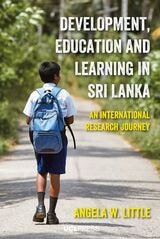
Development, Education and Learning in Sri Lanka
An International Research JourneyAngela W. Little
University College London, 2024
Sri Lanka’s early achievements in education and literacy became well-known among the international development community in the middle of the last century and were often used to benchmark progress elsewhere. Development, Education and Learning in Sri Lanka presents an illuminating narrative of changing education fortunes and inequalities, based on half a century of research conducted by Angela W. Little. This journey was undertaken in collaboration with Sri Lankan researchers island-wide in myriad communities, schools, classrooms, and education offices, through conversations with countless parents, teachers, students, community members, trade union officers, politicians, and members of local, national, and international development agencies, as well as through extensive documentary analysis.
The book delineates the distinctive and changing features of the Sri Lankan education system and compares it with systems elsewhere, to offer in-depth analyses of myriad issues and challenges in a single country over an extended period, framed by shifting international discourses and comparisons with education systems elsewhere. These analyses are framed by themes in the international development discourse on education and development–some of which have been influenced by the Sri Lankan story–ranging from modernization to basic needs to sustainable development. The book promotes a message about the need to understand education and development on a country’s own terms and to place learning at the heart of education policy, situating it within broader conceptions of the purpose, values, and means of development.
Dewey for Artists
Mary Jane Jacob
University of Chicago Press, 2018
Dewey argued that there is strong social value to be found in art, and it is artists who often most challenge our preconceived notions. Dewey for Artists shows us how Dewey advocated for an “art of democracy.” Identifying the audience as co-creator of a work of art by virtue of their experience, he made space for public participation. Moreover, he believed that societies only become—and remain—truly democratic if its citizens embrace democracy itself as a creative act, and in this he advocated for the social participation of artists.
Throughout the book, Mary Jane Jacob draws on the experiences of contemporary artists who have modeled Dewey’s principles within their practices. We see how their work springs from deeply held values. We see, too, how carefully considered curatorial practice can address the manifold ways in which aesthetic experience happens and, thus, enable viewers to find greater meaning and purpose. And it is this potential of art for self and social realization, Jacob helps us understand, that further ensures Dewey’s legacy—and the culture we live in.
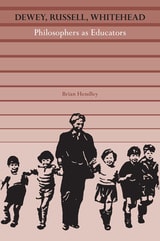
Dewey, Russell, Whitehead
Philosophers as EducatorsBrian Patrick Hendley
Southern Illinois University Press, 1986
In Philosophers as Educators Brian Patrick Hendley argues that philosophers of education should reject their preoccupation with defining terms and analyzing concepts and embrace the philosophical task of constructing general theories of education. Hendley discusses in detail the educational philosophies of John Dewey, Bertrand Russell, and Alfred North Whitehead. He sees in these men excellent role models that contemporary philosophers might well follow. Hendley believes that, like these mentors, philosophers should take a more active, practical role in education. Dewey and Russell ran their own schools, and Whitehead served as a university administrator and as a member of many committees created to study education.
Dialogic Education
Conversation About Ideas and Between PersonsRonald C. Arnett
Southern Illinois University Press, 1993
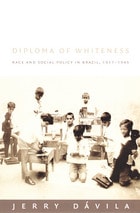
Diploma of Whiteness
Race and Social Policy in Brazil, 1917–1945Jerry Dávila
Duke University Press, 2003
Providing a unique historical perspective on how racial attitudes move from elite discourse into people’s lives, Diploma of Whiteness shows how public schools promoted the idea that whites were inherently fit and those of African or mixed ancestry were necessarily in need of remedial attention. Analyzing primary material—including school system records, teacher journals, photographs, private letters, and unpublished documents—Dávila traces the emergence of racially coded hiring practices and student-tracking policies as well as the development of a social and scientific philosophy of eugenics. He contends that the implementation of the various policies intended to “improve” nonwhites institutionalized subtle barriers to their equitable integration into Brazilian society.

Dirty Words
The Rhetoric of Public Sex Education, 1870-1924Robin E. Jensen
University of Illinois Press, 2010
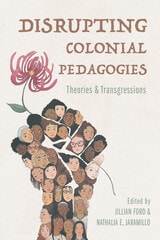
Disrupting Colonial Pedagogies
Theories and TransgressionsEdited by Jillian Ford and Nathalia Jaramillo
University of Illinois Press, 2023
Jillian Ford and Nathalia E. Jaramillo edit a collection of writings by women that examine womanist worldviews in philosophy, theory, curriculum, public health, and education. Drawing on thinkers like bell hooks and Cynthia Dillard, the essayists challenge the colonizing hegemonies that raise and sustain patriarchal and male-centered systems of teaching and learning. Part One examines how womanist theorizing and creative activity offer a space to study the impact of conquest and colonization on the Black female body and spirit. In Part Two, the contributors look at ways of using text, philosophy, and research methodologies to challenge colonizing and colonial definitions of womanhood, enlightenment, and well-being. The essays in Part Three undo the colonial pedagogical project and share the insights they have gained by freeing themselves from its chokehold.
Powerful and interdisciplinary, Disrupting Colonial Pedagogies challenges colonialism and its influence on education to advance freer and more just forms of knowledge making.
Contributors: Silvia García Aguilár, Khalilah Ali, Angela Malone Cartwright, Adriana Diego, LeConté Dill, Sameena Eidoo, Genevieve Flores-Haro, Jillian Ford, Leena Her, Nathalia E. Jaramillo, Patricia Krueger-Henney, Claudia Lozáno, Liliana Manriquez, Alberta Salazár, León Salazár, and Lorri Santamaría
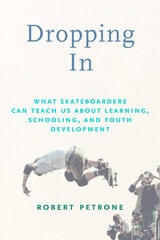
Dropping In
What Skateboarders Can Teach Us about Learning, Schooling, and Youth DevelopmentRobert Petrone
University of Massachusetts Press, 2023
The die-hard local skateboarders of Franklin Skatepark—a group of working-class, Latino and white young men in the rural Midwest—are typically classified by schools and society as “struggling,” “at-risk,” “failing,” and “in crisis.” But at the skatepark, they thrive and succeed, not only by landing tricks but also by finding meaning and purpose in their lives.
In Dropping In, Robert Petrone draws from multiple years of ethnographic research to bring readers into this rich environment, exploring how and why these young men engage more with skateboarding and its related cultural communities than with school. For them, it is in these alternative communities and spaces that they meet their intellectual, literate, and learning needs; cultivate meaningful and supportive relationships; and develop a larger understanding of their place in the world. By looking at what these skateboarders can teach us about what is right and working in their lives, Petrone asks educators and others committed to youth development to rethink schooling structures and practices to provide equitable education for all students.