Results by title
230 books match the query 'Physics' and 7 start with d
Darney's Circuit Modelling for Electromagnetic Compatibility
Ian B. Darney
The Institution of Engineering and Technology, 2026
Electromagnetic interference or compatibility is a challenge faced by circuit designers across all areas of research, applications and industries, and is the subject of strict regulatory requirements. Darney's Circuit Modelling for Electromagnetic Compatibility, 2nd Edition shows how the analytical tools of circuit theory can be used to simulate the coupling of interference into, and out of, any signal link in the system being reviewed. This approach offers EMC testers and product designers a tool to work with at an early stage, before running expensive Faraday cage tests, which offers insight into whether a design is on the right track to achieving its design specification and so saving time and money.
[more]
Darney's Circuit Theory and Modelling
Updated and extended for EMC/EMIIan B. Darney
The Institution of Engineering and Technology, 2024
The equipotential earth is a fundamental requirement of circuit theory, because it dramatically reduces the complexity of the mathematics required to simulate a circuit. Unfortunately, in the real world, no such equipotential earth exists, nor can it ever do so, which means simulating a circuit to evaluate its electromagnetic compatibility (EMC) and susceptibility to electromagnetic interference (EMI) is largely dependent on using the Maxwell equations. The Maxwell equations are inherently complex, however, and so have high processing power requirements and, as with all complex systems, there is a propensity to generate and magnify errors.
[more]
Descartes' Metaphysical Physics
Daniel Garber
University of Chicago Press, 1992
In this first book-length treatment of Descartes' important and influential natural philosophy, Daniel Garber is principally concerned with Descartes' accounts of matter and motion—the joint between Descartes' philosophical and scientific interests. These accounts constitute the point at which the metaphysical doctrines on God, the soul, and body, developed in writings like the Meditations, give rise to physical conclusions regarding atoms, vacua, and the laws that matter in motion must obey.
Garber achieves a philosophically rigorous reading of Descartes that is sensitive to the historical and intellectual context in which he wrote. What emerges is a novel view of this familiar figure, at once unexpected and truer to the historical Descartes.
The book begins with a discussion of Descartes' intellectual development and the larger project that frames his natural philosophy, the complete reform of all the sciences. After this introduction Garber thoroughly examines various aspects of Descartes' physics: the notion of body and its identification with extension; Descartes' rejection of the substantial forms of the scholastics; his relation to the atomistic tradition of atoms and the void; the concept of motion and the laws of motion, including Descartes' conservation principle, his laws of the persistence of motion, and his collision law; and the grounding of his laws in God.
[more]

Diffraction of Electromagnetic Waves by Small Apertures
Applications to transmission, absorption, and scattering resonancesYoung Ki Cho
The Institution of Engineering and Technology, 2024
This book deals with low-frequency diffraction characteristics of small aperture structures such as a narrow slit and a small hole and their periodic structures, with emphasis on the transmission maximum phenomena through those structures. A narrow slit structure in a conducting plane has been used as a simple model for a narrow slot planar antenna, for example, whereas a small hole structure has been widely used as an aperture-coupling element in a transmission cavity filter or a directional coupler in the microwave regime.
[more]

Discovering Alvarez
Selected Works of Luis W. Alvarez with Commentary by His Students and ColleaguesEdited by Peter Trower
University of Chicago Press, 1987
Luis W. Alvarez has had a breathtakingly varied and important career of discovery, adventure, and invention. The winner of the 1968 Nobel Prize in physics for his work on subatomic particles, Alvarez participated as a scientific observer of the Hiroshima bombing mission, formulated the asteroid theory of dinosaur extinctions, discovered the radioactivity of tritium, took x-rays of the Second Pyramid at Giza, designed the Berkeley proton linear accelerator, first observed fundamental particle resonances, created the variable-focus thin lens, analyzed the Kennedy assassination film, and invented the Ground Control Approach radar system for airplane landings, to name but a few of his experiences and accomplishments.
Discovering Alvarez collects articles by this innovative physicist, documenting his outstanding contributions. The articles, which span his career, are accompanied by a remarkable collection of commentary by the colleagues and students who worked closely with Alvarez on each project or discovery.
Discovering Alvarez collects articles by this innovative physicist, documenting his outstanding contributions. The articles, which span his career, are accompanied by a remarkable collection of commentary by the colleagues and students who worked closely with Alvarez on each project or discovery.
[more]
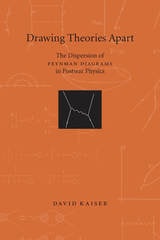
Drawing Theories Apart
The Dispersion of Feynman Diagrams in Postwar PhysicsDavid Kaiser
University of Chicago Press, 2005
Winner of the 2007 Pfizer Prize from the History of Science Society.
Feynman diagrams have revolutionized nearly every aspect of theoretical physics since the middle of the twentieth century. Introduced by the American physicist Richard Feynman (1918-88) soon after World War II as a means of simplifying lengthy calculations in quantum electrodynamics, they soon gained adherents in many branches of the discipline. Yet as new physicists adopted the tiny line drawings, they also adapted the diagrams and introduced their own interpretations. Drawing Theories Apart traces how generations of young theorists learned to frame their research in terms of the diagrams—and how both the diagrams and their users were molded in the process.
Drawing on rich archival materials, interviews, and more than five hundred scientific articles from the period, Drawing Theories Apart uses the Feynman diagrams as a means to explore the development of American postwar physics. By focusing on the ways young physicists learned new calculational skills, David Kaiser frames his story around the crafting and stabilizing of the basic tools in the physicist's kit—thus offering the first book to follow the diagrams once they left Feynman's hands and entered the physics vernacular.
Drawing on rich archival materials, interviews, and more than five hundred scientific articles from the period, Drawing Theories Apart uses the Feynman diagrams as a means to explore the development of American postwar physics. By focusing on the ways young physicists learned new calculational skills, David Kaiser frames his story around the crafting and stabilizing of the basic tools in the physicist's kit—thus offering the first book to follow the diagrams once they left Feynman's hands and entered the physics vernacular.
[more]
Drift and Mastery
An Attempt to Diagnose the Current UnrestWalter Lippmann, Introduction and notes by William E. Leuchtenburg, Foreword by Ganesh Sitaraman
University of Wisconsin Press, 2015
In 1914, a brilliant young political journalist published a book arguing that the United States had entered a period of “drift”—a lack of control over rapidly changing forces in society. He highlighted the tensions between expansion and consolidation, traditionalism and progressivism, and emotion and rationality. He wrote to convince readers that they could balance these tensions: they could be organized, efficient, and functional without sacrificing impulse, choice, or liberty. Mastery over drift is attainable, Walter Lippmann argued, through diligent attention to facts and making active choices. Democracy, Lippman wrote, is “a use of freedom, an embrace of opportunity.”
Lippman’s Drift and Mastery became one of the most important and influential documents of the Progressive Movement. It remains a valuable text for understanding the political thought of early twentieth-century America and a lucid exploration of timeless themes in American government and politics. Distinguished historian Walter Leuchtenberg’s 1986 introduction and notes are retained in this edition.
Lippman’s Drift and Mastery became one of the most important and influential documents of the Progressive Movement. It remains a valuable text for understanding the political thought of early twentieth-century America and a lucid exploration of timeless themes in American government and politics. Distinguished historian Walter Leuchtenberg’s 1986 introduction and notes are retained in this edition.
Ganesh Sitaraman, who has provided a foreword for this centennial edition, suggests that Lippmann’s classic still has much to say to twenty-first-century progressives. The underlying solutions for our time, he believes, are similar to those of Lippman’s era. Sitaraman contends that American society can regain mastery over drift by reforming finance and reducing inequality, by rethinking the relationship between corporations and workers, and by embracing changes in social life.
[more]