Results by title
187 books match the query 'Place' and 9 start with d
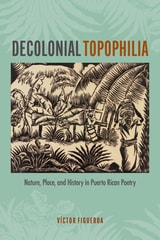
Decolonial Topophilia
Nature, Place, and History in Puerto Rican PoetryVíctor Figueroa
Bucknell University Press, 2026
Decolonial Topophilia: Nature, Place, and History in Puerto Rican Poetry examines how four major poets—Luis Lloréns Torres, Luis Palés Matos, Juan Antonio Corretjer, and Julia de Burgos—address the ecological and human consequences of colonial domination in early twentieth-century Puerto Rico. Their poetry raises questions about the capitalist transformation of land through monocultures like sugarcane, the reduction of nature to exploitable resources, and the ties between attachment to place and nationalism. In tracing these connections, this pathbreaking book reveals how poetic visions of place can challenge colonial histories and imagine more reciprocal ways of inhabiting the world.
Published by Bucknell University Press. Distributed worldwide by Rutgers University Press.
Democracy's Hidden Heroes
Fitting Policy to People and PlaceDavid C. Campbell
Temple University Press, 2024
David Campbell recounts compelling stories of the workarounds, sidesteps, informal agreements, and grantor–grantee negotiations that help policy initiatives succeed as intended. The settings include schools, human services departments, workforce development agencies, and community-based organizations. He explains why it is difficult, though necessary, to translate locally attuned implementation dynamics into accountability metrics for distant funders.
Drawing on 2,000 interviews, Democracy’s Hidden Heroes is the culmination of decades spent talking to people who must reconcile bureaucratic and community cultures. Campbell’s grounded approach and balanced perspective bring fresh insights to the analysis of policy implementation, public management, and results accountability, while offering both cautionary advice and a hopeful prognosis.
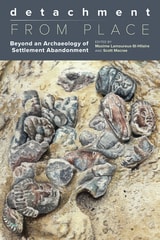
Detachment from Place
Beyond an Archaeology of Settlement AbandonmentMaxime Lamoureux-St-Hilaire
University Press of Colorado, 2019
Detachment from Place is the first comparative and interdisciplinary volume on the archaeology of settlement abandonment, with contributions focusing on materiality, ideology, the environment, and social construction of space. The volume sheds new light on an important but underexamined aspect of settlement abandonment wherein sedentary groups undergoing the process of abandonment leave behind many meaningful elements of their inhabited landscape. The process of detaching from place—which could last centuries—transformed inhabitants into migrants and transformed settled, constructed, and agricultural landscapes into imagined ones that continued to figure significantly in the identities of migrant groups.
Drawing on case studies from the Americas, Africa, and Asia, the volume explores how relationships between ancient peoples and the places they lived were transformed as they migrated elsewhere. Contributors focus on social structure, ecology, and ideology to study how people and places both disentangled from each other and remained tied together during this process. From Huron-Wendat villages and Classic Maya palaces to historical villages in Togo and the great Southeast Asian Medieval capital of Bagan, specific cultural, historical, and environmental factors led ancient peoples to detach from their homes and embark on migrations that altered social memory and cultural identity—as evidenced in the archaeological record.
Detachment from Place provides new insights into transfigurations of community identity, political organization, social and economic relations, religion, warfare, and agricultural practices and will be of interest to landscape archaeologists as well as researchers focused on collective memory, population movement, migratory patterns, and interaction.
Contributors:
Tomas Q. Barrientos, Jennifer Birch, Eduardo José Bustamante Luna, Catherine M. Cameron, Marcello A. Canuto, Jeffrey H. Cohen, Michael D. Danti, Phillip de Barros, Pete Demarte, Donna M. Glowacki, Gyles Iannone, Louis Lesage, Patricia A. McAnany, Asa R. Randall, Kenneth E. Sassaman
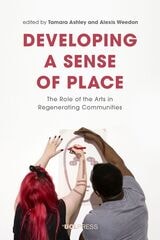
Developing a Sense of Place
The Role of the Arts in Regenerating CommunitiesEdited by Tamara Ashley and Alexis Weedon
University College London, 2020
Developing a Sense of Place offers a range of viewpoints, including those of the arts strategist, the academic, the practice-researcher, and the artist. Through its innovative models, from performing arts to architectural design, the book serves diverse interests, such as the arts and cultural policy managers, master planners, and arts workers, as well as students of human geography, cultural planning, business and the creative industries, and arts administration, at the undergraduate and postgraduate levels.
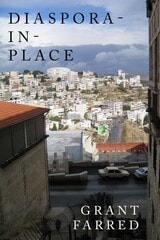
Diaspora-in-Place
Grant Farred
Temple University Press, 2027
“I was gone before I left,” writes Grant Farred in his compelling philosophical meditation, Diaspora-in-Place. Building on a concept he introduced in his critique The Perversity of Gratitude, Farred rethinks diaspora as not just physical deracination and relocation, but also a state of being in exile at home while remaining, visibly, in place. Partially the consequence of growing up in South Africa during apartheid, Farred extends the concept to “the Palestinian condition” of living in/out of place in Gaza.
Divided into a series of witty fragments, evocative epigrams, and sobering aphorisms, Diaspora-in-Place builds on thinkers ranging from Edward Said and Jacques Derrida, to the poetry of Olivia Elias, to musicians Bob Dylan, Miles Davis, and John Coltrane to examine how individuals process their national identity and subjecthood in a place where they feel out of place.
Farred writes eloquently about this expansive but not universal contradiction as being “a mobile immobility” or “an immobile mobility.” In doing so, he offers an entirely new and provocative way of conceiving how we understand diaspora.
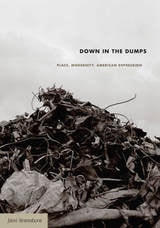
Down in the Dumps
Place, Modernity, American DepressionJani Scandura
Duke University Press, 2007
An interpretive bricolage that draws on an unlikely archive of 1930s detritus—office memos, scribbled manuscripts, scrapbooks, ruined photographs, newspaper clippings, glass eyes, incinerated stage sets, pulp novels, and junk washed ashore—Down in the Dumps escorts its readers through Reno’s divorce factory of the 1930s, where couples from across the United States came to quickly dissolve matrimonial bonds; Key West’s multilingual salvage economy and its status as the island that became the center of an ideological tug-of-war between the American New Deal government and a politically fraught Caribbean; post-Renaissance Harlem, in the process of memorializing, remembering, grieving, and rewriting a modernity that had already passed; and Studio-era Hollywood, Nathanael West’s “dump of dreams,” in which the introduction of sound in film and shifts in art direction began to transform how Americans understood place-making and even being itself. A coda on Alcatraz and the Pentagon brings the book into the present, exploring how American Depression comes to bear on post-9/11 America.
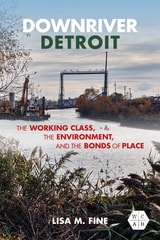
Downriver Detroit
The Working Class, the Environment, and the Bonds of PlaceLisa M. Fine
University of Illinois Press, 2026
Lisa M. Fine examines important moments in the ongoing efforts of the area’s citizens to create a humane and habitable environment. Her analysis shows how people preserved wetlands and the river by working through sportsmen’s organizations, appealing to state agencies, and forming grassroots movements. Fueled by enduring connections to place, local unions fought a proposed nuclear power plant in the 1950s. Years later, steel workers facing the steamroller of deindustrialization tried to preserve their communities by purchasing their own company. The ties that bind gave a unique character to activism in the Downriver region, challenging stereotypes of working-class attitudes toward the environment.
A creative merger of labor and environmental history, Downriver Detroit shows that working people have a right to live in and protect the places they love.
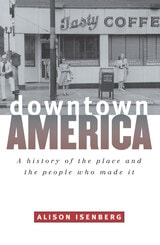
Downtown America
A History of the Place and the People Who Made ItAlison Isenberg
University of Chicago Press, 2005
Downtown America cuts beneath the archetypal story of downtown's rise and fall and offers a dynamic new story of urban development in the United States. Moving beyond conventional narratives, Alison Isenberg shows that downtown's trajectory was not dictated by inevitable free market forces or natural life-and-death cycles. Instead, it was the product of human actors—the contested creation of retailers, developers, government leaders, architects, and planners, as well as political activists, consumers, civic clubs, real estate appraisers, even postcard artists. Throughout the twentieth century, conflicts over downtown's mundane conditions—what it should look like and who should walk its streets—pointed to fundamental disagreements over American values.
Isenberg reveals how the innovative efforts of these participants infused Main Street with its resonant symbolism, while still accounting for pervasive uncertainty and fears of decline. Readers of this work will find anything but a story of inevitability. Even some of the downtown's darkest moments—the Great Depression's collapse in land values, the rioting and looting of the 1960s, or abandonment and vacancy during the 1970s—illuminate how core cultural values have animated and intertwined with economic investment to reinvent the physical form and social experiences of urban commerce. Downtown America—its empty stores, revitalized marketplaces, and romanticized past—will never look quite the same again.
A book that does away with our most clichéd approaches to urban studies, Downtown America will appeal to readers interested in the history of the United States and the mythology surrounding its most cherished institutions.
A Choice Oustanding Academic Title.
Winner of the 2005 Ellis W. Hawley Prize from the Organization of American Historians.
Winner of the 2005 Lewis Mumford Prize for Best Book in American
Planning History.
Winner of the 2005 Historic Preservation Book Price from the University of Mary Washington Center for Historic Preservation.
Named 2005 Honor Book from the New Jersey Council for the Humanities.
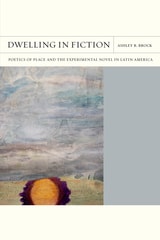
Dwelling in Fiction
Poetics of Place and the Experimental Novel in Latin AmericaAshley R. Brock
Northwestern University Press, 2023
The radical formal experiments undertaken by writers across Latin America in the mid-twentieth century introduced friction, opacity, and self-reflexivity to the very act of reading. Dwelling in Fiction: Poetics of Place and the Experimental Novel in Latin America explores the limitations and the possibilities of literature for conveying place-specific forms of life. Focusing on authors such as José María Arguedas, João Guimarães Rosa, and Juan José Saer, who are often celebrated for universalizing regional themes, Ashley R. Brock brings a new critical lens to Latin American writers who were ambivalent toward their era’s “boom.”
Beyond mere resistance to or critique of the commodification and political instrumentalization of rural topics and types, this countertrend of critical regionalism positions readers themselves as outsiders, pushing them to engage their senses, to train their attention, and to learn to dwell in unknown textual landscapes. Dwelling in Fiction draws on a transnational community of thinkers and writers to show how their midcentury aesthetic practices of sensorial pedagogy anticipate contemporary turns toward affect, embodiment, decoloniality, and ecological thought.