Results by title
183 books match the query 'Places' and 10 start with d
Dancing in Odessa
Ilya Kaminsky
Tupelo Press, 2004
Democracy's Lot
Rhetoric, Publics, and the Places of InventionCandice Rai
University of Alabama Press, 2016
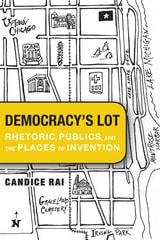
Candice Rai’s Democracy’s Lot is an incisive exploration of the limitations and possibilities of democratic discourse for resolving conflicts in urban communities. Rai roots her study of democratic politics and publics in a range of urban case studies focused on public art, community policing, and urban development. These studies examine the issues that erupted within an ethnically and economically diverse Chicago neighborhood over conflicting visions for a vacant lot called Wilson Yard. Tracing how residents with disparate agendas organized factions and deployed language, symbols, and other rhetorical devices in the struggle over Wilson Yard’s redevelopment and other contested public spaces, Rai demonstrates that rhetoric is not solely a tool of elite communicators, but rather a framework for understanding the agile communication strategies that are improvised in the rough-and-tumble work of democratic life.
Wilson Yard, a lot eight blocks north of Wrigley Field in Chicago’s gentrifying Uptown neighborhood, is a diverse enclave of residents enlivened by recent immigrants from Guatemala, Mexico, Vietnam, Ethiopia, and elsewhere. The neighborhood’s North Broadway Street witnesses a daily multilingual hubbub of people from a wide spectrum of income levels, religions, sexual identifications, and interest groups. When a fire left the lot vacant, this divided community projected on Wilson Yard disparate and conflicting aspirations, the resolution of which not only determined the fate of this particular urban space, but also revealed the lot of democracy itself as a process of complex problem-solving. Rai’s detailed study of one block in an iconic American city brings into vivid focus the remarkable challenges that beset democratic urban populations anywhere on the globe—and how rhetoric supplies a framework to understand and resolve those challenges.
Based on exhaustive field work, Rai uses rhetorical ethnography to study competing publics, citizenship, and rhetoric in action, exploring “rhetorical invention,” the discovery or development by individuals of the resources or methods of engaging with and persuading others. She builds a case for democratic processes and behaviors based not on reflexive idealism but rather on the hard work and practice of democracy, which must address apathy, passion, conflict, and ambivalence.

Des
Sati Mookherjee
Tupelo Press, 2027
In this formally inventive poetry collection, Sati Mookherjee resurrects a shared precolonial pan-South Asian identity, history, and culture in joyful defiance of the nationalist and sectarian movements of today.
This unusual poetry collection emerged from the author’s interviews of her Indian, Pakistani, and Bangladeshi immigrant family and friends in her native Pacific Northwest about their personal histories: of partition and childhood, immigration experiences, and religious and metaphysical beliefs. The resulting poems reflect the kaleidoscopic identity of the South Asian (“desi”) diaspora—the world’s largest diaspora. At this ugly historic moment, desi-ness offers a real-world model of a joyful, plural community, even as such tolerance is under grave threat from both today’s American right-wing anti-immigrant movement and the toxic nationalism and sectarianism of South Asian geopolitics. The poems themselves are a diaspora of forms: hybrid cross-pollinations of American tradition (Frost, Penn Warren), ancient Indo-Persian-Arabic forms, and self-invention. In a time when hatred of the other is normalized, this book holds love, celebrating a kinship tradition and shared homeland—a Des—that is both precolonial and extant, borderless, found not on any map, but held in the collective un/consciousness of the desi diaspora. In defiance of nationalist rhetoric that would see us divided by language, religion, and country of origin, Des joins the decentralized global movement of scholars, artists, activists, and young people reclaiming the beauty of a shared, precolonial composite culture.
Designing the Creative Child
Playthings and Places in Midcentury AmericaAmy F. Ogata
University of Minnesota Press, 2013
The postwar American stereotypes of suburban sameness, traditional gender roles, and educational conservatism have masked an alternate self-image tailor-made for the Cold War. The creative child, an idealized future citizen, was the darling of baby boom parents, psychologists, marketers, and designers who saw in the next generation promise that appeared to answer the most pressing worries of the age.
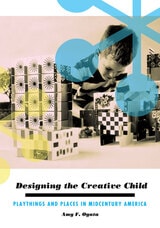
Designing the Creative Child reveals how a postwar cult of childhood creativity developed and continues to this day. Exploring how the idea of children as imaginative and naturally creative was constructed, disseminated, and consumed in the United States after World War II, Amy F. Ogata argues that educational toys, playgrounds, small middle-class houses, new schools, and children’s museums were designed to cultivate imagination in a growing cohort of baby boom children. Enthusiasm for encouraging creativity in children countered Cold War fears of failing competitiveness and the postwar critique of social conformity, making creativity an emblem of national revitalization.
Ogata describes how a historically rooted belief in children’s capacity for independent thinking was transformed from an elite concern of the interwar years to a fully consumable and aspirational ideal that persists today. From building blocks to Gumby, playhouses to Playskool trains, Creative Playthings to the Eames House of Cards, Crayola fingerpaint to children’s museums, material goods and spaces shaped a popular understanding of creativity, and Designing the Creative Child demonstrates how this notion has been woven into the fabric of American culture.

Devonte Travels the Sorry Route
T.J. Anderson III
Omnidawn, 2019
As fantastical as this account seems, in these poems, T.J. Anderson III captures a critical aspect of the ways identity is formed through community and collective memory, particularly among the peoples of the African diaspora. The way the words expand across the page enacts this polyvocal coalescing, and the blank space in between evokes the vast oceans that first separated and continue to resonate in the collective imagination of the Black community. At the same time that he relates the difficulty of crossing vast expanses of time and space to connect with our history, in these gripping poems Anderson proposes that the past is never far off—in fact, like Devonte, it lives in our own personalities and experiences today.
Discover Colorado
Its People, Places, and TimesMatthew Downey and Ty Bliss
University Press of Colorado, 2012
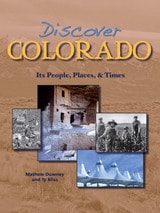
Discover Colorado
Its People, Places, and TimesMatthey Downey
University Press of Colorado, 2012
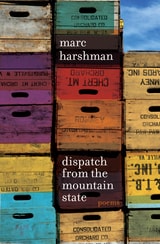
Dispatch from the Mountain State
PoemsMarc Harshman
West Virginia University Press, 2025
This collection of over forty poems sings with a fluid voice and dazzles with imagery that surprises and rings true, often underlain by and intertwined with the darker threads of our common living and dying as contemporary Appalachians. It is rare to find a poet like Harshman, who is deeply connected to the life of rural America and yet writes poetry untouched by any sentiment for the old ways found there.
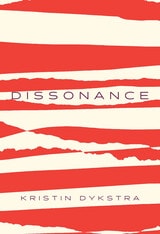
Dissonance
Kristin Dykstra
University of Chicago Press, 2025
In Dissonance, translator Kristin Dykstra’s first book of original poetry, the author leads us to inner worlds shaped partly by the New England countryside, tracking shifts in the region’s nature, infrastructure, and people, while sharing observations on borders and climate catastrophe that reverberate globally. Dykstra condenses signs of urban expansion, economic division, and battles over democracy into an innovative meditation. With a dynamic approach to form, musicality, and scope, Dissonance explores ways of experiencing regional landscapes and imagined communities in the twenty-first century.
Through her extended sequence of prose poems, photographs, and lyric fragments, Dykstra merges clips from documents and dialogues with observations drawn from two local libraries and her daily walks down a dirt road through Vermont’s foothills. As she moves down this public road, which lies within the nation’s federally designated hundred-mile border zone, she finds a daily convergence of tensions. Dissonance asks how poetry can unsettle impressions of a place, and how that process, in turn, disturbs impressions of self, of others, and of time itself.
Dissonance is the recipient of the third annual Phoenix Emerging Poet Book Prize.
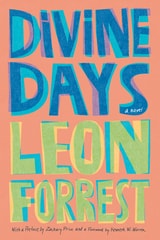
Divine Days
A NovelLeon Forrest; Foreword by Kenneth W. Warren, Preface by Zachary Price
Northwestern University Press, 2023
“I have an awful memory for faces, but an excellent one for voices,” muses Joubert Jones, the aspiring playwright at the center of Divine Days. A kaleidoscopic whorl of characters, language, music, and Black experience, this saga follows Jones for one week in 1966 as he pursues the lore and legends of fictional Forest County, a place resembling Chicago’s South Side. Joubert is a veteran, recently returned to the city, who works for his aunt Eloise’s newspaper and pours drinks at her Night Light Lounge. He wants to write a play about Sugar-Groove, a drifter, “eternal wunderkind,” and local folk hero who seems to have passed away. Sugar-Groove’s disappearance recalls the subject of one of Joubert’s earlier writing attempts—W. A. D. Ford, a protean, diabolical preacher who led a religious sect known as “Divine Days.” Joubert takes notes as he learns about both tricksters, trying to understand their significance.
Divine Days introduces readers to a score of indelible characters: Imani, Joubert’s girlfriend, an artist and social worker searching for her lost siblings and struggling to reconcile middle class life with her values and Black identity; Eloise, who raised Joubert and whose influence is at odds with his writerly ambitions; (Oscar) Williemain, a local barber, storyteller, and founder of the Royal Rites and Righteous Ramblings Club; and the Night Light’s many patrons. With a structure inspired by James Joyce and jazz, Leon Forrest folds references to African American literature and cinema, Shakespeare, the Bible, and classical mythology into a heady quest that embraces life in all its tumult and adventure.
This edition brings Forrest’s masterpiece back into print, incorporating hundreds of editorial changes that the author had requested from W. W. Norton, but were not made for their editions in 1993 and 1994. Much of the inventory from the original printing of the book by Another Chicago Press in 1992 had been destroyed in a disastrous warehouse fire.