Results by title
267 books match the query 'Poetics' and 7 start with d

Dark Shamans
Kanaimà and the Poetics of Violent DeathNeil L. Whitehead
Duke University Press, 2002
Neil L. Whitehead tells of his own involvement with kanaimà—including an attempt to kill him with poison—and relates the personal testimonies of kanaimà shamans, their potential victims, and the victims’ families. He then goes on to discuss the historical emergence of kanaimà, describing how, in the face of successive modern colonizing forces—missionaries, rubber gatherers, miners, and development agencies—the practice has become an assertion of native autonomy. His analysis explores the ways in which kanaimà mediates both national and international impacts on native peoples in the region and considers the significance of kanaimà for current accounts of shamanism and religious belief and for theories of war and violence.
Kanaimà appears here as part of the wider lexicon of rebellious terror and exotic horror—alongside the cannibal, vampire, and zombie—that haunts the western imagination. Dark Shamans broadens discussions of violence and of the representation of primitive savagery by recasting both in the light of current debates on modernity and globalization.
Democratic Criticism
Poetics of Incitement and the Muslim SacredMasood Raja
Lever Press, 2023
After the publication of Salman Rushdie’s The Satanic Verses (1988), the poetics of incitement— found in texts originating in the West containing themes and representations of Islam hurtful to Muslims—became an accepted method of textual production in the West. Production of such texts intensified after the attacks of 9/11. Democratic Criticism: Poetics of Incitement and the Muslim Sacred by Masood Ashraf Raja urges a new mode of reading, one that permits Western readers to transcend local reading practices in order to, as best as one can, read from the point of view of the Other.
Raja argues that the lack of understanding of Muslim responses to the poetics of incitement in the West is the result of a lack of cross-cultural knowledge. He claims metropolitan universities often do not teach the proper social, historical, and religious context required for effectively reading these texts with any form of cultural knowledge. To remedy this, Raja offers and theorizes “democratic reading practices” and new ways for students to engage with texts. A genealogy of the Muslim Sacred is included, thereby giving readers the history and specific knowledge that constitutes an average Muslim reader of these texts, a subject who should be imagined and empathized with when those in the West read works of the poetics of incitement.
Democratic Criticism encourages Western readers to develop a deeper understanding of the meaning-making processes of the Islamic world while at the same time encouraging the Muslim readers to read representations of the Islamic world with a more expansive understanding. It will be a helpful tool in creating reading practices that allow both teachers and students of literature to transcend their mode of reading as universal and to read from the perspective of the Other, and allow readers to engage meaningfully with these texts. Students and scholars of world literature, history, and religious studies will find this book insightful and valuable.
Differentials
Poetry, Poetics, PedagogyMarjorie Perloff
University of Alabama Press, 2004
A new collection of essays from a distinguished critic of contemporary poetry
Marjorie Perloff is one of the foremost critics of contemporary American poetry writing today. Her works are credited by many with creating and sustaining new critical interest not only in the work of major modernist poets such as Yeats, Pound, Eliot, and Williams but also in the postwar tradition of American poetic innovation that ranges from the Black Mountain poets, through the New York School and concrete poetry, to the Language Poets of the 1980s and '90s.
In Differentials, Perloff explores and defends her belief in the power of close reading, a strategy often maligned as reactionary in today's critical climate but which, when construed differentially, is vital, she believes, to any true understanding of a literary or poetic work, irrespective of how traditional or experimental it is. Perloff also examines key issues in modernism, from Eliot's conservative poetics and Pound's nominalism to translation theory (Wittgenstein, Eugene Jolas, Haroldo de Campos), and the contemporary avant garde, as represented by writers like Susan Howe, Tom Raworth, Rae Armantrout, Ron Silliman, Ronald Johnson, Caroline Bergvall, and Kenneth Goldsmith.
Ultimately, Perloff's most important offerings in Differentials are her remarkably original reflections on the aesthetic process: on how poetry works, and what it means, in and for our time.
Dissonance (if you are interested)
Rosmarie Waldrop
University of Alabama Press, 2005
Incisive essays on modern poetry and translation by a noted poet, translator, and critic.
In this comprehensive collection of her essays, Waldrop addresses considerations central to her life’s work: typical genres and ways of countering the conventions of genre; how concrete poets have made syntax spatial rather than grammatical; and the move away from metaphor in poetry toward contiguity and metonymy. Three essays on translation struggle with the sources and targets of translation, of the degree of strangeness or foreignness a translator should allow into any English translation. Finally, other essays examine the two-way traffic between reading and writing, and Waldrop’s notion of reading as experience.
Dissonant Voices
Race, Jazz, and Innovative Poetics in Midcentury AmericaJoseph Pizza
University of Iowa Press, 2023
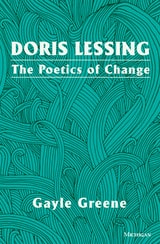
Doris Lessing
The Poetics of ChangeGayle Greene
University of Michigan Press, 1997
Doris Lessing has been a chronicler of our age for nearly half a century, and a study of her writing career does not yield easy generalizations. Difficult though she is to categorize, she is always concerned with change, with a search for "something new" against "the nightmare repetition" of history. The feminist quest she articulated in The Children of Violence and The Golden Notebook entered the culture with the force of a new myth: these books changed lives. The Golden Notebook--together with such works as The Second Sex and The Feminine Mystique--raised the consciousness of a generation of women readers and played a major part in making the second wave of feminism. It is the power of Lessing's novels to change people's lives, the effect she had raising the consciousness of a generation of women and the effect she continues to have on young readers, that is the subject of this book.
Gayle Greene employs an eclectic range of approaches (psychoanalytic, Marxist, biographical, historical, intertextual, formalist, feminist) to shed new light on Lessing's remarkable achievement. She sees Lessing as a feminist writer, not in offering strong female role models who climb top the top of existing social structures, but in envisioning, and indeed helping to bring about, a transformation of those structures. Lessing critiques Western values of individualism, competition, and materialism in terms similar to those developed by feminism; and, in getting us to view our culture from without, in teaching us to read cultural constructs as systems, her novels perform the deconstructing and demystifying work of feminism.
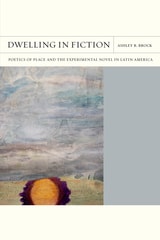
Dwelling in Fiction
Poetics of Place and the Experimental Novel in Latin AmericaAshley R. Brock
Northwestern University Press, 2023
The radical formal experiments undertaken by writers across Latin America in the mid-twentieth century introduced friction, opacity, and self-reflexivity to the very act of reading. Dwelling in Fiction: Poetics of Place and the Experimental Novel in Latin America explores the limitations and the possibilities of literature for conveying place-specific forms of life. Focusing on authors such as José María Arguedas, João Guimarães Rosa, and Juan José Saer, who are often celebrated for universalizing regional themes, Ashley R. Brock brings a new critical lens to Latin American writers who were ambivalent toward their era’s “boom.”
Beyond mere resistance to or critique of the commodification and political instrumentalization of rural topics and types, this countertrend of critical regionalism positions readers themselves as outsiders, pushing them to engage their senses, to train their attention, and to learn to dwell in unknown textual landscapes. Dwelling in Fiction draws on a transnational community of thinkers and writers to show how their midcentury aesthetic practices of sensorial pedagogy anticipate contemporary turns toward affect, embodiment, decoloniality, and ecological thought.