100 books match the query 'Politicians' and 3 start with d
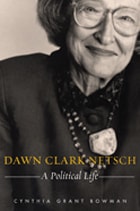
cover of Dawn Clark Netsch: A Political Life

Dawn Clark Netsch

A Political Life

Cynthia Grant Bowman

Northwestern University Press, 2010

Illinois Democratic politics has recently produced the most skilled and inspirational politician in memory . . . and has also reminded us of the need for further reform. It is fitting, then, that the latest installment of the Chicago Lives series turns to Dawn Clark Netsch, a leading reformer of Illinois politics since the 1950s and the first woman major party nominee for governor of Illinois.

Netsch was a pioneer, or the first of her gender, in almost every endeavor she undertook. From the very beginning of her career, when she led the move to desegregate Northwestern University's undergraduate dorms, her passion for social justice extended beyond the rights of women to rights for racial minorities and those of all sexual orientations. Bowman charts Dawn Clark Netsch's remarkable political career, from her work behind the scenes as assistant to Governor Otto Kerner and as a participant in the 1970 Constitutional Convention to her later service in elected office, first as Illinois state senator for eighteen years and later as Illinois comptroller, and culminating in her historic run for governor in 1994. Throughout, Netsch lost neither her genteel yet unpretentious demeanor, nor her passion for progressive politics as exemplified by her early mentor, Governor Adlai E. Stevenson.
[more]
cover of Distorted Mirrors: Americans and Their Relations with Russia and China in the Twentieth Century

Distorted Mirrors

Americans and Their Relations with Russia and China in the Twentieth Century

Donald E. Davis & Eugene P. Trani

University of Missouri Press, 2009
As the United States enters the twenty-first century, it confronts two powers that loomed less large on the world stage a century before. Yet American policies toward Russia and China have been shaped by attitudes going back even further, as this new book relates.
Distorted Mirrors traces American prejudices toward the two countries by focusing on the views of influential writers and politicians over the course of the twentieth century. Donald Davis and Eugene Trani show where American images of Russia and China originated, how they evolved, and how they have often helped sustain foreign policies generally negative toward the former and positive toward the latter.
This wide-ranging survey draws on memoirs, archives, and interviews, much the material appearing in print for the first time, to show how influential individuals shaped these perceptions and policies based on what they saw—or thought they saw—in those two countries. Through a series of tableaux that traces America’s relations with Russia and China through the twentieth century, the authors show how personalities of certain players impacted interpretation of key situations and conflicts and how cultural attitudes toward Russia and China became ingrained and difficult to dislodge.
The book traces formative attitudes back to two late-nineteenth-century books, with George Kennan’s Siberia and the Exile System painting a grim picture of tsarist penal colonies and William Rockhill’s Land of the Lamas depicting China as an exotic Shangri-la. Davis and Trani show how these images were sustained over the years: for Russia, by Slavic expert Samuel Harper, State Department official Robert Kelley, journalist Eugene Lyons, ambassador William Bullitt, President Franklin D. Roosevelt, and policymakers George F. Kennan and Paul Nitze; and for China, by President Woodrow Wilson, philosopher John Dewey, journalist Edgar Snow, novelist Pearl S. Buck, ambassador Nelson T. Johnson, FDR, journalist Theodore White, and statesman Henry Kissinger. They also relate how Ronald Reagan and George H. W. Bush tried to replace these misconceptions with a policy of accommodation, and they assess the state of current U.S. attitudes and policies.
Distorted Mirrors marks a fresh approach to U.S. relations with these countries, emphasizing long-term attitudes that influenced policies rather than the reverse. It shows us that perceptions shaped over the course of the twentieth century are crucial for their bearing on the twenty-first, particularly if those unrestrained prejudices reemerge.
[more]
cover of Dynastic Democracy: Political Families of Thailand

Dynastic Democracy

Political Families of Thailand

Yoshinori Nishizaki

University of Wisconsin Press, 2022

The political history of Thailand since the overthrow of absolute monarchy in 1932 has conventionally been interpreted as a long series of popular struggles for representative democracy and against military authoritarian rule. Yoshinori Nishizaki argues that this history can be better understood as one of struggles by elite political families for and against “dynastic democracy”—a form of democracy that is characterized by the patrimonial transmission of power between members of select ruling families. Dynastic Democracy suggests it is these familial-based contestations for political ascendancy that underlie the tumultuous politics of Thailand, a country that has experienced no fewer than twenty-two coups over the course of the past century.
 
Drawing extensively on Thai-language primary sources, including assets documents and cremation volumes for deceased politicians and their kin, Nishizaki traces the intricate blood and marriage connections among Thailand’s political families. These families may fall into two categories: influential commoner families that have held parliamentary seats since 1932 and form the core of Thailand’s dynastic democracy; and upper-class families that are kin to or aligned ideologically with the royal family and have repeatedly challenged dynastic democracy through coups, constitutional changes, and other political maneuvers. Nishizaki’s exploration of dynastic democracy illustrates how democratic pluralism in Thailand has been consistently stifled, to the detriment of ordinary citizens. Dynastic Democracy fleshes out a widely acknowledged yet heretofore empirically unsubstantiated facet of Thai political history—that in Thai politics, family matters.
[more]