Results by title
1427 books match the query 'Politics' and 51 start with d

Dammed
The Politics of Loss and Survival in Anishinaabe TerritoryBrittany Luby
University of Manitoba Press, 2020
Dance, Politics & Co-Immunity
Current Perspectives on Politics and Communities in the Arts Vol. 1Edited by Stefan Hölscher and Gerald Siegmund
Diaphanes, 2013

Dancing at the Devil's Party
Essays on Poetry, Politics, and the EroticAlicia Suskin Ostriker
University of Michigan Press, 2000
In her work, Ostriker can be controversial, as when she attacks the academic establishment for rejecting the erotic dimension of poetry, or when she meditates on the significance of the black poet Lucille Clifton to herself as a reader, or when she argues that Allen Ginsberg's "Howl"--famous as the primary poem of the Beat Generation--is also a profoundly Jewish poem. Yet her writing is always lively and readable, free of academic jargon, inviting the reader to enjoy a wide range of poetic styles and experiences.
Ostriker's criticism, like her poetry, is both feminist and deeply humane. These essays on American poetry will appeal to students of poetry, scholars of American literature, and anyone who enjoys the work of the poets discussed in the book.
Alicia Ostriker is the author of nine books of poetry, including The Imaginary Lover, which won the William Carlos Williams Award and The Crack in Everything, which was a National Book award finalist in 1996, and which received the Paterson Prize in 1997 and the San Fransisco State Poetry Center Award in 1998. She is Distinguished Professor of English at Rutgers University.
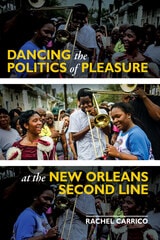
Dancing the Politics of Pleasure at the New Orleans Second Line
Rachel Carrico
University of Illinois Press, 2024
On many Sundays, Black New Orleanians dance through city streets in Second Lines. These processions invite would-be spectators to join in, grooving to an ambulatory brass band for several hours. Though an increasingly popular attraction for tourists, parading provides the second liners themselves with a potent public expression of Black resistance.
Rachel Carrico examines the parading bodies in motion as a form of negotiating and understanding power. Seeing pleasure as a bodily experience, Carrico reveals how second liners’ moves link joy and liberation, self and communal identities, play and dissent, and reclamations of place. As she shows, dancers’ choices allow them to access the pleasure of reclaiming self and city through motion and rhythm while expanding a sense of the possible in the present and for the future.
In-depth and empathetic, Dancing the Politics of Pleasure at the New Orleans Second Line blends analysis with a chorus of Black voices to reveal an indelible facet of Black culture in the Crescent City.

Dark Matter
Art and Politics in the Age of Enterprise CultureGregory Sholette
Pluto Press, 2011
Gregory Sholette, a politically engaged artist, argues that imagination and creativity in the art world originate thrive in the non-commercial sector shut off from prestigious galleries and champagne receptions. This broader creative culture feeds the mainstream with new forms and styles that can be commodified and used to sustain the few artists admitted into the elite.
This dependency, and the advent of inexpensive communication, audio and video technology, has allowed this 'dark matter' of the alternative art world to increasingly subvert the mainstream and intervene politically as both new and old forms of non-capitalist, public art. This book is essential for anyone interested in interventionist art, collectivism, and the political economy of the art world.
David Duke and the Politics of Race in the South
John C. Kuzenski
Vanderbilt University Press, 1995

Dead Subjects
Toward a Politics of Loss in Latino StudiesAntonio Viego
Duke University Press, 2007
Viego argues that the repeated themes of wholeness, completeness, and transparency with respect to ethnic and racialized subjectivity are fundamentally problematic as these themes ultimately lend themselves to the project of managing and controlling ethnic and racialized subjects by positing them as fully knowable, calculable sums: as dead subjects. He asserts that the refusal of critical race and ethnic studies scholars to read ethnic and racialized subjects in a Lacanian framework—as divided subjects, split in language—contributes to a racist discourse. Focusing on theoretical, historical, and literary work in Latino studies, he mines the implicit connection between Latino studies’ theory of the “border subject” and Lacan’s theory of the “barred subject” in language to argue that Latino studies is poised to craft a critical multiculturalist, anti-racist Lacanian account of subjectivity while adding historical texture and specificity to Lacanian theory.
Death and Dissymmetry
The Politics of Coherence in the Book of JudgesMieke Bal
University of Chicago Press, 1988
Counter to standard readings of Judges, Bal's interpretation demonstrates that the book has a political and ideological coherence in which the treatment of women plays a pivotal role. Bal concentrates here not on the assassinations and battles that rage through Judges but on the violence in the domestic lives of individual characters, particularly sexual violence directed at women. Her skillful reading reveals that murder, in this text, relates to gender and reflects a social structure that is inherently contradictory. By foregrounding the stories of women and subjecting them to subtle narrative analysis, she is able to expose a set of preoccupations that are essential to the sense of these stories but are not articulated in them. Bal thereby develops a "countercoherence" in conflict with the apparent emphases of Judges—the politics, wars, and historiography that have been the constant focus of commentators on the book.
Death and Dissymmetry makes an important contribution to the development of a feminist method of interpreting ancient texts, with consequences for religious studies, ancient history, literary theory, and gender studies.
Decentring Race
The Politics of Welcoming Ukrainians in RomaniaRaluca Bejan
Central European University Press, 2026
Decolonizing Memory
Algeria and the Politics of TestimonyJill Jarvis
Duke University Press, 2021

Defining Latvia
Recent Explorations in History, Culture, and PoliticsMatthew Kott
Central European University Press, 2022
In just over a century, Latvia has transitioned from imperial periphery to nation-state, then Soviet republic, and finally following the collapse of the Soviet Union to an independent republic. Defining Latvia brings together the latest research on the multiple social, political, and cultural contexts of Latvia throughout this turbulent period. Its ten chapters are written by leading political scientists, historians, and area studies specialists from across Europe and North America.
The volume moves beyond an exclusively political context to incorporate a variety of social and cultural perspectives, ranging from the experiences of Latvian mapmakers in the Russian Empire, to the participation of Latvians in the Wehrmacht and Red Army during World War II, Latvian national communism, and the development of extremist politics following Latvia’s accession to the European Union. Other chapters address developing trends in the fields of history and political science, including the history of antisemitism, memory, language politics, photography, and political extremism.
Based on the book’s temporal span from the nineteenth century to the present, the authors and editors of Defining Latvia understand the construction of Latvian identity as a continuous and interconnected process across significant political and ideological ruptures.
Defining Reality
Definitions and the Politics of MeaningEdward Schiappa
Southern Illinois University Press, 2003
In Defining Reality, Edward Schiappa argues that definitional disputes should be treated less as philosophical questions of “is”and more as sociopolitical questions of “ought.” Instead of asking “What is X?” he advocates that definitions be considered as proposals for shared knowledge and institutional norms, as in “What should count as X in context Y, given our needs and interests?”
Covering a broad scope of argument in rhetorical theory, as well as in legal, medical, scientific, and environmental debates, Schiappa shows the act of defining to be a specialized and learned behavior, and therefore one that can be studied and improved. In response to theories that deem discourse to be persuasive, the author asserts that all discourse is definitive discourse that contributes to our construction of a shared reality.
Defining Reality sheds light on our methods of creating common truths through language and argumentation and forces us to reconsider the contexts, limitations, and adaptability of our definitions. Hinging on a synthesis of arguments regarding the significance of definitional practices, the book is bolstered by a series of case studies of debates about rape, euthanasia, abortion, and political and environmental issues. These case studies ground Schiappa’s concepts in reality and delineate the power of public discourse within legal contexts. Ranging widely among disciplines from philosophy and classical philology to constitutional law and cognitive psychology, this study substantially contributes to the scholarship of rhetoric and argumentation, particularly as they function in the realm of public discourse.

Demanding Child Care
Women's Activism and the Politics of Welfare, 1940-1971Natalie M. Fousekis
University of Illinois Press, 2013
During World War II, as women stepped in to fill jobs vacated by men in the armed services, the federal government established public child care centers in local communities for the first time. When the government announced plans to withdraw funding and terminate its child care services at the end of the war, women in California protested and lobbied to keep their centers open, even as these services rapidly vanished in other states.
Analyzing the informal networks of cross-class and cross-race reformers, policymakers, and educators, Demanding Child Care: Women's Activism and the Politics of Welfare, 1940–1971 traces the rapidly changing alliances among these groups. During the early stages of the childcare movement, feminists, Communists, and labor activists banded together, only to have these alliances dissolve by the 1950s as the movement welcomed new leadership composed of working-class mothers and early childhood educators. In the 1960s, when federal policymakers earmarked child care funds for children of women on welfare and children described as culturally deprived, it expanded child care services available to these groups but eventually eliminated public child care for the working poor.
Deftly exploring the possibilities for partnership as well as the limitations among these key parties, Fousekis helps to explain the barriers to a publically funded comprehensive child care program in the United States.

Democracy After Pinochet
Politics, Parties, and Elections in ChileAlan Angell
University of London Press, 2007

Democracy on a Tightrope
Politics and Bureaucracy in BrazilPedro Abramovay
Central European University Press, 2026
Democratic Swarms
Ancient Comedy and the Politics of the PeoplePage duBois
University of Chicago Press, 2022
With Democratic Swarms, Page duBois revisits the role of Greek comedy in ancient politics, considering how it has been overlooked as a political medium by modern theorists and critics. Moving beyond the popular readings of ancient Greece through the lens of tragedy, she calls for a revitalized look at Greek comedy. Rather than revisiting the sufferings of Oedipus and his family or tragedy’s relationship to questions of sovereignty, this book calls for comedy—its laughter, its free speech, its wild swarming animal choruses, and its rebellious women—to inform another model of democracy.
Ancient comedy has been underplayed in the study of Greek drama. Yet, with the irrepressible energy of the comic swarm, it provides a unique perspective on everyday life, gender and sexuality, and the utopian politics of the classical period of Athenian democracy. Using the concepts of swarm intelligence and nomadic theory, duBois augments tragic thought with the resistant, utopian, libidinous, and often joyous communal legacy of comedy, and she connects the lively anti-authoritarianism of the ancient comic chorus with the social justice movements of today.
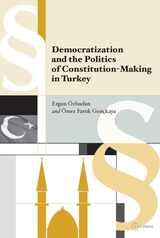
Democratization and the Politics of Constitution-Making in Turkey
Ömer Faruk Gençkaya
Central European University Press, 2009
Designed for Play
Children’s Playgrounds and the Politics of Urban Space, 1840–2010Jon Winder
University of London Press, 2024
This book is an original and accessible history of the modern playground in Britain and beyond, charting its journey from marginal obscurity to popular ubiquity. Tracing the playground’s history from the mid-nineteenth century to 2010, Designed for Play demonstrates how a diverse set of actors across the philanthropic, voluntary, state, and commercial sectors all sought to reimagine and reshape the urban landscape to improve childhood outcomes.
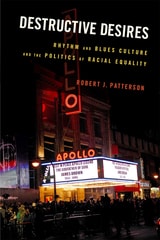
Destructive Desires
Rhythm and Blues Culture and the Politics of Racial EqualityRobert J. Patterson
Rutgers University Press, 2019
Diasporas in the New Media Age
Identity, Politics, and CommunityAndoni Alonso
University of Nevada Press, 2010
The explosion of digital information and communication technologies has influenced almost every aspect of contemporary life. Diasporas in the New Media Age is the first book-length examination of the social use of these technologies by emigrants and diasporas around the world. The eighteen original essays in the book explore the personal, familial, and social impact of modern communication technology on populations of European, Asian, African, Caribbean, Middle Eastern, and Latin American emigrants. It also looks at the role and transformation of such concepts as identity, nation, culture, and community in the era of information technology and economic globalization. The contributors, who represent a number of disciplines and national origins, also take a range of approaches—empirical, theoretical, and rhetorical—and combine case studies with thoughtful analysis. Diasporas in the New Media Age is both a discussion of the use of communication technologies by various emigrant groups and an engaging account of the immigrant experience in the contemporary world. It offers important insights into the ways that dispersed populations are using digital media to maintain ties with their families and homeland, and to create new communities that preserve their culture and reinforce their sense of identity. In addition, the book is a significant contribution to our understanding of the impact of technology on society in general.
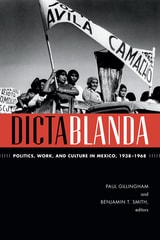
Dictablanda
Politics, Work, and Culture in Mexico, 1938–1968Paul Gillingham and Benjamin T. Smith, eds.
Duke University Press, 2014
This deliberately heterodox volume brings together social historians, anthropologists, sociologists, and political scientists to offer a radical new understanding of the emergence and persistence of the modern Mexican state. It also proposes bold, multidisciplinary approaches to critical problems in contemporary politics. With its blend of contested elections, authoritarianism, and resistance, Mexico foreshadowed the hybrid regimes that have spread across much of the globe. Dictablanda suggests how they may endure.
Contributors. Roberto Blancarte, Christopher R. Boyer, Guillermo de la Peña, María Teresa Fernández Aceves, Paul Gillingham, Rogelio Hernández Rodríguez, Alan Knight, Gladys McCormick, Tanalís Padilla, Wil G. Pansters, Andrew Paxman, Jaime Pensado, Pablo Piccato, Thomas Rath, Jeffrey W. Rubin, Benjamin T. Smith, Michael Snodgrass
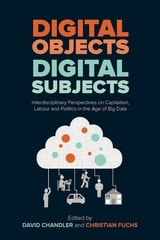
Digital Objects, Digital Subjects
Interdisciplinary Perspectives on Capitalism, Labour and Politics in the Age of Big DataDavid Chandler and Christian Fuchs
University of Westminster Press, 2019
This volume explores activism, research and critique in the age of digital subjects and objects and Big Data capitalism after a digital turn said to have radically transformed our political futures. Optimists assert that the ‘digital’ promises: new forms of community and ways of knowing and sensing, innovation, participatory culture, networked activism, and distributed democracy. Pessimists argue that digital technologies have extended domination via new forms of control, networked authoritarianism and exploitation, dehumanization and the surveillance society. Leading international scholars present varied interdisciplinary assessments of such claims – in theory and via dialogue – and of the digital’s impact on society and the potentials, pitfalls, limits and ideologies, of digital activism. They reflect on whether computational social science, digital humanities and ubiquitous datafication lead to digital positivism that threatens critical research or lead to new horizons in theory and society.
An electronic version of this book is freely available, thanks to the support of libraries working with Knowledge Unlatched. KU is a collaborative initiative designed to make high quality books Open Access for the public good. More information about the initiative and details about KU’s Open Access programme can be found at www.knowledgeunlatched.org.
Disability, Civil Rights, and Public Policy
The Politics of ImplementationStephen L. Percy
University of Alabama Press, 1989
Following on the heels of other Civil Rights movements, disability rights laws emerged in the late 1960s and early 1970s. Often these laws were more symbolic than precise in terms of objectives and strategies to guide the implementation of antidiscrimination policies. Policy refinement, the process of translating legislative mandates into strategies and procedures to govern administrative action, is both dynamic and controversial.
The premise of Disability, Civil Rights, and Public Policy is that implementation policies in these areas evolved through protracted political struggles among a variety of persons and groups affected by disability rights laws. Efforts to influence policies extended far beyond the process of legislative enactment and resulted in struggles that were played out in the courts and in the executive branch. Included within this examination of federal disability rights laws are the role of symbolic politics, the strengths and weaknesses of contemporary models used for the study of policy implementation, and the politics of administrative policymaking.
Disabling Pedagogy
Power, Politics, and Deaf EducationLinda Komesaroff
Gallaudet University Press, 2008
Traditionally, deaf education has been treated as the domain of special educators who strive to overcome the difficulties associated with hearing loss. Recently, the sociocultural view of deafness has prompted research and academic study of Deaf culture, sign language linguistics, and bilingual education. Linda Komesaroff exposes the power of the entrenched dominant groups and their influence on the politics of educational policy and practice in Disabling Pedagogy: Power, Politics, and Deaf Education.
Komesaroff suggests a reconstruction of deaf education based on educational and social theory. First, she establishes a deep and situated account of deaf education in Australia through interviews with teachers, Deaf leaders, parents, and other stakeholders. Komesaroff then documents a shift to bilingual education by one school community as part of her ethnographic study of language practices in deaf education. She also reports on the experiences of deaf students in teacher education. Her study provides an analytical account of legal cases and discrimination suits brought by deaf parents for lack of access to native sign language in the classroom. Komesaroff confronts the issue of cochlear implantation, locating it within the broader context of gene technology and bioethics, and advocates linguistic rights and self-determination for deaf people on the international level. Disabling Pedagogy concludes with a realistic assessment of the political challenge and the potential of the “Deaf Resurgence” movement to enfranchise deaf people in the politics of their own education.
Disagreement
Politics And PhilosophyJacques Ranciere
University of Minnesota Press, 2004
“Is there any such thing as political philosophy?” So begins this provocative book by one of the foremost figures in Continental thought. Here, Jacques Rancière brings a new and highly useful set of terms to the vexed debate about political effectiveness and “the end of politics.”
What precisely is at stake in the relationship between “philosophy” and the adjective “political”? In Disagreement, Rancière explores the apparent contradiction between these terms and reveals the uneasy meaning of their union in the phrase “political philosophy”—a juncture related to age-old attempts in philosophy to answer Plato’s devaluing of politics as a “democratic egalitarian” process.
According to Rancière, the phrase also expresses the paradox of politics itself: the absence of a proper foundation. Politics, he argues, begins when the “demos” (the “excessive” or unrepresented part of society) seeks to disrupt the order of domination and distribution of goods “naturalized” by police and legal institutions. In addition, the notion of “equality” operates as a game of contestation that constantly substitutes litigation for political action and community. This game, Rancière maintains, operates by a primary logic of “misunderstanding.” In turn, political philosophy has always tried to substitute the “politics of truth” for the politics of appearances.
Disagreement investigates the various transformations of this regime of “truth” and their effects on practical politics. Rancière then distinguishes what we mean by “democracy” from the practices of a consensual system in order to unravel the ramifications of the fashionable phrase “the end of politics.” His conclusions will be of interest to readers concerned with political questions from the broadest to the most specific and local.
Disalienation
Politics, Philosophy, and Radical Psychiatry in Postwar FranceCamille Robcis
University of Chicago Press, 2021
In Disalienation, Camille Robcis grapples with the historical, intellectual, and psychiatric meaning of the ethics articulated at Saint-Alban by exploring the movement’s key thinkers, including François Tosquelles, Frantz Fanon, Félix Guattari, and Michel Foucault. Anchored in the history of one hospital, Robcis's study draws on a wide geographic context—revolutionary Spain, occupied France, colonial Algeria, and beyond—and charts the movement's place within a broad political-economic landscape, from fascism to Stalinism to postwar capitalism.

Discovering Addiction
The Science and Politics of Substance Abuse ResearchNancy D. Campbell
University of Michigan Press, 2007
Discovering Addiction brings the history of human and animal experimentation in addiction science into the present with a wealth of archival research and dozens of oral-history interviews with addiction researchers. Professor Campbell examines the birth of addiction science---the National Academy of Sciences's project to find a pharmacological fix for narcotics addiction in the late 1930s---and then explores the human and primate experimentation involved in the succeeding studies of the "opium problem," revealing how addiction science became "brain science" by the 1990s.
Psychoactive drugs have always had multiple personalities---some cause social problems; others solve them---and the study of these drugs involves similar contradictions. Discovering Addiction enriches discussions of bioethics by exploring controversial topics, including the federal prison research that took place in the 1970s---a still unresolved debate that continues to divide the research community---and the effect of new rules regarding informed consent and the calculus of risk and benefit. This fascinating volume is both an informative history and a thought-provoking guide that asks whether it is possible to differentiate between ethical and unethical research by looking closely at how science is made.
Discrimination, Jobs, and Politics
The Struggle for Equal Employment Opportunity in the United States since the New DealPaul Burstein
University of Chicago Press, 1985
"This is an important, well-researched book. . . . Burstein has had the courage to break through narrow specializations within sociology . . . and even to address the types of acceptable questions usually associated with three different disciplines (political science, sociology, and economics). . . . This book should be read by all professionals interested in political sociology and social movements."—Donald Tomaskovic-Devey, Social Forces
"Discrimination, Jobs and Politics [is] satisfying because it tells a more complete story . . . than does most sociological research. . . . I find myself returning to it when I'm studying the U.S. women's movement and recommending it to students struggling to do coherent research."—Rachel Rosenfeld, Contemporary Sociology

Disoriented Disciplines
China, Latin America, and the Shape of World LiteratureRosario Hubert
Northwestern University Press, 2024
In the absence of specialized programs of study, abstract discussions of China in Latin America took shape in contingent critical infrastructures built at the crossroads of the literary market, cultural diplomacy, and commerce. As Rosario Hubert reveals, modernism flourishes comparatively, in contexts where cultural criticism is a creative and cosmopolitan practice.
Disoriented Disciplines: China, Latin America, and the Shape of World Literature understands translation as a material act of transfer, decentering the authority of the text and connecting seemingly untranslatable cultural traditions. In this book, chinoiserie, “coolie” testimonies, Maoist prints, visual poetry, and Cold War memoirs compose a massive archive of primary sources that cannot be read or deciphered with the conventional tools of literary criticism. As Hubert demonstrates, even canonical Latin American authors, including Jorge Luis Borges, Octavio Paz, and Haroldo de Campos, write about China from the edges of philology, mediating the concrete as well as the sensorial.
Advocating for indiscipline as a core method of comparative literary studies, Disoriented Disciplines challenges us to interrogate the traditional contours of the archives and approaches that define the geopolitics of knowledge.
Distorting the Law
Politics, Media, and the Litigation CrisisWilliam Haltom and Michael McCann
University of Chicago Press, 2004
Scholars have argued for years that this common view of the depraved ruin of our civil legal system is a myth, but their research and statistics rarely make the news. William Haltom and Michael McCann here persuasively show how popularized distorted understandings of tort litigation (or tort tales) have been perpetuated by the mass media and reform proponents. Distorting the Law lays bare how media coverage has sensationalized lawsuits and sympathetically portrayed corporate interests, supporting big business and reinforcing negative stereotypes of law practices.
Based on extensive interviews, nearly two decades of newspaper coverage, and in-depth studies of the McDonald's coffee case and tobacco litigation, Distorting the Law offers a compelling analysis of the presumed litigation crisis, the campaign for tort law reform, and the crucial role the media play in this process.
Distributions of the Sensible
Rancière, between Aesthetics and PoliticsEdited by Scott Durham and Dilip Gaonkar With an afterword by Jacques Rancière
Northwestern University Press, 2019
Jacques Rancière’s work is increasingly central to several debates across the humanities. Distributions of the Sensible confronts a question at the heart of his thought: How should we conceive the relationship between the “politics of aesthetics” and the “aesthetics of politics”? Specifically, the book explores the implications of Rancière’s rethinking of the relationship of aesthetic to political democracy from a wide range of critical perspectives.
Distributions of the Sensible contains original essays by leading scholars on topics such as Rancière’s relation to political theory, critical theory, philosophical aesthetics, and film. The book concludes with a new essay by Rancière himself that reconsiders the practice of theory between aesthetics and politics.
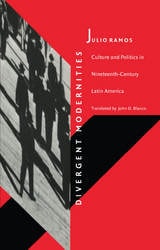
Divergent Modernities
Culture and Politics in Nineteenth-Century Latin AmericaJulio Ramos
Duke University Press, 2001
Since its first publication in Spanish nearly a decade ago, Julio Ramos’s Desenucuentros de la modernidad en America Latina por el siglo XIX has been recognized as one of the most important studies of modernity in the western hemisphere. Available for the first time in English—and now published with new material—Ramos’s study not only offers an analysis of the complex relationships between history, literature, and nation-building in the modern Latin American context but also takes crucial steps toward the development of a truly comparative inter-American cultural criticism.
With his focus on the nineteenth century, Ramos begins his genealogy of an emerging Latin Americanism with an examination of Argentinean Domingo Sarmiento and Chilean Andrés Bello, representing the “enlightened letrados” of tradition. In contrast to these “lettered men,” he turns to Cuban journalist, revolutionary, and poet José Martí, who, Ramos suggests, inaugurated a new kind of intellectual subject for the Americas. Though tracing Latin American modernity in general, it is the analysis of Martí—particularly his work in the United States—that becomes the focal point of Ramos’s study. Martí’s confrontation with the unequal modernization of the New World, the dependent status of Latin America, and the contrast between Latin America’s culture of elites and the northern mass culture of commodification are, for Ramos, key elements in understanding the complex Latin American experience of modernity.
Including two new chapters written for this edition, as well as translations of three of Martí’s most important works, Divergent Modernities will be indispensable for anyone seeking to understand development and modernity across the Americas.

Divination, Politics, and Ancient Near Eastern Empires
Alan Lenzi
SBL Press, 2014
Advance your understanding of divination’s role in supporting or undermining imperial aspirations in the ancient Near East
This collection examines the ways that divinatory texts in the Hebrew Bible and the ancient Near East undermined and upheld the empires in which the texts were composed, edited, and read. Nine essays and an introduction engage biblical scholarship on the Prophets, Assyriology, the Dead Sea Scrolls, and the critical study of Ancient Empires.
Features:
- Interdisciplinary approaches include propaganda studies
- Essays examine how biblical and other ancient Near Eastern texts were shaped by political and theological empires
- Index of ancient sources

Doctors and the State
The Politics of Health Care in France and the United StatesDavid Wilsford
Duke University Press, 1991
In France, Wilsford shows, the state is strong in the health policy domain, while organized medicine is weak and divided. Consequently, physicians exercise little influence over health care policymaking. By contrast, in the United States the state is weak, the employers and insurers who pay for health care are fragmented, and organized medicine is strong and well financed. As a result, medical professionals are able to exert a greater influence on policymaking, thus making cost control more difficult.
Wilsford extends his comparison to health care systems in the United Kingdom, West Germany, Italy, Canada, and Japan. Whether the private or public sector finances health care, he discovers, there is now an important trend in all of the advanced industrial countries toward controlling escalating costs by curbing both the medical profession’s clinical autonomy and physicians’ incomes.

Doctors and the State
The Politics of Health Care in France and the United StatesDavid Wilsford
Duke University Press, 0
In France, Wilsford shows, the state is strong in the health policy domain, while organized medicine is weak and divided. Consequently, physicians exercise little influence over health care policymaking. By contrast, in the United States the state is weak, the employers and insurers who pay for health care are fragmented, and organized medicine is strong and well financed. As a result, medical professionals are able to exert a greater influence on policymaking, thus making cost control more difficult.
Wilsford extends his comparison to health care systems in the United Kingdom, West Germany, Italy, Canada, and Japan. Whether the private or public sector finances health care, he discovers, there is now an important trend in all of the advanced industrial countries toward controlling escalating costs by curbing both the medical profession’s clinical autonomy and physicians’ incomes.
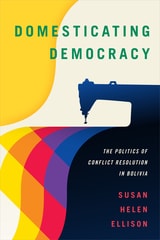
Domesticating Democracy
The Politics of Conflict Resolution in BoliviaSusan Helen Ellison
Duke University Press, 2018

Domestication Gone Wild
Politics and Practices of Multispecies RelationsHeather Anne Swanson, Gro B. Ween, and Marianne E. Lien, editors
Duke University Press, 2018
Contributors. Inger Anneberg, Natasha Fijn, Rune Flikke, Frida Hastrup, Marianne Elisabeth Lien, Knut G. Nustad, Sara Asu Schroer, Heather Anne Swanson, Anna Lowenhaupt Tsing, Mette Vaarst, Gro B. Ween, Jon Henrik Ziegler Remme

Domestications
American Empire, Literary Culture, and the Postcolonial LensHosam Aboul-Ela
Northwestern University Press, 2018
Domestications traces a genealogy of American global engagement with the Global South since World War II. Hosam Aboul-Ela reads American writers contrapuntally against intellectuals from the Global South in their common—yet ideologically divergent—concerns with hegemony, world domination, and uneven development. Using Edward Said’s Culture and Imperialism as a model, Aboul-Ela explores the nature of U.S. imperialism’s relationship to literary culture through an exploration of five key terms from the postcolonial bibliography: novel, idea, perspective, gender, and space.
Within this framework the book examines juxtapositions including that of Paul Bowles’s Morocco with North African intellectuals’ critique of Orientalism, the global treatment of Vietnamese liberation movements with the American narrative of personal trauma in the novels of Tim O’Brien and Hollywood film, and the war on terror’s philosophical idealism with Korean and post-Arab nationalist materialist archival fiction.
Domestications departs from other recent studies of world literature in its emphases not only on U.S. imperialism but also on intellectuals working in the Global South and writing in languages other than English and French. Although rooted in comparative literature, its readings address issues of key concern to scholars in American studies, postcolonial studies, literary theory, and Middle Eastern studies.

Dorsality
Thinking Back through Technology and PoliticsDavid Wills
University of Minnesota Press, 2008
In this highly original book David Wills rethinks not only our nature before all technology but also what we understand to be technology. Rather than considering the human being as something natural that then develops technology, Wills argues, we should instead imagine an originary imbrication of nature and machine that begins with a dorsal turn-a turn that takes place behind our back, outside our field of vision.
With subtle and insightful readings, Wills pursues this sense of what lies behind our idea of the human by rescuing Heidegger’s thinking from a reductionist dismissal of technology, examining different angles on Lévinas’s face-to-face relation, and tracing a politics of friendship and sexuality in Derrida and Sade. He also analyzes versions of exile in Joyce’s rewriting of Homer and Broch’s rewriting of Virgil and discusses how Freud and Rimbaud exemplify the rhetoric of soil and blood that underlies every attempt to draw lines between nations and discriminate between peoples. In closing, Wills demonstrates the political force of rhetoric in a sophisticated analysis of Nietzsche’s oft-quoted declaration that “God is dead.”
Forward motion, Wills ultimately reveals, is an ideology through which we have favored the front-what can be seen-over the aspects of the human and technology that lie behind the back and in the spine-what can be sensed otherwise-and shows that this preference has had profound environmental, political, sexual, and ethical consequences.
David Wills is professor of French and English at the University of Albany (SUNY). He is the author of Prosthesis and Matchbook: Essays in Deconstruction as well as the translator of works by Jacques Derrida, including The Gift of Death.

Double Crossover
Gender, Media, and Politics in Global BasketballCourtney M. Cox
University of Illinois Press, 2025
As they compete in leagues around the world, elite women’s basketball players continually adjust to new cultures, rules, and contracts.
Courtney M. Cox follows athletes, coaches, journalists, and advocates of women’s basketball as they pursue careers within the sport. Despite all attempts to contain them or prevent forward momentum, they circumvent expectations and open new possibilities within and outside of the game. Throughout the book, Cox explores the intersection of race and gender against the backdrop of the WNBA, NCAA, and other leagues within the United States and around the world. Blending interviews and participant observation with content analysis, she charts how athletes and advocates of women’s hoops illuminate new forms of navigating the global sports-media complex.
Timely and original, Double Crossover takes readers into the lived world of women’s basketball to shed light on the struggles, triumphs, and contributions of today’s players and those around them.

Down and Dirty Down South
Politics and the Art of RevengeRoger Glasgow
Butler Center for Arkansas Studies, 2016
While pursuing a race for district prosecutor in the 1970s, Glasgow had run afoul of the local political machine. The machine later decided to teach Glasgow a lesson even though he’d lost the race. Down and Dirty Down South is Glasgow’s story of how he attempted to clear his name and also track down the people who had set him up for charges of smuggling illegal drugs into the United States.

Dr. Nurse
Science, Politics, and the Transformation of American NursingDominique A. Tobbell
University of Chicago Press, 2022
Nurses represent the largest segment of the U.S. health care workforce and spend significantly more time with patients than any other member of the health care team. Dr. Nurse probes their history to examine major changes that have taken place in American health care in the second half of the twentieth century. The book reveals how federal and state health and higher education policies shaped education within health professions after World War II.
Starting in the 1950s, academic nurses sought to construct a science of nursing—distinct from that of the related biomedical or behavioral sciences—that would provide the basis for nursing practice. Their efforts transformed nursing’s labor into a valuable site of knowledge production and proved how the application of their knowledge was integral to improving patient outcomes. Exploring the knowledge claims, strategies, and politics involved as academic nurses negotiated their roles and nursing’s future, Dr. Nurse highlights how state-supported health centers have profoundly shaped nursing education and health care delivery.

Dr. Nurse
Science, Politics, and the Transformation of American NursingDominique A. Tobbell
University of Chicago Press, 2022
An analysis of the efforts of American nurses to establish nursing as an academic discipline and nurses as valued researchers in the decades after World War II.
Nurses represent the largest segment of the U.S. health care workforce and spend significantly more time with patients than any other member of the health care team. Dr. Nurse probes their history to examine major changes that have taken place in American health care in the second half of the twentieth century. The book reveals how federal and state health and higher education policies shaped education within health professions after World War II.
Starting in the 1950s, academic nurses sought to construct a science of nursing—distinct from that of the related biomedical or behavioral sciences—that would provide the basis for nursing practice. Their efforts transformed nursing’s labor into a valuable site of knowledge production and proved how the application of their knowledge was integral to improving patient outcomes. Exploring the knowledge claims, strategies, and politics involved as academic nurses negotiated their roles and nursing’s future, Dr. Nurse highlights how state-supported health centers have profoundly shaped nursing education and health care delivery.
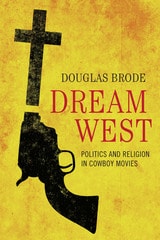
Dream West
Politics and Religion in Cowboy MoviesBy Douglas Brode
University of Texas Press, 2013
While political liberals celebrated the end of “cowboy politics” with the election of Barack Obama to the presidency, political conservatives in the Tea Party and other like-minded groups still vociferously support “cowboy” values such as small government, low taxes, free-market capitalism, and the right to bear arms. Yet, as Douglas Brode argues in this paradigm-shifting book, these supposedly cowboy or “Old West” values hail not so much from the actual American frontier of the nineteenth century as from Hollywood’s portrayal of it in the twentieth century. And a close reading of Western films and TV shows reveals a much more complex picture than the romanticized, simplistic vision espoused by the conservative right.
Examining dozens of Westerns, including Gunfight at the O.K. Corral, Red River, 3:10 to Yuma (old and new), The Wild Ones, High Noon, My Darling Clementine, The Alamo, and No Country for Old Men, Brode demonstrates that the genre (with notable exceptions that he fully covers) was the product of Hollywood liberals who used it to project a progressive agenda on issues such as gun control, environmental protection, respect for non-Christian belief systems, and community cohesion versus rugged individualism. Challenging us to rethink everything we thought we knew about the genre, Brode argues that the Western stands for precisely the opposite of what most people today—whether they love it or hate it—believe to be the essential premise of “the only truly, authentically, and uniquely American narrative form.”
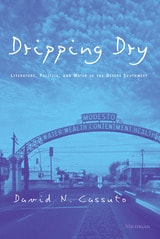
Dripping Dry
Literature, Politics and Water in the Desert SouthwestDavid N. Cassuto
University of Michigan Press, 2001
The four works selected (Animal Dreams, The Monkey Wrench Gang, The Grapes of Wrath, and The Ford) present a composite portrait of reclamation, which the author argues is one of the most important cultural and ecological phenomena in the nation's history. The tensions and contradictions presented by the novels underscore the compelling need for an ecocritique of the relationship between literature and politics. David N. Cassuto deciphers the myths of reclamation and restoration and presents a third alternative--sustainability--in their stead. The challenge is a large one, because of the size and complexity of the region and because nature continues to evolve and create itself, a process involving language, ideology, and the land.
The book is designed to be an interdisciplinary contribution both to the emerging field of literature and the environment, as well as to environmental studies. It will be welcomed by scholars as well as general readers interested in new approaches to literature and environmental issues, and by those interested in the geography and literature of the western United States.
David N. Cassuto, formerly of the English Department of the University of Missouri-Rolla, is a practicing attorney in San Francisco, specializing in environmental issues.

Drive in Cinema
Essays on Film, Theory and PoliticsMarc James Léger
Intellect Books, 2015
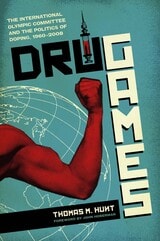
Drug Games
The International Olympic Committee and the Politics of Doping, 1960–2008By Thomas M. Hunt
University of Texas Press, 2011
On August 26, 1960, twenty-three-year-old Danish cyclist Knud Jensen, competing in that year's Rome Olympic Games, suddenly fell from his bike and fractured his skull. His death hours later led to rumors that performance-enhancing drugs were in his system. Though certainly not the first instance of doping in the Olympic Games, Jensen's death serves as the starting point for Thomas M. Hunt's thoroughly researched, chronological history of the modern relationship of doping to the Olympics. Utilizing concepts derived from international relations theory, diplomatic history, and administrative law, this work connects the issue to global political relations.
During the Cold War, national governments had little reason to support effective anti-doping controls in the Olympics. Both the United States and the Soviet Union conceptualized power in sport as a means of impressing both friends and rivals abroad. The resulting medals race motivated nations on both sides of the Iron Curtain to allow drug regulatory powers to remain with private sport authorities. Given the costs involved in testing and the repercussions of drug scandals, these authorities tried to avoid the issue whenever possible. But toward the end of the Cold War, governments became more involved in the issue of testing. Having historically been a combined scientific, ethical, and political dilemma, obstacles to the elimination of doping in the Olympics are becoming less restrained by political inertia.
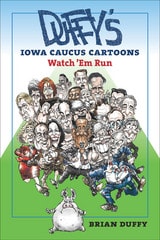
Duffy's Iowa Caucus Cartoons
Watch 'Em RunBrian Duffy
University of Iowa Press, 2015
Whether you’re anticipating or dreading the onset of another caucus season in 2016, this book will put it all into perspective. From Jimmy Carter’s innovative 1976 effort to Barack Obama’s come-from-behind win in 2008, from George H. W. Bush’s storming to victory in 1980 to George W. Bush’s coasting to his win in 2000, from Gary Hart’s peccadillos in 1988 to John Edwards’s missteps in 2008, from Elizabeth Dole’s determination to breach the White House boys’ club in 2000 to Hillary Clinton’s fall from frontrunner to third place in 2008, here is American presidential campaigning in all its glory. With pigs.
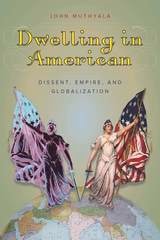
Dwelling in American
Dissent, Empire, and GlobalizationJohn Muthyala
Dartmouth College Press, 2012

Dwelling in Fiction
Poetics of Place and the Experimental Novel in Latin AmericaAshley R. Brock
Northwestern University Press, 2023
The radical formal experiments undertaken by writers across Latin America in the mid-twentieth century introduced friction, opacity, and self-reflexivity to the very act of reading. Dwelling in Fiction: Poetics of Place and the Experimental Novel in Latin America explores the limitations and the possibilities of literature for conveying place-specific forms of life. Focusing on authors such as José María Arguedas, João Guimarães Rosa, and Juan José Saer, who are often celebrated for universalizing regional themes, Ashley R. Brock brings a new critical lens to Latin American writers who were ambivalent toward their era’s “boom.”
Beyond mere resistance to or critique of the commodification and political instrumentalization of rural topics and types, this countertrend of critical regionalism positions readers themselves as outsiders, pushing them to engage their senses, to train their attention, and to learn to dwell in unknown textual landscapes. Dwelling in Fiction draws on a transnational community of thinkers and writers to show how their midcentury aesthetic practices of sensorial pedagogy anticipate contemporary turns toward affect, embodiment, decoloniality, and ecological thought.