Results by title
54 books match the query 'Populism' and 3 start with d

Deadline
Populism and the Press in VenezuelaRobert Samet
University of Chicago Press, 2019
In Deadline, anthropologist Robert Samet answers this question by focusing on the relationship between populism, the press, and what he calls “the will to security.” Drawing on nearly a decade of ethnographic research alongside journalists on the Caracas crime beat, he shows how the media shaped the politics of security from the ground up. Paradoxically, Venezuela’s punitive turn was not the product of dictatorship, but rather an outgrowth of practices and institutions normally associated with democracy. Samet reckons with this apparent contradiction by exploring the circulation of extralegal denuncias (accusations) by crime journalists, editors, sources, and audiences. Denuncias are a form of public shaming or exposé that channels popular anger against the powers that be. By showing how denuncias mobilize dissent, Deadline weaves a much larger tale about the relationship between the press, popular outrage, and the politics of security in the twenty-first century.

Democracy Fatigue
An East European EpidemyCarlos García-Rivero
Central European University Press, 2023
Over the early 21st century, democracy worldwide has deteriorated significantly. At the same time, new populist forces have appeared that challenge democracies through legal reforms. The stark contrast between Eastern and Western Europe in this respect is the focus of this collection of essays.
The authors consider the 2008-2012 economic crisis to be at the root of the success of the populist parties and the rise of cultural backlash against liberal values. In turn, European governments’ responses to the crisis—mainly austerity measures demanded by IMF and the EU— help explain desenchantment with the European Union. These policies made the wider public feel that they were being left out of politics, and populist parties promised to return power to them.
The contributors argue that polarization of the electorate can set in motion a radicalization that strengthens authoritarians at the expense of democrats. They also demonstrate that Eastern and Western Europe differ in their attitudes to the decline in quality of democracy. The studies consider how satisfied people are with the political changes they witness, and argue that seemingly more authoritarian attitudes in the East explain why people feel more satisfied with a defective democracy that empowers the populist-authoritarian political actors that they support.
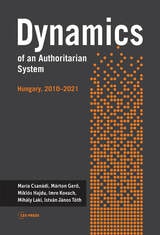
Dynamics of an Authoritarian System
Hungary, 2010–2021Mária Csanádi
Central European University Press, 2022
This conceptually synthetic and empirically rich book demonstrates the vulnerability of democratic settings to authoritarianism and populism. Six scholars from various professional fields explore here the metamorphosis of a political party into a centralized authoritarian system. Viktor Orbán and his Fidesz party needed less than ten years to accomplish this transformation in Hungary. In 2010, after winning a majority that could make changes in the constitution – two-thirds of the parliamentary seats, they evolved and stabilized the system, which produced again the two-thirds majority in 2014 and 2018.
The authors reveal how a democratic setting can be used as a device for political capture. They show how a political entity managed to penetrate almost all sub-fields of the economy to arrive at institutionalized corruption, and how the centralized power structure reproduces itself. With the help of a powerful empirical apparatus—among others analyses of more than 220,000 public tenders, redistributions of state subsidies, and the interconnectedness of those privileged with the political elite — the authors detail the functioning of a crony system and the network aspects of political connections in the rapid enrichment of politically-linked businesses. Their studies demonstrate the role of political capture in this redistribution and how this capture leads to a new social stratification.