138 books match the query 'Postcolonialism' and 9 start with d

cover of Darfur Allegory

Darfur Allegory

Rogaia Mustafa Abusharaf

University of Chicago Press, 2021

The Darfur conflict exploded in early 2003 when two rebel groups, the Sudan Liberation Movement and the Justice and Equality Movement, struck national military installations in Darfur to send a hard-hitting message of resentment over the region’s political and economic marginalization. The conflict devastated the region’s economy, shredded its fragile social fabric, and drove millions of people from their homes. Darfur Allegory is a dispatch from the humanitarian crisis that explains the historical and ethnographic background to competing narratives that have informed international responses. At the heart of the book is Sudanese anthropologist Rogaia Abusharaf’s critique of the pseudoscientific notions of race and ethnicity that posit divisions between “Arab” northerners and “African” Darfuris.
 
Elaborated in colonial times and enshrined in policy afterwards, such binary categories have been adopted by the media to explain the civil war in Darfur. The narratives that circulate internationally are thus highly fraught and cover over—to counterproductive effect—forms of Darfurian activism that have emerged in the conflict’s wake. Darfur Allegory marries the analytical precision of a committed anthropologist with an insider’s view of Sudanese politics at home and in the diaspora, laying bare the power of words to heal or perpetuate civil conflict.
[more]
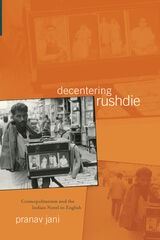
cover of Decentering Rushdie: Cosmopolitanism and the Indian Novel in English

Decentering Rushdie

Cosmopolitanism and the Indian Novel in English

Pranav Jani

The Ohio State University Press, 2010

Interrogating current theories of cosmopolitanism, nationalism, and aesthetics in Postcolonial Studies, Decentering Rushdie offers a new perspective on the Indian novel in English. Since Salman Rushdie’s Midnight’s Children won the Booker Prize in 1981, its postmodern style and postnational politics have dominated discussions of postcolonial literature. As a result, the rich variety of narrative forms and perspectives on the nation that constitute the field have been obscured, if not erased altogether.

Reading a range of novels published between the 1950s and 1990s, including works by Nayantara Sahgal, Kamala Markandaya, Anita Desai, and Arundhati Roy, Decentering Rushdie suggests an alternative understanding of the genre in postcolonial India. Pranav Jani documents the broad shift from nation-oriented to postnationalist perspectives following the watershed crisis of the Emergency of the 1970s. Recovering the “namak-halaal cosmopolitanism” of early novels—a cosmopolitanism that is “true to its salt”—Decentering Rushdie also explains the rise and critical celebration of postnational cosmopolitanism.
 
Decentering Rushdie thus resituates contemporary literature within a nuanced history of Indian debates about cosmopolitanism and the national question. In the process, Jani articulates definitions of cosmopolitanism and nationalism that speak to the complex negotiation of language, culture, and representation in postcolonial South Asia.
[more]
cover of Decolonial Care: Reimagining Caregiving in the French Caribbean

Decolonial Care

Reimagining Caregiving in the French Caribbean

Jennifer Boum Make

Rutgers University Press, 2025
Decolonial Care examines the relationship between the legacies of colonialism and the dynamics of caregiving that have emerged from the French Caribbean. Through a variety of media, including novels, graphic narratives, and curatorial discourse, this book explores four key contexts at the intersection of care and colonialism: care-focused gender roles, domestic service, nurturing human life and environments, and curation as caring. Decolonial Care argues that to imagine caregiving in the context of the French Caribbean means reckoning with intrinsically uncaring practices inherited from colonial rule that show disregard for human life and environments. Putting in dialogue postcolonial studies and care studies, this book elucidates how caring and uncaring have been historically shaped by colonialism, showing how media and narratives about the French Caribbean document the damaging impact of colonialism but also help develop decolonial approaches to care that sustain human life and livable environments.
[more]
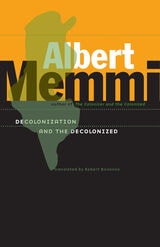
cover of Decolonization and the Decolonized

Decolonization and the Decolonized

Albert Memmi

University of Minnesota Press, 2006
In this time of global instability and widespread violence, Albert Memmi—author of the highly influential and groundbreaking work The Colonizer and the Colonized—turns his attention to the present-day situation of formerly colonized peoples. In Decolonization and the Decolonized, Memmi expands his intellectual engagement with the subject and examines the manifold causes of the failure of decolonization efforts throughout the world.As outspoken and controversial as ever, Memmi initiates a much-needed discussion of the ex-colonized and refuses to idealize those who are too often painted as hapless victims. He shows how, in light of a radically changed world, it would be problematic—and even irresponsible—to continue to deploy concepts that were useful and valid during the period of anticolonial struggle.Decolonization and the Decolonized contributes to the most current debates on Islamophobia in France, the “new” anti-Semitism, and the unrelenting poverty gripping the African continent. Memmi, who is Jewish, was born and raised in Tunis, and focuses primarily on what he calls the Arab-Muslim condition, while also incorporating comparisons with South America, Asia, Black Africa, and the United States. In Decolonization and the Decolonized, Memmi has written that rare book—a manifesto informed by intellect and animated by passion—that will propel public analysis of the most urgent global issues to a new level.Albert Memmi is professor emeritus of sociology at the University of Paris, Nanterre, and the author of Racism (Minnesota, 1997).Robert Bononno, a teacher and translator, lives in New York City.
[more]
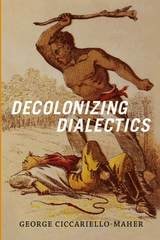
cover of Decolonizing Dialectics

Decolonizing Dialectics

Geo Maher

Duke University Press, 2017

Anticolonial theorists and revolutionaries have long turned to dialectical thought as a central weapon in their fight against oppressive structures and conditions. This relationship was never easy, however, as anticolonial thinkers have resisted the historical determinism, teleology, Eurocentrism, and singular emphasis that some Marxisms place on class identity at the expense of race, nation, and popular identity. In recent decades, the conflict between dialectics and postcolonial theory has only deepened. In Decolonizing Dialectics Geo Maher breaks this impasse by bringing the work of Georges Sorel, Frantz Fanon, and Enrique Dussel together with contemporary Venezuelan politics to formulate a dialectics suited to the struggle against the legacies of colonialism and slavery. This is a decolonized dialectics premised on constant struggle in which progress must be fought for and where the struggles of the wretched of the earth themselves provide the only guarantee of historical motion.
[more]
cover of Diné Perspectives: Revitalizing and Reclaiming Navajo Thought

Diné Perspectives

Revitalizing and Reclaiming Navajo Thought

Edited by Lloyd L. Lee; Foreword by Gregory Cajete

University of Arizona Press, 2014

What does it mean to be a Navajo (Diné) person today? What does it mean to “respect tradition”? How can a contemporary life be informed by the traditions of the past? These are the kinds of questions addressed by contributors to this unusual and pathbreaking book.
 
All of the contributors are coming to personal terms with a phrase that underpins the matrix of Diné culture: Sa’ah Naagháí Bik’eh Hózhóón. Often referred to simply as SNBH, the phrase can be translated in many ways but is generally understood to mean “one’s journey of striving to live a long, harmonious life.” The book offers a variety of perspectives of Diné men and women on the Diné cultural paradigm that is embedded in SNBH. Their writings represent embodied knowledge grounded in a way of knowing that connects thought, speech, experience, history, tradition, and land. Some of the contributors are scholars. Some are Diné who are fighting for justice and prosperity for the Navajo Nation. Some are poets and artists. They are united in working to preserve both intellectual and cultural sovereignty for Diné peoples. And their contributions exemplify how Indigenous peoples are creatively applying tools of decolonization and critical research to re-create Indigenous thought and culture in a present day that rarely resembles the days of their ancestors.
 
More than 300,000 people self-identify as Diné today. Every one must grapple with how to make a life that acknowledges Sa’ah Naagháí Bik’eh Hózhóón. Diné Perspectives is unique in bringing such personal journeys to the public eye.

[more]
cover of Discipline and the Other Body: Correction, Corporeality, Colonialism

Discipline and the Other Body

Correction, Corporeality, Colonialism

Steven Pierce and Anupama Rao, eds.

Duke University Press, 2006

Discipline and the Other Body reveals the intimate relationship between violence and difference underlying modern governmental power and the human rights discourses that critique it. The comparative essays brought together in this collection show how, in using physical violence to discipline and control colonial subjects, governments repeatedly found themselves enmeshed in a fundamental paradox: Colonialism was about the management of difference—the “civilized” ruling the “uncivilized”—but colonial violence seemed to many the antithesis of civility, threatening to undermine the very distinction that validated its use. Violation of the bodies of colonial subjects regularly generated scandals, and eventually led to humanitarian initiatives, ultimately changing conceptions of “the human” and helping to constitute modern forms of human rights discourse. Colonial violence and discipline also played a crucial role in hardening modern categories of difference—race, gender, ethnicity, sexuality, and religion.

The contributors, who include both historians and anthropologists, address instances of colonial violence from the early modern period to the twentieth century and from Asia to Africa to North America. They consider diverse topics, from the interactions of race, law, and violence in colonial Louisiana to British attempts to regulate sex and marriage in the Indian army in the early nineteenth century. They examine the political dilemmas raised by the extensive use of torture in colonial India and the ways that British colonizers flogged Nigerians based on beliefs that different ethnic and religious affiliations corresponded to different degrees of social evolution and levels of susceptibility to physical pain. An essay on how contemporary Sufi healers deploy bodily violence to maintain sexual and religious hierarchies in postcolonial northern Nigeria makes it clear that the state is not the only enforcer of disciplinary regimes based on ideas of difference.

Contributors. Laura Bear, Yvette Christiansë, Shannon Lee Dawdy, Dorothy Ko, Isaac Land, Susan O’Brien, Douglas M. Peers, Steven Pierce, Anupama Rao, Kerry Ward

[more]
cover of Dockside Reading: Hydrocolonialism and the Custom House

Dockside Reading

Hydrocolonialism and the Custom House

Isabel Hofmeyr

Duke University Press, 2022

In Dockside Reading Isabel Hofmeyr traces the relationships among print culture, colonialism, and the ocean through the institution of the British colonial Custom House. During the late nineteenth and early twentieth centuries, dockside customs officials would leaf through publications looking for obscenity, politically objectionable materials, or reprints of British copyrighted works, often dumping these condemned goods into the water. These practices, echoing other colonial imaginaries of the ocean as a space for erasing incriminating evidence of the violence of empire, informed later censorship regimes under apartheid in South Africa. By tracking printed matter from ship to shore, Hofmeyr shows how literary institutions like copyright and censorship were shaped by colonial control of coastal waters. Set in the environmental context of the colonial port city, Dockside Reading explores how imperialism colonizes water. Hofmeyr examines this theme through the concept of hydrocolonialism, which puts together land and sea, empire and environment.
[more]
cover of Duress: Imperial Durabilities in Our Times

Duress

Imperial Durabilities in Our Times

Ann Laura Stoler

Duke University Press, 2016

How do colonial histories matter to the urgencies and conditions of our current world? How have those histories so often been rendered as leftovers, as "legacies" of a dead past rather than as active and violating forces in the world today? With precision and clarity, Ann Laura Stoler argues that recognizing "colonial presence" may have as much to do with how the connections between colonial histories and the present are expected to look as it does with how they are expected to be. In Duress, Stoler considers what methodological renovations might serve to write histories that yield neither to smooth continuities nor to abrupt epochal breaks. Capturing the uneven, recursive qualities of the visions and practices that imperial formations have animated, Stoler works through a set of conceptual and concrete reconsiderations that locate the political effects and practices that imperial projects produce: occluded histories, gradated sovereignties, affective security regimes, "new" racisms, bodily exposures, active debris, and carceral archipelagos of colony and camp that carve out the distribution of inequities and deep fault lines of duress today.
[more]