Results by title
52 books match the query 'Postcolonialism in literature' and 4 start with d
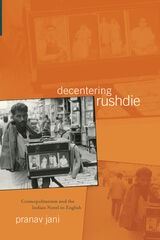
Decentering Rushdie
Cosmopolitanism and the Indian Novel in EnglishPranav Jani
The Ohio State University Press, 2010
Interrogating current theories of cosmopolitanism, nationalism, and aesthetics in Postcolonial Studies, Decentering Rushdie offers a new perspective on the Indian novel in English. Since Salman Rushdie’s Midnight’s Children won the Booker Prize in 1981, its postmodern style and postnational politics have dominated discussions of postcolonial literature. As a result, the rich variety of narrative forms and perspectives on the nation that constitute the field have been obscured, if not erased altogether.
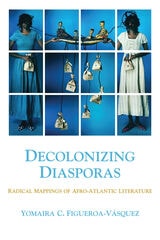
Decolonizing Diasporas
Radical Mappings of Afro-Atlantic LiteratureYomaira C. Figueroa-Vásquez
Northwestern University Press, 2021
Winner, MLA Prize in United States Latina and Latino and Chicana and Chicano Literary and Cultural Studies
Mapping literature from Spanish-speaking sub-Saharan African and Afro-Latinx Caribbean diasporas, Decolonizing Diasporas argues that the works of diasporic writers and artists from Equatorial Guinea, Puerto Rico, the Dominican Republic, and Cuba offer new worldviews that unsettle and dismantle the logics of colonial modernity. With women of color feminisms and decolonial theory as frameworks, Yomaira C. Figueroa-Vásquez juxtaposes Afro-Latinx and Afro-Hispanic diasporic artists, analyzing work by Nelly Rosario, Juan Tomás Ávila Laurel, Trifonia Melibea Obono, Donato Ndongo, Junot Díaz, Aracelis Girmay, Loida Maritza Pérez, Ernesto Quiñonez, Christina Olivares, Joaquín Mbomio Bacheng, Ibeyi, Daniel José Older, and María Magdalena Campos-Pons. Figueroa-Vásquez’s study reveals the thematic, conceptual, and liberatory tools these artists offer when read in relation to one another.
Decolonizing Diasporas examines how themes of intimacy, witnessing, dispossession, reparations, and futurities are remapped in these works by tracing interlocking structures of oppression, including public and intimate forms of domination, sexual and structural violence, sociopolitical and racial exclusion, and the haunting remnants of colonial intervention. Figueroa-Vásquez contends that these diasporic literatures reveal violence but also forms of resistance and the radical potential of Afro-futurities.
This study centers the cultural productions of peoples of African descent as Afro-diasporic imaginaries that subvert coloniality and offer new ways to approach questions of home, location, belonging, and justice.
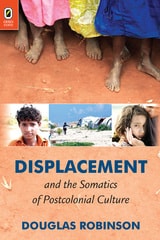
Displacement and the Somatics of Postcolonial Culture
Douglas Robinson
The Ohio State University Press, 2013

Domestications
American Empire, Literary Culture, and the Postcolonial LensHosam Aboul-Ela
Northwestern University Press, 2018
Domestications traces a genealogy of American global engagement with the Global South since World War II. Hosam Aboul-Ela reads American writers contrapuntally against intellectuals from the Global South in their common—yet ideologically divergent—concerns with hegemony, world domination, and uneven development. Using Edward Said’s Culture and Imperialism as a model, Aboul-Ela explores the nature of U.S. imperialism’s relationship to literary culture through an exploration of five key terms from the postcolonial bibliography: novel, idea, perspective, gender, and space.
Within this framework the book examines juxtapositions including that of Paul Bowles’s Morocco with North African intellectuals’ critique of Orientalism, the global treatment of Vietnamese liberation movements with the American narrative of personal trauma in the novels of Tim O’Brien and Hollywood film, and the war on terror’s philosophical idealism with Korean and post-Arab nationalist materialist archival fiction.
Domestications departs from other recent studies of world literature in its emphases not only on U.S. imperialism but also on intellectuals working in the Global South and writing in languages other than English and French. Although rooted in comparative literature, its readings address issues of key concern to scholars in American studies, postcolonial studies, literary theory, and Middle Eastern studies.