Results by title
160 books match the query 'Poverty & Homelessness' and 4 start with d

Deconstruction Machines
Writing in the Age of CyberwarJustin Joque
University of Minnesota Press, 2018
A bold new theory of cyberwar argues that militarized hacking is best understood as a form of deconstruction
From shadowy attempts to steal state secrets to the explosive destruction of Iranian centrifuges, cyberwar has been a vital part of statecraft for nearly thirty years. But although computer-based warfare has been with us for decades, it has changed dramatically since its emergence in the 1990s, and the pace of change is accelerating.
In Deconstruction Machines, Justin Joque inquires into the fundamental nature of cyberwar through a detailed investigation of what happens at the crisis points when cybersecurity systems break down and reveal their internal contradictions. He concludes that cyberwar is best envisioned as a series of networks whose constantly shifting connections shape its very possibilities. He ultimately envisions cyberwar as a form of writing, advancing the innovative thesis that cyber attacks should be seen as a militarized form of deconstruction in which computer programs are systems that operate within the broader world of texts.
Throughout, Joque addresses hot-button subjects such as technological social control and cyber-resistance entities like Anonymous and Wikileaks while also providing a rich, detailed history of cyberwar. Deconstruction Machines provides a necessary new interpretation of deconstruction and timely analysis of media, war, and technology.
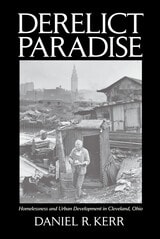
Derelict Paradise
Homelessness and Urban Development in Cleveland, OhioDaniel R. Kerr
University of Massachusetts Press, 2011
Seeking answers to the question, “Who benefits from homelessness?” this book takes the reader on a sweeping tour of Cleveland's history from the late nineteenth-century through the early twenty-first. Daniel Kerr shows that homelessness has deep roots in the shifting ground of urban labor markets, social policy, downtown development, the criminal justice system, and corporate power. Rather than being attributable to the illnesses and inadequacies of the unhoused themselves, it is a product of both structural and political dynamics shaping the city. Kerr locates the origins of today's shelter system in the era that followed the massive railroad rebellions of 1877. From that period through the Great Depression, business and political leaders sought to transform downtown Cleveland to their own advantage. As they focused on bringing business travelers and tourists to the city and beckoned upper-income residents to return to its center, they demolished two downtown working-class neighborhoods and institutionalized a shelter system to contain and control the unhoused and unemployed. The precedents from this period informed the strategies of the post–World War II urban renewal era as the "new urbanism" of the late twentieth century. The efforts of the city's elites have not gone uncontested. Kerr documents a rich history of opposition by people at the margins of whose organized resistance and everyday survival strategies have undermined the grand plans crafted by the powerful and transformed the institutions designed to constrain the lives of the homeless.
Down and Out in Los Angeles and Berlin
The Sociospatial Exclusion of Homeless PeopleJurgen von Mahs
Temple University Press, 2015
Drawing on fascinating ethnographic insights, von Mahs shows how homeless people in both cities face sociospatial exclusion-legal displacement for criminal activities, poor shelters in impoverished neighborhoods, as well as market barriers that restrict reintegration. Providing a necessary wake-up call, Down and Out in Los Angeles and Berlin addresses the critical public policy issues that can produce effective services to improve homeless people's chances for a lasting exit.
Down, Out, and Under Arrest
Policing and Everyday Life in Skid RowForrest Stuart
University of Chicago Press, 2016
Juliette, a woman he met during that time, has been stopped by police well over one hundred times, arrested upward of sixty times, and has given up more than a year of her life serving week-long jail sentences. Her most common crime? Simply sitting on the sidewalk—an arrestable offense in LA.
Why? What purpose did those arrests serve, for society or for Juliette? How did we reach a point where we’ve cut support for our poorest citizens, yet are spending ever more on policing and prisons? That’s the complicated, maddening story that Stuart tells in Down, Out and Under Arrest, a close-up look at the hows and whys of policing poverty in the contemporary United States. What emerges from Stuart’s years of fieldwork—not only with Skid Row residents, but with the police charged with managing them—is a tragedy built on mistakes and misplaced priorities more than on heroes and villains. He reveals a situation where a lot of people on both sides of this issue are genuinely trying to do the right thing, yet often come up short. Sometimes, in ways that do serious harm.
At a time when distrust between police and the residents of disadvantaged neighborhoods has never been higher, Stuart’s book helps us see where we’ve gone wrong, and what steps we could take to begin to change the lives of our poorest citizens—and ultimately our society itself—for the better.