Results by title
117 books match the query 'Production and direction' and 14 start with d
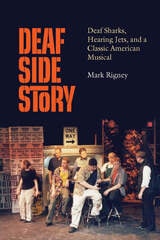
Deaf Side Story
Deaf Sharks, Hearing Jets, and a Classic American MusicalMark Rigney
Gallaudet University Press, 2003
The 1957 classic American musical West Side Story has been staged by countless community and school theater groups, but none more ambitious than the 2000 production by MacMurray College, a small school in Jacksonville, Illinois. Diane Brewer, the new drama head at the college, determined to add an extra element to the usual demands of putting on a show by having deaf students perform half of the parts. Deaf Side Story presents a fascinating narrative of Brewer and the cast’s efforts to mount this challenging play.
Brewer turned to the Illinois School for the Deaf (ISD) to cast the Sharks, the Puerto Rican gang at odds with the Anglo Jets in this musical version of Romeo and Juliet set in the slums of New York. Hearing performers auditioned to be the Jets, and once Brewer had cast her hearing Tony and deaf Maria, then came the challenge of teaching them all to sing/sign and dance the riveting show numbers for which the musical is renowned. She also had to manage a series of sensitive issues, from ensuring the seamless incorporation of American Sign Language into the play to reassuring ISD administrators and students that the production would not be symbolic of any conflict between Deaf and hearing people.
Author Mark Rigney portrays superbly the progress of the production, including the frustrations and triumphs of the leads, the labyrinthine campus and community politics, and the inevitable clashes between the deaf high school cast members and their hearing college counterparts. His representations of the many individuals involved are real and distinguished. The ultimate success of the MacMurray production reverberates in Deaf Side Story as a keen depiction of how several distinct individuals from as many cultures could cooperate to perform a classic American art form brilliantly together.
Designing Sound
Audiovisual Aesthetics in 1970s American CinemaBeck, Jay
Rutgers University Press, 2016
Directed By Allen Smithee
Jeremy Braddock
University of Minnesota Press, 2001
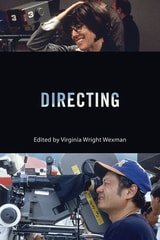
Directing
Virginia Wright Wexman
Rutgers University Press, 2017
The latest volume in the Behind the Silver Screen series, this collection provides the first comprehensive overview of how directing, as both an art and profession, has evolved in tandem with changing film industry practices. Each chapter is written by an expert on a different period of Hollywood, from the silent film era to today’s digital filmmaking, providing in-depth examinations of key trends like the emergence of independent production after World War II and the rise of auteurism in the 1970s. Challenging the myth of the lone director, these studies demonstrate how directors work with a multitude of other talented creative professionals, including actors, writers, producers, editors, and cinematographers.
Directing examines a diverse range of classic and contemporary directors, including Orson Welles, Tim Burton, Cecil B. DeMille, Steven Soderbergh, Spike Lee, and Ida Lupino, offering a rich composite picture of how they have negotiated industry constraints, utilized new technologies, and harnessed the creative contributions of their many collaborators throughout a century of Hollywood filmmaking.
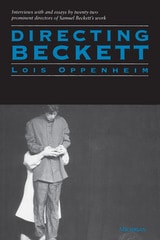
Directing Beckett
Lois Oppenheim
University of Michigan Press, 1997
In exploring this key figure in the history of theater, Oppenheim's interviews--with such directors as JoAnne Akalaitis, Edward Albee, Herbert Blau, Joseph Chaikin, and Carey Perloff--also address many of the complexities of the director's role, such as the meaning of directorial integrity and fidelity to the playwright's vision--an issue of particular relevance to a playwright whose exactitude, with respect to stage directions, is well documented. Additional highlights include photographs from many of the productions; the unpublished text of a lecture by the late Alan Schneider, Beckett's most accomplished American director; and an interview with the late Roger Blin, the very first director of Beckett's work.
"Directing Beckett is a rare thing--a book both pleasant to read and useful to have . . . it is like listening to the ideal panel, everyone who should be there there and all at their articulate best." --Toby Silverman Zinman, Theatre Journal
"Anyone intending to direct or act in a work by Beckett, or to write about his work, must read this book." --Choice
Lois Oppenheim is Professor of French, Montclair State University
Directing Postmodern Theater
Shaping Signification in PerformanceJon Whitmore
University of Michigan Press, 1994

Directing Shakespeare
A Scholar OnstageSidney Homan
Ohio University Press, 2004
An impossible question from a Chinese actor—“Why is Shakespeare eternal?”—drove Sidney Homan after fifty years in the theater to ponder just what makes Shakespeare…well, Shakespeare. The result, Directing Shakespeare, reflects the two worlds in which Homan operates—as a scholar and teacher on campus, and as a director and actor in professional and university theaters. His concern is the entire process, beginning in the lonely period when the director develops a concept, and moving into increasingly larger realms: interaction with stage designers; rehearsals; and performances in which the audience’s response further shapes the play.
Homan recounts the experience of staging King Lear accompanied by a musical score for piano, violin, and cello played live onstage. He discusses the challenge of making and trying to justify cuts in Hamlet. A casual remark from an actress leads to a feminist production of A Midsummer Night’s Dream. He describes the delicate collaboration between director and performer as he works with actors preparing for The Merchant of Venice, King Lear, and Hamlet. Other chapters treat a set designer’s bold red drapes that influenced the director’s concept for Julius Caesar, and the cross-influence of back-to-back runs of Stoppard’s Rosencrantz and Guildenstsern Are Dead and Hamlet.
In a highly personal concluding chapter, Homan tells of joyously working with a spontaneous young actor playing Puck and with an audience of unruly teenagers who wept at a performance of Lear.
Delightfully written, and filled with practical insights, Directing Shakespeare draws together scholars, critics, and those who work in the theater to bring the written word to life.
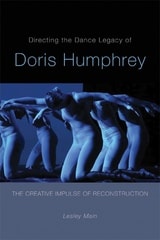
Directing the Dance Legacy of Doris Humphrey
The Creative Impulse of ReconstructionLesley Main
University of Wisconsin Press, 2012
Directing the Dance Legacy of Doris Humphrey looks inside four of Doris Humphrey’s major choreographic works—Water Study (1928), The Shakers (1931), With My Red Fires (1936), and Passacaglia (1938)—with an eye to how directorial strategies applied in recent contemporized stagings in the United States and Europe could work across the modern and contemporary dance genre. Author Lesley Main, a seasoned practitioner of Doris Humphrey choreography, stresses to the reader the need to balance respect for classical works from the modern dance repertory with the necessity for fresh directorial strategies, to balance between traditional practices and a creative role for the reconstructor.
Drawing upon her own dance experience, Main’s book addresses an area of dance research and practice that is becoming increasingly pertinent as the dancer-choreographers of the 20th century modern and contemporary dance are no longer alive to attend to the re-stagings of the body of their works. Insightful and thought-provoking, Directing the Dance Legacy of Doris Humphrey calls for the creation of new forms of directorial practice in dance beyond reconstruction. The radical new practices it proposes to replace the old are sure to spark debate and fresh thinking across the dance field.
Discorrelated Images
Shane Denson
Duke University Press, 2020
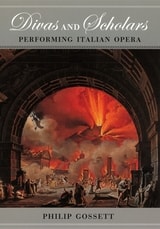
Divas and Scholars
Performing Italian OperaPhilip Gossett
University of Chicago Press, 2006
Winner of the 2007 Otto Kinkeldey Award from the American Musicological Society and the 2007 Deems Taylor Award from the American Society of Composers, Authors, and Publishers.
Divas and Scholars is a dazzling and beguiling account of how opera comes to the stage, filled with Philip Gossett’s personal experiences of triumphant—and even failed—performances and suffused with his towering and tonic passion for music. Writing as a fan, a musician, and a scholar, Gossett, the world's leading authority on the performance of Italian opera, brings colorfully to life the problems, and occasionally the scandals, that attend the production of some of our most favorite operas.
Gossett begins by tracing the social history of nineteenth-century Italian theaters in order to explain the nature of the musical scores from which performers have long worked. He then illuminates the often hidden but crucial negotiations opera scholars and opera conductors and performers: What does it mean to talk about performing from a critical edition? How does one determine what music to perform when multiple versions of an opera exist? What are the implications of omitting passages from an opera in a performance? In addition to vexing questions such as these, Gossett also tackles issues of ornamentation and transposition in vocal style, the matters of translation and adaptation, and even aspects of stage direction and set design.
Throughout this extensive and passionate work, Gossett enlivens his history with reports from his own experiences with major opera companies at venues ranging from the Metropolitan and Santa Fe operas to the Rossini Opera Festival at Pesaro. The result is a book that will enthrall both aficionados of Italian opera and newcomers seeking a reliable introduction to it—in all its incomparable grandeur and timeless allure.
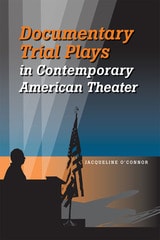
Documentary Trial Plays in Contemporary American Theater
Jacqueline O’Connor
Southern Illinois University Press, 2013
From the Chicago Conspiracy Trial and the O. J. Simpson trial to the Clarence Thomas/Anita Hill congressional hearings, legal and legislative proceedings in the latter part of the twentieth-century kept Americans spellbound. Situated on the shifting border between imagination and the law, trial plays edit, arrange, and reproduce court records, media coverage, and first-person interviews, transforming these elements into a performance. In this first book-length critical study of contemporary American documentary theater, Jacqueline O’Connor examines in depth ten such plays, all written and staged since 1970, and considers the role of the genre in re-creating and revising narratives of significant conflicts in contemporary history.
Documentary theater, she shows, is a particularly appropriate and widely utilized theatrical form for engaging in debate about tensions between civil rights and institutional power, the inconsistency of justice, and challenges to gender norms. For each of the plays discussed, including The Trial of the Catonsville Nine, Unquestioned Integrity: The Hill/Thomas Hearings, and The Laramie Project, O'Connor provides historical context and a brief production history before considering the trial the play focuses on. Grouping plays historically and thematically, she demonstrates how dramatic representation advances our understanding of the law's power while revealing the complexities that hinder society's pursuit of justice.
Double Exposure
How Social Psychology Fell in Love with the MoviesKathryn Millard
Rutgers University Press, 2022
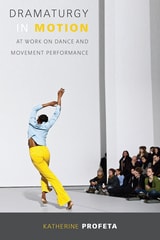
Dramaturgy in Motion
At Work on Dance and Movement PerformanceKatherine Profeta
University of Wisconsin Press, 2015
Profeta explores five arenas for the dramaturg’s attention—text and language, research, audience, movement, and interculturalism. Drawing on her extended collaboration with choreographer and visual artist Ralph Lemon, she grounds her thinking in actual rehearsal-room examples and situates practice within theoretical discourse about contemporary dramaturgy. Moving between theory and practice, word and movement, question and answer until these distinctions blur, she develops the foundational concept of dramaturgical labor as a quality of motion.
Dramaturgy in Motion will be invaluable to practitioners and scholars interested in the processes of creating contemporary dance and movement performance—particularly artists wondering what it might be like to collaborate with a dramaturg and dramaturgs wondering what it might be like to collaborate on movement performance. The book will also appeal to those intrigued by the work of Lemon and his collaborators, to which Profeta turns repeatedly to unfold the thorny questions and rich benefits of dramaturgical labor.
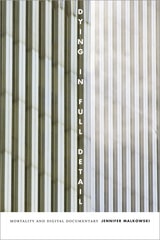
Dying in Full Detail
Mortality and Digital DocumentaryJennifer Malkowski
Duke University Press, 2017