Results by title
156 books match the query 'Psychotherapy' and 6 start with d

Dark Continents
Psychoanalysis and ColonialismRanjana Khanna
Duke University Press, 2003
bringing psychoanalysis, colonialism, and women together can become the starting point of a postcolonial feminist theory. Psychoanalysis brings to light, Khanna argues, how nation-statehood for the former colonies of Europe institutes the violence of European imperialist history. Far from rejecting psychoanalysis, Dark Continents reveals its importance as a reading practice that makes visible the psychical strife of colonial and
postcolonial modernity. Assessing the merits of various models of nationalism, psychoanalysis, and colonialism, it refashions colonial melancholy as a transnational feminist ethics.
Khanna traces the colonial backgrounds of psychoanalysis from its beginnings in the late nineteenth century up to the present. Illuminating Freud’s debt to the languages of archaeology and anthropology throughout his career, Khanna describes how Freud altered his theories of the ego as his own political status shifted from Habsburg loyalist to Nazi victim. Dark Continents explores how psychoanalytic theory was taken up in Europe and its colonies in the period of decolonization following World War II, focusing on its use by a range of writers including Jean-Paul Sartre, Simone de Beauvoir, Octave Mannoni, Aimé and Suzanne Césaire, René Ménil, Frantz Fanon, Albert Memmi, Wulf Sachs, and Ellen Hellman. Given the multiple gendered and colonial contexts of many of these writings, Khanna argues for the necessity of a postcolonial, feminist critique of
decolonization and postcoloniality.
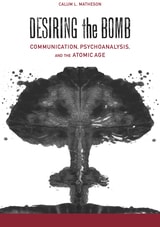
Desiring the Bomb
Communication, Psychoanalysis, and the Atomic AgeCalum L. Matheson
University of Alabama Press, 2019
Every culture throughout history has obsessed over various “end of the world” scenarios. The dawn of the Atomic Age marked a new twist in this tale. For the first time, our species became aware of its capacity to deliberately destroy itself. Since that time the Bomb has served as an organizing metaphor, a symbol of human annihilation, a stand-in for the unspeakable void of extinction, and a discursive construct that challenges the limits of communication itself. The parallel fascination with and abhorrence of nuclear weapons has metastasized into a host of other end-of-the-world scenarios, from global pandemics and climate change to zombie uprisings and asteroid collisions.
Desiring the Bomb: Communication, Psychoanalysis, and the Atomic Age explores these world-ending fantasies through the lens of psychoanalysis to reveal their implications for both contemporary apocalyptic culture and the operations of language itself. What accounts for the enduring power of the Bomb as a symbol? What does the prospect of annihilation suggest about language and its limits? Thoroughly researched and accessibly written, this study expands on the theories of Kenneth Burke, Jacques Lacan, Sigmund Freud, and many others from a variety of disciplines to arrive at some answers to these questions.
Calum L. Matheson undertakes a series of case studies—including the Trinity test site, nuclear war games, urban shelter schemes, and contemporary survivalism—and argues that contending with the anxieties (individual, social, cultural, and political) born of the Atomic Age depends on rhetorical conceptions of the “real,” an order of experience that cannot be easily negotiated in language. Using aspects of media studies, rhetorical theory, and psychoanalysis, the author deftly engages the topics of Atomic Age survival, extinction, religion, and fantasy, along with their enduring cultural legacies, to develop an account of the Bomb as a signifier and to explore why some Americans have become fascinated with fantasies of nuclear warfare and narratives of postapocalyptic rebirth.

Deviant Art Histories
From Radical Psychiatry to Cultural CitizenshipKaira M. Cabañas
University of Chicago Press, 2027
A groundbreaking examination of the entanglement between psychiatry, art, and art history.
Looking beyond the white walls of art galleries and museums, Kaira M. Cabañas explores art history through the psychiatric wards of the twentieth century, offering a reevaluation of the relationship between madness, making, and the art world and considering the deeply intertwined fields of psychiatry and art.
Putting aside romanticized myths about “outsider art,” Cabañas argues for a radical revisioning that centers artists in psychiatric settings not as deviants and curiosities but rather as skilled, sophisticated innovators and active participants in shared culture. Beginning with the story of legendary art historian Aby Warburg, whose own psychiatric internment and subsequent recovery serve as a point of departure, the narrative then covers the globe, following visionary reformers such as Nise da Silveira in Brazil and Franco and Franca Basaglia in Italy. The book tracks how psychiatrists collaborated with professional artists and patients to turn clinical spaces into laboratories of liberation. By documenting how patient-artists moved from being subjects of clinical study to recognized cultural producers, Deviant Art Histories demonstrates how art was a primary vehicle for reclaiming their agency. Featuring a diverse cast of figures—including Lygia Clark, Ornette Coleman, and Antonin Artaud—the book offers a powerful testament to art’s ability to break the clinical frame and transform the definition of what it means to be a creative citizen in the modern world.
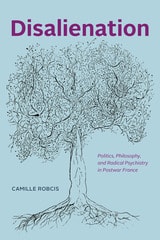
Disalienation
Politics, Philosophy, and Radical Psychiatry in Postwar FranceCamille Robcis
University of Chicago Press, 2021
In Disalienation, Camille Robcis grapples with the historical, intellectual, and psychiatric meaning of the ethics articulated at Saint-Alban by exploring the movement’s key thinkers, including François Tosquelles, Frantz Fanon, Félix Guattari, and Michel Foucault. Anchored in the history of one hospital, Robcis's study draws on a wide geographic context—revolutionary Spain, occupied France, colonial Algeria, and beyond—and charts the movement's place within a broad political-economic landscape, from fascism to Stalinism to postwar capitalism.

Doing Psychotherapy Effectively
Mona Sue Weissmark and Daniel A. Giacomo
University of Chicago Press, 1997
Mona Sue Weissmark and Daniel A. Giacomo offer a unique mode of evaluation that focuses not on a particular school of therapy but on the relationship between therapist and patient. Their approach, the "Harvard Psychotherapy Coding Method," begins with the assumption that good therapeutic relationships are far from intuitive. Successful relationships follow a pattern of behaviors that can be identified and quantified, as the authors demonstrate through clinical research and videotaped sessions of expert therapists. Likewise, positive changes in the patient, observed through client feedback and case studies, can be described operationally; they involve the process of overcoming feelings of detachment, helplessness, and rigidity and becoming more involved, effective, and adaptable.
Weissmark and Giacomo explain and ground these principles in the practice of psychotherapy, making Doing Psychotherapy Effectively an accessible and pragmatic work which will give readers a tool for measuring therapeutic effectiveness and further understanding human transformation. For the first time, successful therapy is described in a way that can be practiced and communicated.

Dreaming in Dark Times
Six Exercises in Political ThoughtSharon Sliwinski
University of Minnesota Press, 2017
What do dreams manage to say—or indeed, show—about human experience that is not legible otherwise? Can the disclosure of our dream-life be understood as a form of political avowal? To what does a dream attest? And to whom?
Blending psychoanalytic theory with the work of such political thinkers as Hannah Arendt and Michel Foucault, Sharon Sliwinski explores how the disclosure of dream-life represents a special kind of communicative gesture—a form of unconscious thinking that can serve as a potent brand of political intervention and a means for resisting sovereign power. Each chapter centers on a specific dream plucked from the historical record, slowly unwinding the significance of this extraordinary disclosure. From Wilfred Owen and Lee Miller to Frantz Fanon and Nelson Mandela, Sliwinski shows how each of these figures grappled with dream-life as a means to conjure up the courage to speak about dark times. Here dreaming is defined as an integral political exercise—a vehicle for otherwise unthinkable thoughts and a wellspring for the freedom of expression.
Dreaming in Dark Times defends the idea that dream-life matters—that attending to this thought-landscape is vital to the life of the individual but also vital to our shared social and political worlds.